
When specifications conflict, present the original statements side by side; do not pick the more flattering one. The sentences that need to be listed separately on the wheeled lift dual-arm teleoperation platform page include: single-arm rated payload 5 kg. The 8 kg in the parameter table is the weight of a single arm. The dual-arm rated 8 kg previously written on the cover conflicts with the parameter table; the parameter table takes precedence. The whole-machine mass is approximately 80 kg. The standard configuration lists the robotic arm as RM65-B-V ×2, while the robotic arm parameter table lists the model as RM75-B-V. Keep both model numbers; lock in before ordering; do not collapse them into one. The battery is lithium iron phosphate DC 48V 20Ah. The 2026-08-03 material does not state battery life in hours. Do not fill in approximately 6 hours, and do not rewrite it as 48V 31Ah or approximately 4 hours. These look like they are describing "capability," but they are actually different rows. Once merged into a single sentence, each party will hold a different number at acceptance.
Specification basis
Units follow the numbers. Millimeters, kilograms, newtons, seconds, revolutions per minute, volts, and ampere-hours must not be dropped during restatement. Lift travel 900 mm, vertical working range 0–2.4 m (also written as 0–2400 mm in the table). Single-arm reach 633 mm. Single-side overhang beyond the chassis 790 mm; the original text does not specify a unit at this point, and it appears alongside millimeters in the same sentence, so it is written externally as 790 mm with this note retained. If the original material does not specify a unit at certain points, retain the note "unit not specified in the original" externally, rather than deleting the note to make the numbers look cleaner.
Standard rows, recommended rows, and optional rows are also part of the specification, not a matter of copywriting tone. Recommended configuration is RM75-B-V ×2, two-wheel differential chassis ×1, gripper CTAG2F90-D ×2. Teleoperation options are servo teleoperation, backpack teleoperation, and mobile teleoperation; these are not in the standard configuration quantity table. When the cover slogan, parameter table, and quantity list are inconsistent, the wheeled lift dual-arm teleoperation platform product page has chosen to present them side by side rather than collapse them into one. Write the article following this discipline.
A restatement written for colleagues can be short, but the short sentence must be able to point back to a row in the table. Adjectives that cannot point back, such as "high payload," "long battery life," or "fully equipped cameras," do not enter the specification summary. The complete table is at /product-body-lift.html.
How to Use This Page in This Version
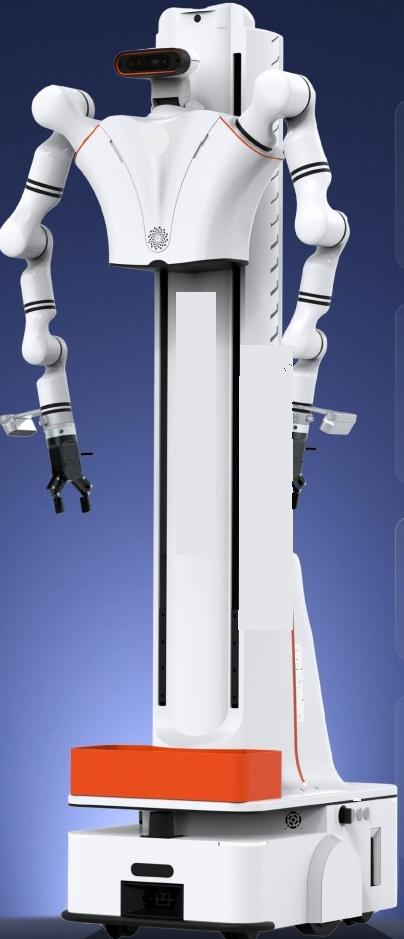
Read the specifications of the wheeled lifting dual-arm teleoperation robotic platform line by line, not by adjectives. It is recommended to copy the product page table onto a checking sheet, keeping the subject on each line. The following lines are the most likely to be merged, so mark them in different colors on the checking sheet. Payload and mass: single-arm rated payload 5 kg. The 8 kg in the parameter table is the single-arm self-weight. The dual-arm rated 8 kg once written on the cover conflicts with the parameter table; the parameter table takes precedence. The whole-machine approximately 80 kg is the whole-machine mass. Geometry: model RMC-AIDAL. Stowed dimensions 640 × 450 × 1780 mm. Chassis 640 × 450 × 250 mm. Lifting stroke 900 mm, vertical working range 0–2.4 m (also written as 0–2400 mm in the table). Single-arm reach 633 mm. Overhang beyond the chassis on one side 790 mm; the original text did not specify a unit there, and it appears alongside millimeters in the same sentence; write it externally as 790 mm and retain this note. Motion: two-wheel differential drive, speed 1.5 m/s, climbing 5°. Positioning accuracy ±10 mm / ±3°. Power: the battery is lithium iron phosphate DC 48V 20Ah. This document dated 2026-08-03 does not state battery life in hours. Do not add approximately 6 hours, and do not rewrite it as 48V 31Ah or approximately 4 hours. Perception and computing: main controller Nvidia Jetson AGX Orin 64G, plus a 1T solid-state drive. Standard vision configuration is D435 ×1, wide-angle camera ×2, voice module ×1. If the cover writes 3 depth channels plus 2 wide-angle channels, it conflicts with the list; the specification follows the list. D435 line: ideal ranging 0.3–3 m; depth ≤1280×720, ≤90 fps; RGB 1920×1080, 30 fps; field of view 69°×42°; rolling shutter. Navigation separately lists depth camera ×1, IMU + encoder ×1, LiDAR ×1, safety edge ×1, ultrasonic ×2. End effectors and missing items: the recommended configuration lists gripper CTAG2F90-D ×2. The standard configuration quantity table has no gripper. RMG22-65 is a separate product page. The standard configuration robotic arm is listed as RM65-B-V ×2, while the robotic arm parameter table model is RM75-B-V. Keep both model sets; lock them before ordering; do not collapse them into one.
There is only one rule for color: different subjects must not be painted the same color. Rated load and self-weight are not the same color. Envelope load and friction load are not the same color. Charging time and runtime are not the same color. Standard list and cover slogan are not the same color. Parameter-table model and standard-configuration model are not the same color. Force feedback and zero-force gravity compensation are not the same color.
The second column of the checklist reads "can it be written in the same sentence." The answer is often no. For example, you cannot write "rated 8 kg, battery life 6 hours," because 8 kg is the self-weight on the lift model, 6 hours only appears on the folding model, and the two machines cannot be merged into one sentence. The mergeable relationships for the wheeled lift dual-arm teleoperation platform follow its own table, not the conventions of another product card.
The third column of the checklist records the source: the product page path /product-body-lift.html, and whether the row is standard, recommended, or optional. Recommended configuration is RM75-B-V ×2, two-wheel differential chassis ×1, gripper CTAG2F90-D ×2. Teleoperation options are servo teleoperation, backpack teleoperation, and mobile teleoperation; these are not in the standard configuration quantity table. Numbers without a source are erased from the checklist. Erasing is closer to being acceptable than keeping an "approximately."
Finally, hand the verification sheet to the person drafting the contract, not to the person drafting the poster. The poster can be short, but every short phrase must be traceable to a full line on the verification sheet. Anything that cannot be found there must not appear in external-facing text. Attachment may be copied: RMC-AIDAL; 640×450×1780 mm; approximately 80 kg; lift 900 mm; vertical 0–2.4 m; reach 633 mm; rated 5 kg; self-weight 8 kg; repeatability ±0.05 mm; differential drive 1.5 m/s; slope climbing 5°; positioning ±10 mm / ±3°; Orin 64G + 1T SSD; lithium iron phosphate DC 48V 20Ah, hours not provided. This is the kind of sentence that can be kept — not raw material that can be freely converted.
Line-by-Line Verification
Degrees of freedom. The single-arm degrees of freedom for the robotic arm parameter table model RM75-B-V is 7. The product page does not publish the whole-machine degrees of freedom; do not fill in 17 or 20. This row only states the joint counts and body parts that have already been made public. It does not evaluate intelligence, and it does not automatically include waist, legs, neck, or a whole-machine total that is not named on the page. When writing into the action vector, only build channels for the body parts present in this row; body parts not present remain blank. Do not write blank as 0, because 0 will be treated by the training script as a real angle. Do not fill in the degrees-of-freedom integer from another device after this row to make it add up. If the page does not provide the order of the leader-follower joints, mark it as pending written configuration confirmation; do not number them yourself. In the specification summary, degrees of freedom are bound to body parts; do not leave a standalone integer. The action vector only builds channels for the body parts named in this row; unnamed body parts remain blank, not filled with 0.
Load and mass. The rated payload of a single arm is 5 kg. The 8 kg in the parameter table is the self-weight of a single arm. The dual-arm rated 8 kg once written on the cover conflicts with the parameter table; the parameter table takes precedence. The whole unit is approximately 80 kg, which is the overall mass. The numbers in this row must be read with their subjects: rated, self-weight, overall mass, envelope, friction or gripping force. If the subjects differ, they cannot be merged into a single number, nor can any conversion not given on the page be performed. If objects on site are heavier, the specification cannot be changed retroactively; a higher specification does not prove that every grasping method reaches that limit. The tool mass is undetermined, so do not write the arm's rated payload as the graspable object mass. The acceptance table retains its original units. In the specification summary, every mass figure retains the subject it has in the table. During acceptance, read the subject first and then the number; if the subjects are inconsistent, split them into two rows.
Dimensions and scale. Model RMC-AIDAL. Stowed dimensions 640 × 450 × 1780 mm. Base 640 × 450 × 250 mm. This line describes form factor or structural scale, used to check doorways, elevators, tabletops, or transport — it is not operating height, nor is it arm reach. Do not add it to the vertical range. If the diagram shows protrusions, antennas, or human positioning not present in this line, note separately that they are not part of the specification. If weight appears in an adjacent line, do not include it in the dimension sentence. When restating form-factor numbers, do not round to phrases like "about 1.7 meters" that lose millimeter precision. Doorways, elevators, and transport only check form factor; do not treat this line as operating height.
Operating range. The lift stroke is 900 mm, and the vertical working range is 0–2.4 m (also written as 0–2400 mm in the table). The reach of a single arm is 633 mm. The overhang beyond the chassis on one side is 790 mm; the original text does not specify a unit at that point, and it appears alongside millimeters in the same sentence, so write it as 790 mm externally and retain this note. This row describes the range that the hand or lift can reach; the definition must follow the original sentence: vertical working range, reach, motion radius or stroke — these cannot be added together or renamed. If "excluding the end effector" is written, it must remain in the figure caption. When the original text does not specify a unit, retain the note "unit not specified" and do not delete it for the sake of tidiness. When restating range figures, do not merge them with the overall height into a single "height". The figure caption retains the range definition from the original sentence, as well as the words "excluding the end" or "unit not specified".
Motion. Two-wheel differential drive, speed 1.5 m/s, climbing 5°. Positioning accuracy ±10 mm / ±3°. This row describes how the ground base or the main arm moves. Four-wheel steering and four-wheel drive, differential drive, in-place rotation radius and rotational speed are terms for different mechanisms and cannot be substituted for one another. The published speed is a capability, not a recommended teaching speed; teaching may be slower, but the slower speed is recorded under experimental conditions and is not written back as a specification. Do not borrow climbing or positioning figures from other pages for a page that does not state them. Keep the mechanism terms as they are; do not translate them into more fluent synonyms. The teaching speed may be lower, but the lower speed is recorded under operating conditions and does not change the published capability in this row.
Power supply. The battery is lithium iron phosphate, DC 48V 20Ah. This document dated 2026-08-03 does not state endurance in hours. Do not fill in approximately 6 hours, and do not rewrite it as 48V 31Ah or approximately 4 hours. This row retains only the electrical terms that appear on the page: voltage, capacity, endurance, charging, current or power. If there are no "hours", write that endurance is not given; do not fill the gap with hours from an adjacent page. Do not rename charging time as endurance. Rated and maximum values must be listed separately. Approximate figures retain "approximately". Do not sum the ampere-hours of multiple units and state them as the battery of a single unit. When restating the electrical row, do not add hours or ampere-hours that are not in the table. Hours, charging or current that do not appear remain as not given and are not copied in from adjacent pages.
Perception and computing. The main controller is Nvidia Jetson AGX Orin 64G, with an additional 1T solid-state drive. The standard vision configuration is D435 ×1, wide-angle camera ×2, voice module ×1. If the cover states 3 depth channels plus 2 wide-angle channels, that conflicts with the list; the specification follows the list. D435 row: ideal ranging 0.3–3 m; depth ≤1280×720, ≤90 fps; RGB 1920×1080, 30 fps; field of view 69°×42°; rolling shutter. Navigation separately lists depth camera ×1, IMU + encoder ×1, LiDAR ×1, safety edge ×1, ultrasonic ×2. This row inventories the items already specified in sensing, computing or communication, and retains the words standard, included, optional and selectable. An optional item that is not checked does not count. When the cover and the list conflict, cite the list while not pretending that the cover statement does not exist. Head-mounted and glove devices do not enter this row. Processors, drive capacities or camera channel counts that are not written out must not be drawn into the system diagram. When restating sensors, retain the distinctions between standard, optional and cover. Optional sensors that have not been purchased do not enter this data dictionary.
End effector. The recommended configuration specifies gripper CTAG2F90-D ×2. The standard configuration quantity table does not include a gripper. RMG22-65 is a separate product page. This row states where contact or grasping occurs. Quick-change, compatible and recommended are not models already in the box. The ring fixture on the main arm is not a slave-side gripper. Force, stroke and payload are still retained as-is in their respective rows and are not merged into a single system metric merely because they are mounted on a particular body. Flange and protocol mappings that are not given are written as to be confirmed, not as plug-and-play. When restating the end-effector row, do not write capabilities as a list. "Supports" or "compatible" without a model number cannot be treated as delivered.
Boundary. The standard configuration lists the robotic arm as RM65-B-V ×2, while the robotic arm parameter table lists the model as RM75-B-V. Both model numbers are retained; lock them in before placing the order, and do not collapse them into one. This row is a deliberately separated boundary on the page: another model, another column, another product page, or an interface that still requires project confirmation after modularization. The boundary is not a defect note; it is to prevent verbally buying two pages as one. When writing the proposal, copy the boundary into "Not included in this scope". If equipment not included is added later, open a new configuration sheet; do not go back and change the platform name in old samples. The two conflicting rows are retained side by side; do not pick the one that looks more complete. Equipment within the boundary requires a separate order; do not rename old samples to imply it is already included.
Configuration column. The recommended configuration is RM75-B-V ×2, two-wheel differential chassis ×1, gripper CTAG2F90-D ×2. Teleoperation options are servo teleoperation, backpack teleoperation, and mobile teleoperation, which are not included in the standard configuration quantity table. This row distinguishes standard, recommended, and optional. If recommended and optional items are not checked, they will not be delivered. When the standard row and the parameter table row are inconsistent, keep both rows and use "locked for this order" to indicate which one is actually delivered, rather than striking out one row in the order without signing off. Prices and lead times are not written into this row's restatement. Standard, recommended, and optional are split into three sentences in the summary, not merged into "configured." Unchecked recommended and optional items are written on the order as not delivered.
Excerptable. The following can be copied into an appendix: RMC-AIDAL; 640×450×1780 mm; approximately 80 kg; lift 900 mm; vertical 0–2.4 m; reach 633 mm; rated 5 kg; self-weight 8 kg; repeatability ±0.05 mm; differential 1.5 m/s; climbing 5°; positioning ±10 mm / ±3°; Orin 64G + 1T SSD; lithium iron phosphate DC 48V 20Ah, hours not given. This row is the type of content that can be pasted into an appendix: with subject, with unit, and traceable back to the original sentence on the product page. When pasting, retain approximately, excluding, not given, optional and recommended. Do not convert and keep only the result. If the same number has different meanings on two pages, write it as two rows in the appendix. Do not mix test protocols into specification excerpts. Only short sentences that can be traced back to the table belong in an external specification summary. When pasting into the appendix, paste the words approximately, excluding and optional along with them.
Do not write. Do not write 17 whole-machine degrees of freedom, do not write 650×512×1700 mm, approximately 120 kg, lift 0.3 m, vertical 0–2.1 m, speed 0.1–1.0 m/s. Do not write 8 kg as rated load. Do not write battery life in hours. This row is a negative statement for review purposes. It does not describe what the equipment can do; it only prevents hours, degrees of freedom, load subjects, or cover slogans from neighboring pages from being written in. If a negative statement is hit, revert to the original sentence from the product page and do not interpret it as "close enough." Success rates from external papers and total hours not published on this site are likewise not to be written in. Before publishing the abstract, run a full-text search using the negative statements. If a draft search hits a negative statement, revert to the original sentence from the product page.
| Projects | Public-Facing Positioning of This Page |
|---|---|
| Degrees of Freedom | In the robotic arm parameter table, model RM75-B-V has 7 degrees of freedom per arm. The product page does not publish the total degrees of freedom for the whole unit; do not fill in 17 or 20. |
| Load and Mass | Single-arm rated payload 5 kg. The 8 kg in the parameter table is the single-arm self-weight. The cover previously stated a dual-arm rated payload of 8 kg, which conflicted with the parameter table; the parameter table takes precedence. The total unit weight of approximately 80 kg is the overall mass. |
| Form Factor and Scale | Model RMC-AIDAL. Folded dimensions 640 × 450 × 1780 mm. Chassis 640 × 450 × 250 mm. |
| Operating Range | Lifting stroke 900 mm, vertical working range 0–2.4 m (also written as 0–2400 mm in the table). Single-arm reach 633 mm. Single-side overhang beyond the chassis is 790 mm; the original text did not specify a unit at that point, but since it appears alongside millimeters in the same sentence, it is written externally as 790 mm with this note retained. |
| Motion | Two-wheel differential drive, speed 1.5 m/s, climbing slope 5°. Positioning accuracy ±10 mm / ±3°. |
| Power | The battery is lithium iron phosphate DC 48V 20Ah. This document dated 2026-08-03 does not state battery life in hours. Do not add approximately 6 hours, and do not rewrite it as 48V 31Ah or approximately 4 hours. |
| Perception & Compute | Main controller Nvidia Jetson AGX Orin 64G, with an additional 1T solid-state drive. Standard vision configuration is D435 ×1, wide-angle cameras ×2, voice module ×1. If the cover states 3 depth channels plus 2 wide-angle channels, this conflicts with the list; the specifications follow the list. D435 row: ideal ranging 0.3–3 m; depth ≤1280×720, ≤90 fps; RGB 1920×1080, 30 fps; field of view 69°×42°; rolling shutter. Navigation separately lists depth camera ×1, IMU + encoder ×1, LiDAR ×1, safety edge ×1, ultrasonic ×2. |
| End Effector | The recommended configuration lists gripper CTAG2F90-D ×2. The standard configuration quantity table does not include a gripper. RMG22-65 is a separate product page. |
| Boundary | The standard configuration lists the robotic arm as RM65-B-V ×2, while the robotic arm parameter table lists the model as RM75-B-V. Both model numbers are retained; lock one before placing the order — do not collapse them into a single number. |
| Configuration Panel | Recommended configuration is RM75-B-V ×2, two-wheel differential chassis ×1, gripper CTAG2F90-D ×2. Teleoperation options are servo teleoperation, backpack teleoperation, and mobile teleoperation; these are not included in the standard configuration quantity table. |
| Excerptable | Attachment copy: RMC-AIDAL; 640×450×1780 mm; approximately 80 kg; lifting 900 mm; vertical 0–2.4 m; reach 633 mm; rated 5 kg; self-weight 8 kg; repeatability ±0.05 mm; differential drive 1.5 m/s; slope climbing 5°; positioning ±10 mm / ±3°; Orin 64G + 1T SSD; lithium iron phosphate DC 48V 20Ah, hours not specified. |
| Do not write | Do not write 17 degrees of freedom for the whole unit, and do not write 650×512×1700 mm, approximately 120 kg, lifting 0.3 m, vertical 0–2.1 m, speed 0.1–1.0 m/s. Do not write 8 kg as the rated payload. Do not write battery life in hours. |
Relationship to Public Methods and Adjacent Pages
The specification table is the acceptance criterion; the cover slogan is not. If a slogan and a parameter table conflict on the same page, the parameter table and configuration list take precedence, and the conflict itself must be stated in the article — not quietly resolved by picking a better-sounding number. Copying numbers across pages is even more dangerous: the battery life written for the folding model cannot be written onto the lift model just because the voltages are similar; the repeatability of positioning from the lift model's arm table cannot be written as the whole-body accuracy of the wheeled humanoid.
When reading a table, hold to three rules. First, units follow the numbers. Millimeters, kilograms, newtons, seconds, and degrees must not disappear from the sentence. When the source sentence has no unit, note "the source text did not state a unit; recorded here as millimeters based on context" rather than pretending the original wrote one. Second, adjacent rows cannot be merged. Rated load, self-weight, gripping force, and travel are four different things. Third, standard quantity, recommended configuration, and optional items go in three columns. Recommended is not the same as factory standard.
Data aggregation efforts like Open X-Embodiment illustrate the same point from the opposite direction: cross-embodiment training requires the action space and sensor configuration of each robot to be explicitly recorded. Merging the heights or batteries of three embodiments into a single "company parameter" means the training metadata is wrong from day one.
This article separates the numbers on the product page that are easily merged into a single sentence, and provides wording that can be placed into the configuration sheet. Separating them is not nitpicking wording; it is to avoid each side holding a different number at acceptance.
Before handing off to a colleague
After completing the specification checklist, have another person review only the checklist (not the product page) and trace every line back to the table. Delete any line that cannot be traced back. If two lines have the same color but different subjects, split them. If a cover sentence is parallel to the checklist, keep both sentences, but only cite the checklist in the external summary. Before publishing the summary, search for "left/right," "approximately," "fully equipped," and "standard includes." If these words are not followed by an original sentence, delete them down to the original sentence only. Write the verification date in the corner of the sheet, because the product page may be corrected later and the old summary must match the table at that time. The fourth column of the checklist sheet reads "Can this sentence stand on its own?" Sentences that cannot usually do so because they borrowed the subject of the next line. Split the two lines and read them again. If one of the split lines has no numbers, the numbers came from the other line and the merged sentence should be deleted. External briefs are limited to three lines, one subject per line. If more than three lines are needed, convert to a table; do not chain multiple numbers into one sentence with commas. Chaining numbers into one sentence is a common form of specification failure.
First, every number can be traced back to a table.
Second, if the subject differs, split the sentence.
Third, keep both the cover sheet and the checklist; the abstract only cites the checklist.
Fourth, "approximately", "not included", and "not specified" are not deleted.
Fifth, the verification date is written in the corner of the page.
Sixth, sentences that cannot be traced back are deleted, not polished.
Continue Reading
- 01 Task Boundaries
- 02 Specification Standards
- 03 Degrees of Freedom
- 04 Payload & Self-Weight
- 05 Workspace
- 06 Locomotion Method
- 07 Perception and Computing
- 08 Power Specifications
- 09 Data Recording
- 10 Time Alignment
- 11 End-Effector Boundaries
- 12 Site Constraints
- 13 Configuration Sheet
- 14 Three-Way Comparison
- 15 Literature References
- 16 Master-Slave Workstation
- 17 Acceptable Deliverable Statements
- 18 Prohibited Conflations
- 19 On-Site Deployment
- 20 Evaluation Path
Back to Product Center View this product page
This article was written on October 3, 2026, for selection and specification verification purposes. Device parameters are subject to the product page tables and do not constitute a supply commitment. External papers only illustrate how problems are framed in the industry; their success rates and data scales belong to the original authors' experiments and are not TOBI's measured results. Phone: +86 137 5502 0164.