
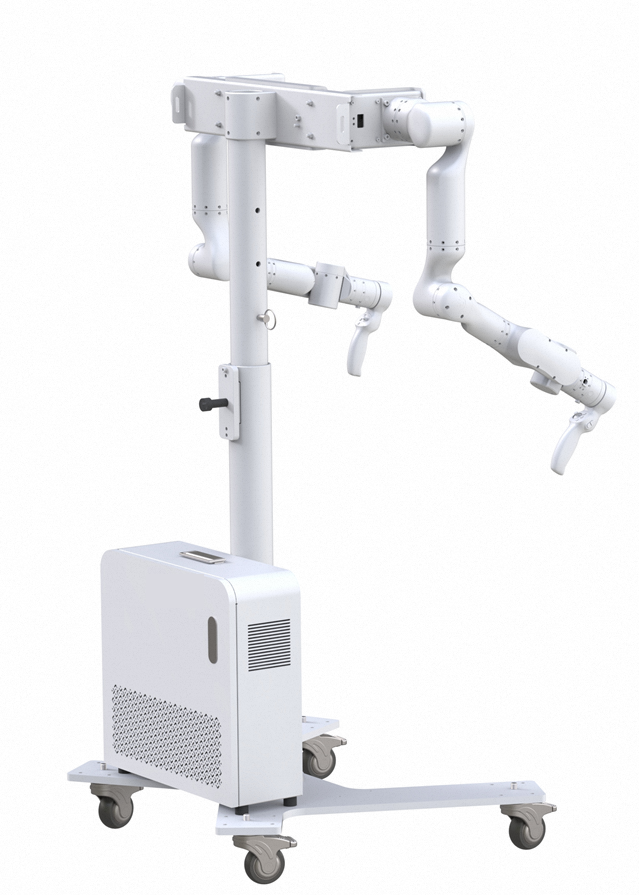
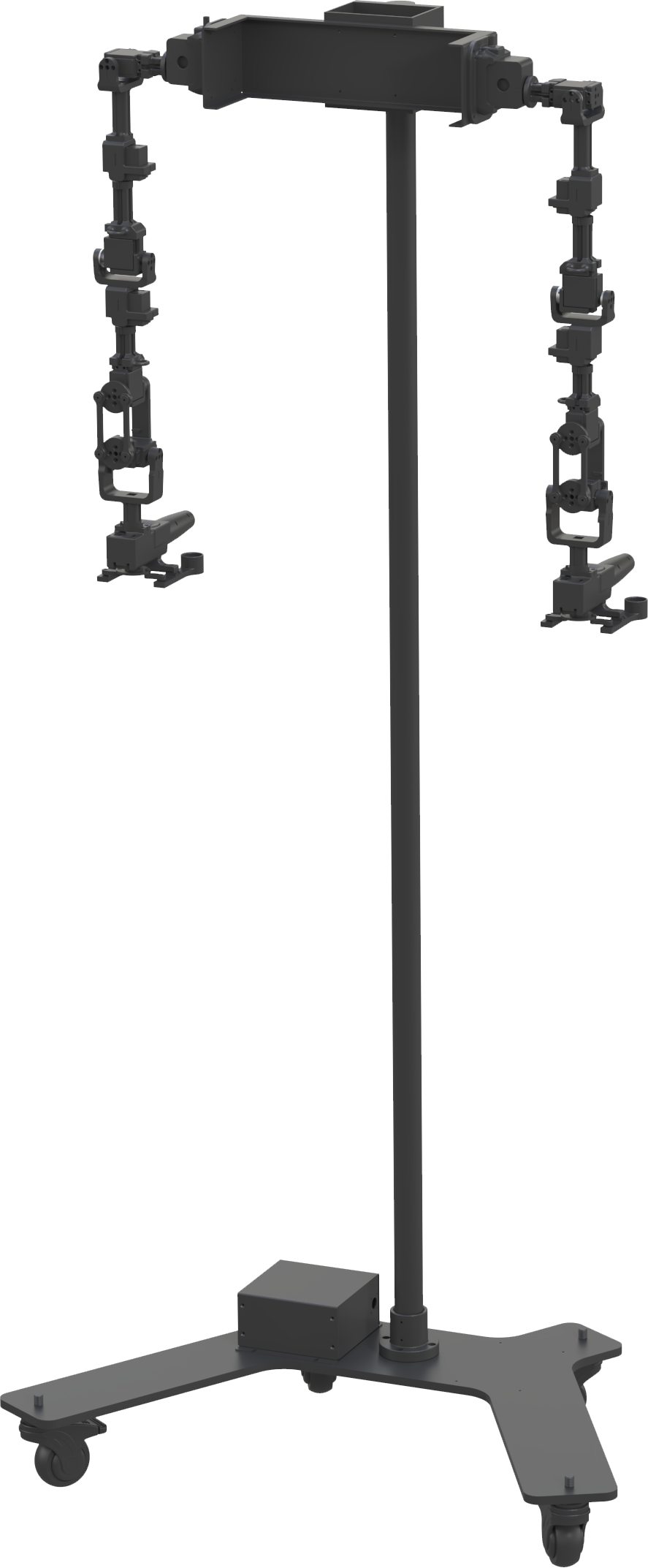
The configuration order is divided into three columns. The contract must state the column names. Purchasing the body does not include the kit by default. For remote operation, refer to the first two columns; for local data acquisition, refer to the third column; in either case, order by cell. Force feedback is stated as supported only for GLN-RX75 and GLN-RX71. The local isomorphic kit is stated as not supported. The main arm models are RX75, RX71, and YDS-DAP-75/65/RX75S respectively. The first column contains rows that should be delivered even without additional notes; the second column is recommended; the third column is optional. Recommended and optional items are not delivered unless checked.
Configuration Sheet
When model numbers are listed side by side, both rows are kept. The RM65-B-V and RM75-B-V of the lifting model are examples; other products are the same: if the page gives a standard row and a parameter table row, do not collapse them into one sentence in the order such as "the standard row is void because the parameter table governs", unless a written confirmation explicitly voids it and is signed.
The kit must have a column name. The gripper must have a model number. The embodiment must have the name from its product page. If any of these three rows is missing, the purchase order is still just a verbal plan.
After completing the three-column layout of the isomorphic teleoperation kit, attach a one-page exclusions list, with content drawn from: do not write "one teleoperation kit, approximately 5 kg, with force feedback." Do not combine 30 RPM and 110 RPM into a single rotational speed, and do not combine DC24V and DC12V into a single voltage. Place the exclusions list alongside the ordering items to avoid relying only on the positive statements.
How to Use This Page in This Version
The order page is recommended to be printed as a table rather than a paragraph. The table for the isomorphic teleoperation kit should include at least these rows: product page name, model locked this time, standard row, whether the recommended row is checked, whether the optional row is checked, end effector model, main-side column name, and exclusions. The contract must state the column names. Purchasing the body does not include the kit by default. For remote operation, refer to the first two columns; for local data acquisition, refer to the third column; in either case, order by cell. Force feedback is stated as supported only for GLN-RX75 and GLN-RX71. The local isomorphic kit is stated as not supported. The main arm models are RX75, RX71, and YDS-DAP-75/65/RX75S respectively. Empty cells should be filled with "not selected this time" and left blank.
Cells with conflicting model numbers may coexist, but there must be a "locked for this order" column. RM65-B-V and RM75-B-V on the lift model are exactly this kind of cell. For other products with only one model, the locked column simply copies that model, to prevent procurement from writing an abbreviation as a different one.
Price and lead time are not filled in this article's template. They change with the written configuration. If the template prints a price, it will be mistaken for a catalog price. What the site publishes is that specs can be reviewed first; price and lead time are discussed after the configuration is confirmed.
Data acquisition begins only after the table is signed. If an unsigned recommended item appears in the laboratory, the data dictionary must treat it as a temporary item and cannot record it as a sample of the standard configuration. Samples of temporary items and samples of standard items are stored in separate directories. The product page corresponding to this template is /product-teleop-kit.html.
Line-by-Line Verification
Degrees of freedom. All three columns show 7 degrees of freedom, but this does not mean they can be merged into a single unit. The column names are GLN-RX75, GLN-RX71, and local isomorphic kit. This row only states the publicly disclosed joint counts and body parts. It does not evaluate intelligence, nor does it automatically include waist, legs, neck, or whole-machine totals not named on the page. When writing action vectors, only create channels for body parts listed in this row; body parts not listed remain blank. Do not write blanks as 0, because 0 will be treated by training scripts as a real angle. Do not fill in degrees-of-freedom integers from another device to complete this row. If the master-slave joint order is not given on the page, mark it as pending written configuration confirmation rather than numbering it yourself. Once the model is locked, follow the degrees-of-freedom stated on the page for that model, not the abbreviation. Action vectors only create channels for body parts named in this row; unnamed body parts remain blank, not filled with 0.
Payload and mass. Main arm self-weight: GLN-RX75 is 7.8 kg, GLN-RX71 is 3.8 kg, the local isomorphic kit is approximately 1.5 kg (including gripper). Self-weight is not the rated payload at the end effector. The numbers in this row must be read aloud with their subject: rated, self-weight, total machine mass, envelope, friction, or gripping force. If the subject differs, they cannot be merged into a single number, nor can any conversion not given on the page be performed. If field objects are heavier, the specifications cannot be revised retroactively; conversely, larger specifications do not prove that every grasping method reaches that limit. Tool mass is undetermined — do not write the arm's rating as the mass of graspable objects. The acceptance table retains the original units. Payload acceptance follows the arm or gripper model locked in this order. During acceptance, read the subject first, then the number; if the subjects are inconsistent, split into two rows.
Form and scale. Motion radii: 709 mm, 474 mm, 599 mm. This is the master arm scale, not the form of the slave-side embodiment. This row is a form or structural scale, used to check doors, elevators, tabletops, or transport; it is not operating height, nor is it arm reach. Do not add it to the vertical range. If the diagram shows protrusions, antennas, or human standing positions not present in this row, note separately that they are not part of the specification. If weight appears in an adjacent row, do not write it into the dimension sentence. The form is based on the model on this page; do not substitute other dimensions from the series. Doors, elevators, and transport are checked only against form; do not treat this row as operating height.
Operating range. Configuration: the first two columns are humanoid configurations, and the local column is a follower arm. Grip: the first two columns use a handle, and the local column uses a rail-type ring fixture. This row describes the range that the hand or lift can reach; the definition must follow the original sentence: vertical working range, arm span, motion radius, or stroke. These cannot be added together or renamed. If "excluding end effector" is stated, it must remain in the figure caption. When the original text does not specify units, retain the "units not specified" note and do not delete it for tidiness. The range sentence follows the locked model; do not mix two sets of arm spans. The figure caption retains the range definition from the original sentence, as well as the terms "excluding end effector" or "units not specified."
Motion. Maximum operating speed: the first two columns are 30 RPM, and the local column is 110 RPM. Traction force: all three columns state zero-force dragging. Zero-force dragging is not force feedback. This row describes how the ground or main arm moves. Four-wheel steering, four-wheel drive, differential drive, in-place rotation radius, and rotational speed are terms for different mechanisms and cannot be substituted for one another. The published speed is a capability, not a recommended teaching speed; teaching can be slower, but the slower speed is recorded under experimental conditions and is not written back into the specification. If the page does not state slope climbing or positioning, do not borrow from another page. If the chassis type is in the recommended column, it is written into the order only after being checked. The teaching speed can be lower, but the lower speed is recorded under the operating conditions and does not change the published capability in this row.
Power supply. Operating voltage: the first two columns are DC24V, and the local column is DC12V. Power: ≤200 W, ≤100 W, rated 84 W. The specification table has no battery row, so do not write endurance. This row retains only the electrical terms that appear on the page: voltage, capacity, endurance, charging, current, or power. If there are no "hours," write that endurance is not given; do not fill in hours from an adjacent page. Do not rename charging time as endurance. Rated and maximum values must be listed in separate columns. Approximate values retain "approximately." Do not sum the ampere-hours of multiple devices and claim it as the battery of a single device. Whether the battery row is standard or a documentation convention follows the original text on this page; do not upgrade the capacity. Hours, charging, or current that do not appear remain as not given and are not copied in from an adjacent page.
Sensing and computing. Angular resolution: the first two columns are ±0.003°, and the local column is 0.088°. Motors: the first two columns use integrated joints, and the local column uses bus servos. Communication: the first two columns use RJ45, and the local column uses RJ45 / 10-pin aviation connector. This row inventories the items already specified in sensing, computing, or communication, and retains the terms standard, included, optional, and selectable. Optional items do not count unless checked. When the cover conflicts with the list, cite the list while not pretending the cover statement does not exist. Headsets and gloves do not enter this row. Processors, hard drive capacity, or camera channel counts that are not written out should not be drawn into the system diagram. Optional cameras and microphones use checkboxes. Optional sensors that are not purchased do not enter the data dictionary for this time.
End effector. The fixture in the local column is a rail-type ring fixture used to grip the main arm; it is not the follower-side RMG22-65. The follower-side gripper is ordered separately. This row states at which end contact or gripping occurs. Quick-change, compatible, and recommended are not models already included in the box. The ring fixture on the main arm is not the follower-side gripper. Force, stroke, and payload remain as they are in their respective rows and are not merged into a single system metric because they are installed on a particular body. For flange and protocol mappings that are not given, write "to be confirmed," not "plug and play." The number of grippers is written in the end effector row, not vaguely passed over in parentheses in the body row. "Supports" or "compatible" without a model number cannot be treated as delivered.
Boundaries. Force feedback is stated as supported only for GLN-RX75 and GLN-RX71. The local isomorphic kit is stated as not supported. The main arm models are RX75, RX71, and YDS-DAP-75/65/RX75S respectively. This row is a boundary deliberately separated on the page: another model, another column, another product page, or an interface that still requires project confirmation after modularization. The boundary is not a defect statement; it prevents verbally buying two pages as one. When writing a proposal, copy the boundary into "not included this time." If equipment not included is later added, open a new configuration order; do not go back and change the body name in the old sample. When two sets of arm models coexist, the locked column is required. Equipment within the boundary must be ordered separately; do not rename the old sample to say it already includes it.
Configuration column. The contract must specify the column names. Purchasing the robotic platform does not include the kit by default. For remote operation, refer to the first two columns; for local data capture, refer to the third column, but orders must still be placed per cell. This row distinguishes standard, recommended, and optional. Unchecked recommended and optional items will not be delivered. When the standard row and the parameter table row are inconsistent, keep both rows and use "locked for this order" to indicate which one is actually delivered, rather than striking out one row in the order without signing off. Prices and lead times are not restated in this row. These are the three columns themselves; leave the space blank if not selected for this order. Unchecked recommended and optional items should be written as not delivered on the order.
Excerptable. Copy the attachments column by column; do not merge them. Example: GLN-RX75, force feedback supported, 709 mm, 7.8 kg, handle, ±0.003°, 30 RPM, integrated joint, RJ45, DC24V, ≤200 W. This row is the type that can be pasted into an attachment: it carries the subject, carries the unit, and can be traced back to the original sentence on the product page. When pasting, retain "approximately," "excluding," "not given," "selectable," and "recommended." Do not convert and keep only the result. If the same number has different meanings on two pages, write it as two rows in the attachment. Test protocols should not be mixed into specification excerpts. Data acquisition is permitted only after the three columns are printed. When pasting into an attachment, paste the words "approximately," "excluding," and "selectable" along with the content.
Do not write. Do not write "one teleoperation kit, approximately 5 kg, with force feedback." Do not merge 30 RPM and 110 RPM into a single speed, and do not merge DC24V and DC12V into a single voltage. This line is a negative statement for review purposes. It does not describe what the equipment can do; it only prevents hours, degrees of freedom, load subjects, or cover slogans from adjacent pages from being written in. If a negative statement is matched, revert to the original sentence on the product page; do not interpret it as "approximately." Do not write in success rates from external papers or total hours not published on this site. Do not use parameters of old models from negative statements as default values for any column. If the manuscript search matches a negative statement, revert to the original sentence on the product page.
| Projects | Public-Facing Positioning of This Page |
|---|---|
| Degrees of Freedom | All three columns have 7 degrees of freedom, but this does not mean they can be merged into a single unit. The column names are GLN-RX75, GLN-RX71, and local isomorphic kit. |
| Load and Mass | Main arm self-weight: GLN-RX75 is 7.8 kg, GLN-RX71 is 3.8 kg, the local isomorphic kit is approximately 1.5 kg (including the fixture). Self-weight is not the rated payload at the end-effector. |
| Form Factor and Scale | Working radius: 709 mm, 474 mm, 599 mm. These are the dimensions of the main arm, not the outline of the end unit. |
| Operating Range | Configuration: the first two columns are anthropomorphic configurations; the local column is the same as the follower arm. Gripping: the first two columns use handles; the local column uses a rail-mounted finger-ring fixture. |
| Motion | Maximum operating speed: the first two columns are 30 RPM, the local column is 110 RPM. All three columns list zero-force gravity compensation. Zero-force gravity compensation is not force feedback. |
| Power | Operating voltage: the first two columns are DC24V, the local column is DC12V. Power: ≤200 W, ≤100 W, rated 84 W. The specification table has no battery row, so do not state battery life. |
| Perception & Compute | Angular resolution: the first two columns are ±0.003°, the local column is 0.088°. Motor: the first two columns use integrated joints, the local column uses bus servos. Communication: the first two columns use RJ45, the local column uses RJ45 / 10-pin aviation connector. |
| End Effector | The fixture in the local column is a rail-type ring fixture used to hold the main arm; it is not the RMG22-65 end-effector. The end-effector gripper is ordered separately. |
| Boundary | Force feedback is listed as supported only for GLN-RX75 and GLN-RX71. The local isomorphic kit is listed as not supported. The main arm models are RX75, RX71, and YDS-DAP-75/65/RX75S. |
| Configuration Panel | The contract must specify column names. Purchasing the platform does not include the kit by default. For remote operation, refer to the first two columns; for local data capture, refer to the third column; in either case, order by the individual cell. |
| Excerptable | Transcribe the attachments column by column; do not merge. Example: GLN-RX75, force feedback supported, 709 mm, 7.8 kg, handle, ±0.003°, 30 RPM, integrated joint, RJ45, DC24V, ≤200 W. |
| Do not write | Do not write "one teleoperation kit, approximately 5 kg, with force feedback." Do not write 30 RPM and 110 RPM as a single speed, and do not write DC24V and DC12V as a single voltage. |
Relationship to Public Methods and Adjacent Pages
The configuration sheet has three columns: standard quantity, recommended configuration, and optional teleoperation method. Standard quantity is the row that should be delivered without additional notes. Recommended configuration is the row suggested for the order; if not written, it will not arrive as recommended. Optional items are for selection, not free gifts.
The lift model most needs these three columns. The standard checklist lists the arm model as two units of RM65-B-V; the recommended configuration and arm parameter table list RM75-B-V. Both rows are accurate and must not be collapsed into "it's just 75" or "it's just 65." Two grippers CTAG2F90-D are in the recommended column. The three teleoperation methods—servo, backpack, and mobile—are in the optional column, not the standard quantity table. Compute is Jetson AGX Orin 64G plus a 1T solid-state drive. The vision standard is one D435 plus two wide-angle cameras. One voice module and two servo channels appear in the standard checklist; follow the checklist and do not merge them with the optional teleoperation methods into one sentence.
The foldable, wheeled humanoid, kit, and gripper each have their own table. The kit must specify the column name: GLN-RX75, GLN-RX71, or a locally isomorphic kit. Gripper orders are written as RMG22-65, not "gripper included with the base unit."
This article shows how to fill in the three columns when ordering this product, so that recommended sentences are not printed as already included.
Before handing off to a colleague
After the order form is printed, no blank cells are allowed. Every blank cell is either unfilled or means "not selected this time." Cells with model conflicts must be signed in the Lock column. An order with a conflict and no Lock column is returned. Recommended grippers, optional teleoperation configurations, and optional cameras that are not selected must be listed on the packing list as "not included this time." Capture personnel recognize only the packing list, not the union of all model numbers that have ever appeared on the product page. The packing list and the data dictionary must use the same configuration number. If the order system can only accept a single model field, do not stuff a second model into the remarks field — use an attachment spreadsheet instead. If the Lock column in the attachment spreadsheet is empty, the system should reject the submission. The default value for recommended items should be "not selected," not "select all." Select all would cause optional items that nobody deselected to be treated as purchased, and the action space in the samples would be larger than what is actually delivered.
First, the only value that can be filled in the blank is "not selected this time."
Second, if the conflicting model has no locked column, return it.
Third, recommended items are unchecked by default.
Fourth, remarks cannot substitute for a second model field.
Fifth, capture personnel only recognize the packing list.
Sixth, the packing-list number must match the data dictionary. The numbers on the order, packing list, and data dictionary must all be identical. Samples with different numbers do not enter the same training set, even if the content appears identical. The numbering rule is written in the header of the order template, not in verbal instructions.
Continue Reading
- 01 Task Boundaries
- 02 Specification Standards
- 03 Degrees of Freedom
- 04 Payload & Self-Weight
- 05 Workspace
- 06 Locomotion Method
- 07 Perception and Computing
- 08 Power Specifications
- 09 Data Recording
- 10 Time Alignment
- 11 End-Effector Boundaries
- 12 Site Constraints
- 13 Configuration Sheet
- 14 Three-Way Comparison
- 15 Literature References
- 16 Master-Slave Workstation
- 17 Acceptable Deliverable Statements
- 18 Prohibited Conflations
- 19 On-Site Deployment
- 20 Evaluation Path
Back to Product Center View this product page
This article was written on October 3, 2026, for selection and specification verification purposes. Device parameters are subject to the product page tables and do not constitute a supply commitment. External papers only illustrate how problems are framed in the industry; their success rates and data scales belong to the original authors' experiments and are not TOBI's measured results. Phone: +86 137 5502 0164.