
Prohibited sentences are for review purposes, not for describing the product. For the two-finger parallel gripper RMG22-65, search for the following first: Do not convert 130 N to 5 kg and delete the original line. Do not write ±0.05 mm as the repeatability of the attached robotic arm. Do not write battery life. If a match is found, restore the original sentence from the product page; do not explain it as "approximately the same."
Prohibited mixed writing
Other frequent cross-page errors include: merging the three-column kit into a single unit, writing 130 N, 65 mm, 5 kg, and 2 kg as one number, writing charging time as battery life, writing the number of cover camera channels as the standard list, and collapsing RM65-B-V and RM75-B-V into a single model number.
External brand logos do not appear. Success rates from external papers do not appear. The total hours of the data marketplace do not appear, because what the current homepage publicly shows are scenarios, samples, fields, quality notes, and licensing — not an hour count.
There is only one replacement rule: replace with the original sentence from /product-gripper-2f.html. If the original sentence does not state a capability, write "not provided on the page."
How to Use This Page in This Version
The review checklist is executed for the two-finger parallel gripper RMG22-65, not according to "common industry usage." Step 1: search for the following sentences: Do not convert 130 N to 5 kg and delete the original line. Do not write ±0.05 mm as the repeatability of the attached robotic arm. Do not write battery life. If a match is found, replace it with the original sentence from /product-gripper-2f.html. Step 2: search for high-frequency cross-page terms: 6 hours, 17 degrees of freedom, dual-arm rated 8 kg, 3-channel depth, single-unit kit, force feedback across the full lineup, 2-hour battery life, 130 N equals 5 kg. These terms may only remain if they actually appear in the original sentences on this page.
Step three: search for brands and papers. External whole-machine brand logos do not appear. Paper success rates, USD costs, and data counts do not appear. Hour totals not published on the homepage do not appear. Human egocentric video is not labeled as robot motion.
Step four: search for combined terms: "comprehensive parameters", "full-series configuration", "standard configuration includes main arm and gripper", "system accuracy". None of these terms appears as a specification row on any of the five cards. If they appear in the manuscript, break them back into the original sentences from each page, or delete them.
After replacement, re-read the data dictionary and the contract attachment. If the two are still inconsistent, correct the dictionary and attachment to match the product page, not the other way around. Transcribe the attachment line by line: envelope 5 kg; recommended friction load 2 kg; maximum gripping force 130 N; stroke 65 mm; finger height 80 mm; 745 g; open/close time 2 s; repeatability ±0.05 mm; 24 V; 1.9/5.7 A; 45.6/136.8 W; RS485 / Modbus-RTU.
Line-by-Line Verification
Degrees of freedom. This is an end-effector gripper, not a multi-joint arm. The public table does not give the gripper an integer "degree of freedom" value; do not fabricate one just to align with other embodiments. This row only states the number of joints and body parts that have been publicly disclosed. It does not evaluate intelligence, and it does not automatically include the waist, legs, neck, or whole-machine totals that are not named on the page. When writing the action vector, only create channels for the body parts listed in this row; body parts not listed should be left blank. Do not write blanks as 0, because 0 will be treated by the training script as a real angle. Also, do not fill in the degrees-of-freedom integer from another device to complete this row. If the master-slave joint order is not given on the page, mark it as pending written configuration confirmation; do not number it yourself. During review, search for incorrect whole-machine degrees of freedom. The action vector only creates channels for the body parts named in this row; body parts not named should be left blank, not filled with 0.
Load and mass. Maximum envelope gripping load 5 kg. Recommended maximum friction load 2 kg. Maximum gripping force 130 N. These three figures must not be written as the same 5. The figures on this line must be read with their subjects: rated, self-weight, total mass, envelope, friction, or gripping force. If the subjects differ, they cannot be merged into a single figure, nor can conversions not provided on the page be performed. If objects in the field are heavier, the specifications cannot be changed retroactively; conversely, a larger specification does not prove that every grasping method reaches that limit. The tool mass is undetermined; do not write the arm's rated value as the graspable object mass. The acceptance table retains the original units. During review, search for sentences that write self-weight or gripping force as rated values. During acceptance, read the subject first and then the figure; if the subjects do not match, split into two lines.
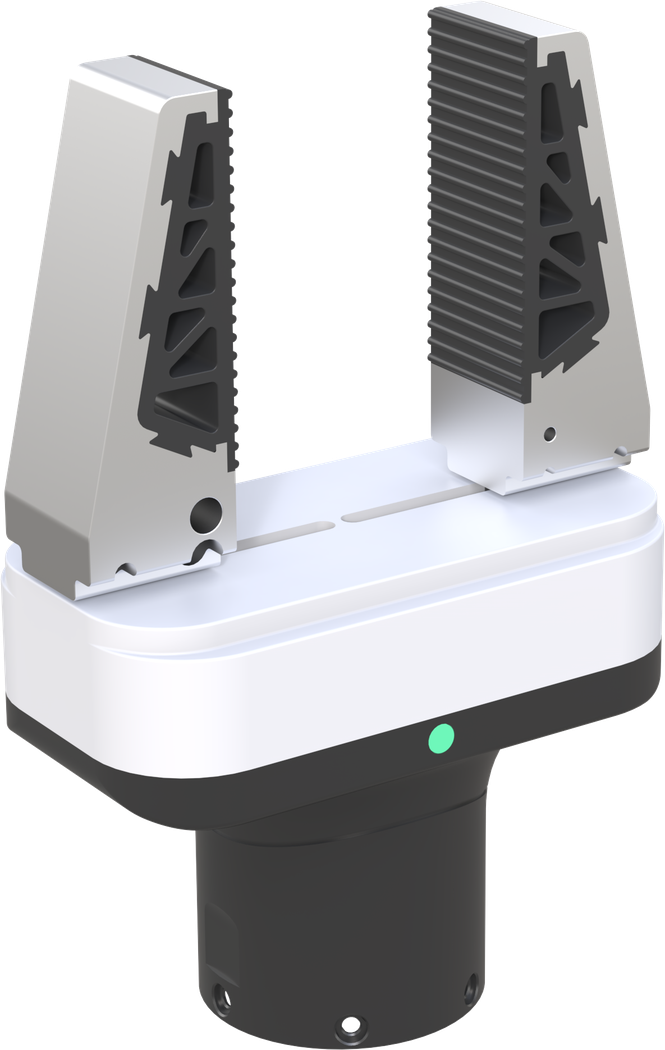
Appearance and scale. Overall dimensions 112 × 60 × 167 mm. Stroke 65 mm. Finger height 80 mm. Body weight 745 g. This row describes appearance or structural scale, used to verify doors, elevators, tabletops, or transport — not operating height, and not arm reach. Do not add it to the vertical range. If the diagram shows protrusions, antennas, or human standing positions not present in this row, note separately that they are not part of the specification. If weight appears in an adjacent row, do not write it into the dimension sentence. During review, search for the appearance of another machine. Doors, elevators, and transport are verified only against appearance; do not treat this row as operating height.
Operating range. Stroke 65 mm is the finger opening distance, not the robotic arm's reach, nor the host body's vertical working range. This line describes the range the hand or lift can reach; the definition must follow the original sentence: vertical working range, reach, motion radius, or stroke. These cannot be added together or renamed. If "excluding end effector" is written, it must remain in the figure caption. If the original text does not specify units, retain the "units not specified" note and do not delete it for tidiness. During review, search for sentences that add together different range definitions. The figure caption retains the range definition from the original sentence, as well as terms such as "excluding end effector" or "units not specified."
Motion. Open / close time 2 s. Positional repeatability ±005 mm. Two seconds is the time metric for opening or closing, not the control frequency. This line describes how the ground unit or main arm moves. Four-wheel steering, four-wheel drive, differential drive, in-place rotation radius, and rotational speed are terms for different mechanisms and cannot substitute for one another. Published speed is a capability, not a recommended teach speed; teaching may be slower, but the slower speed is recorded under experimental conditions and is not written back into the specifications. If the page does not state gradeability or positioning, do not borrow from another page. During review, search for sentences that mix differential drive, four-wheel steering, and rotational speed. Teach speed may be lower, but the lower speed is recorded under operating conditions and does not change the published capability on this line.
Power supply. Rated voltage 24 V. Rated / maximum current 1.9 / 5.7 A. Rated / maximum power 45.6 / 136.8 W. There is no battery capacity and no battery life in hours. This line retains only the electrical terms that appear on the page: voltage, capacity, battery life, charging, current, or power. If there are no "hours," write that battery life is not provided; do not fill in with hours from an adjacent page. Do not rename charging time as battery life. Rated and maximum must be listed separately. Approximate values retain "approximately." Do not sum the ampere-hours of multiple devices and present them as the battery of a single unit. During review, search for the 6 hours borrowed from elsewhere and for charging time written as battery life. Hours, charging, or current that do not appear remain as not provided and are not copied in from an adjacent page.
Perception and computing. Communication interface: 6-pin aviation connector. Communication protocol: RS485 / Modbus-RTU. Operating environment: 0–50 ℃, relative humidity ≤85%. There is no camera on the page. This line inventories the items already specified in sensing, computing, or communication, and retains the terms standard, included, optional, and configurable. An optional item that is not selected does not count. If the cover conflicts with the list, cite the list, but do not pretend the cover statement does not exist. Head-mounted devices and gloves do not enter this line. Processors, storage capacity, or camera channel counts that are not written out must not be drawn into the system diagram. During review, search for cover channel counts written as standard deliverables. Optional sensors that have not been purchased do not enter this data dictionary.
End effector. It is itself the end effector. Whether it directly matches the flange, wiring harness, and protocol of the robotic platform must be confirmed on the configuration sheet; the page should state that it is not plug-and-play by default. This line refers to where contact or gripping occurs. Quick-change, compatible, and recommended are not models already included in the box. A ring fixture on the main arm is not a gripper on the end effector. Force, stroke, and payload remain as-is on their respective rows and are not merged into a single system metric just because they are mounted on a particular robotic platform. Where flange and protocol mappings are not provided, write "to be confirmed," not "plug-and-play." During review, search for unordered grippers described as included. "Supports" or "compatible" without a model number cannot be treated as delivered.
Boundary. The standard quantity table for the lift model does not include this gripper. The fold model lists quick-change capability, not that the RMG22-65 is already in the box. The recommended item CTAG2F90-D is also not for this model. This row is a deliberately separated boundary on the page: another model, another column, another product page, or an interface that still requires project confirmation after modularization. The boundary is not a defect note; it is there to prevent verbally buying two pages as one. When writing a proposal, copy the boundary into "Not included in this order." If an excluded device is added later, open a new configuration sheet rather than going back to change the robotic platform name in old samples. During review, search for cases where two models were collapsed into one. Devices within the boundary require a separate order; do not rename old samples to imply they already include it.
Configuration column. The order should specify model RMG22-65, and state which robotic platform it is mounted on, the quantity, and whether it replaces other gripper models listed in that platform's recommended column. This line distinguishes standard, recommended, and optional. Recommended and optional items are not delivered unless checked. When the standard row and the parameter table row conflict, keep both rows and use "locked for this order" to indicate which one is actually delivered, rather than striking out one row in the order without signing off. Price and lead time are not written into this line's paraphrase. During review, search for recommended items written as standard. Unchecked recommended and optional items are written as not delivered on the order.
Excerptable. Transcribe the attachment line by line: envelope 5 kg; recommended friction load 2 kg; maximum gripping force 130 N; stroke 65 mm; finger height 80 mm; 745 g; open/close time 2 s; repeatability ±0.05 mm; 24 V; 1.9/5.7 A; 45.6/136.8 W; RS485 / Modbus-RTU. This is the type of line that can be pasted into the attachment: with a subject, with units, and traceable to the original sentence on the product page. When pasting, retain terms such as approximately, not included, not provided, optional, and recommended. Do not convert and keep only the result. If the same figure has different meanings on two pages, write it as two lines in the attachment. Test protocols must not be mixed into specification excerpts. During review, confirm that the attachment has not lost the original lines after conversion. When pasting into the attachment, paste terms such as approximately, not included, and optional along with the figures.
Do not write. Do not convert 130 N into 5 kg and delete the original line. Do not write ±0.05 mm as the repeatability accuracy of the attached robotic arm. Do not write battery life. This line is a negative statement for review purposes. It does not describe what the device can do; it only prevents hours, degrees of freedom, payload subjects, or cover slogans from adjacent pages from being written in. If a negative statement is hit, revert to the original product page sentence and do not interpret it as "approximately." Do not bring in external papers' success rates or total hours not published on this site. The negative statement itself does not enter promotional slogans. If manuscript retrieval hits a negative statement, revert to the original product page sentence.
| Projects | Public-Facing Positioning of This Page |
|---|---|
| Degrees of Freedom | This is an end-effector gripper, not a multi-joint arm. The public table does not give the gripper a "degree of freedom" integer; do not fabricate one to align with other platforms. |
| Load and Mass | Maximum envelope grasp payload 5 kg. Recommended maximum friction payload 2 kg. Maximum clamping force 130 N. These three numbers cannot all be written as the same 5. |
| Form Factor and Scale | Overall dimensions 112 × 60 × 167 mm. Stroke 65 mm. Finger height 80 mm. Body weight 745 g. |
| Operating Range | The 65 mm stroke is the finger opening distance, not the robotic arm reach, nor the platform's vertical working range. |
| Motion | Open / close time 2 s. Positional repeatability ±0.05 mm. The 2 seconds is the specification for the open or close time, not the control frequency. |
| Power | Rated voltage 24 V. Rated / maximum current 1.9 / 5.7 A. Rated / maximum power 45.6 / 136.8 W. No battery capacity, no battery life in hours. |
| Perception & Compute | Communication interface: 6-pin aviation connector. Communication protocol: RS485 / Modbus-RTU. Operating environment: 0–50 °C, relative humidity ≤85%. There is no camera on the page. |
| End Effector | It is itself the end-effector. Whether it directly matches the flange, wiring harness, and protocols of the platform must be confirmed on the configuration sheet; the page states that plug-and-play is not the default. |
| Boundary | The standard quantity table for the lift model does not include this gripper. The folding model lists quick-change capability, not that the RMG22-65 is already in the box. The recommended item CTAG2F90-D is also not this model. |
| Configuration Panel | The order should specify model RMG22-65, and state which platform it is mounted on, the quantity, and whether it replaces other gripper models listed in that platform's recommended column. |
| Excerptable | Attachment specifications listed line by line: envelope 5 kg; recommended friction 2 kg; maximum gripping force 130 N; stroke 65 mm; finger height 80 mm; 745 g; open/close time 2 s; repeatability ±0.05 mm; 24 V; 1.9/5.7 A; 45.6/136.8 W; RS485 / Modbus-RTU. |
| Do not write | Do not convert 130 N to 5 kg and then delete the original row. Do not write ±0.05 mm as the repeatability of the attached robotic arm. Do not state battery life. |
Relationship to Public Methods and Adjacent Pages
Prohibiting mixed writing is both an editorial rule and a delivery rule. The following sentences have already caused or are prone to cause misunderstanding in the product copy on this site, and new articles will no longer use them.
Do not attribute the approximately 6 hours of the folding model to the lift model. Do not describe the lift model as having 17 degrees of freedom for the whole machine, nor as 650×512×1700 mm, approximately 120 kg, lifting 0.3 m, vertical 0–2.1 m, speed 0.1–1.0 m/s. Those figures belong to a different publicly documented machine, not to this RMC-AIDAL page. Do not write the arm's self-weight of 8 kg as the dual-arm rated payload. Do not merge RM65-B-V from the standard list and RM75-B-V from the arm table into a single model number. Do not write the cover's "3 depth + 2 wide-angle" as delivered; the standard vision configuration is one D435 depth camera plus two wide-angle cameras. Do not write the left/right extension of 790 as a bare number without units, nor pretend the original text printed a unit.
Do not merge the kit's three columns into one machine, and do not write force feedback for the local column. Do not write RMG22-65's 130 N, 65 mm, 5 kg, and 2 kg as the same "5." Do not write the wheeled humanoid's 40 Ah battery and approximately 2-hour charge time as 2-hour endurance. Do not cite brand logos that do not appear on this site. Do not write external paper success rates as TOBI measured results.
This article uses the three sentences most commonly written incorrectly for this product as counterexamples and provides replacement sentences.
Before handing off to a colleague
Review uses search, not full reading. Create a search table of negative sentences and high-frequency cross-page terms, and run it once each against the article, attachments, and data dictionary. On a hit, replace; do not add "basically consistent" next to it. The search table also includes external brand identifiers and paper success rates. After replacement, sample three rows of numbers and go back to the product page to verify the subject. If the subject is wrong, even if the number matches, it counts as a hit. The review record retains the search terms and the original sentences after replacement. The search table goes into the version repository and is committed together with the article. Changing only the article without updating the search record counts as an incomplete review. The search record logs hit counts. A zero hit count must also be recorded, showing the search was run. The three sampled rows must state the subject and the product page location. If the subject check fails, the entire article is rejected, not just those three rows, because errors of this kind usually occur in more than one place.
First, submit the retrieval table together with the article.
Second, record even if the hit count is zero.
Third, spot-check three rows to verify the subject.
Fourth, if the subject fails, the entire document is returned.
Fifth, the same number with a different subject still counts as a match.
Sixth, do not write "basically consistent" next to a hit. After retrieval is complete, the list of hit terms is appended to the internal record at the end of the document, not to the public page. The public page retains only the original sentence after replacement. The internal record is used for the next review, not for external promotion.
Continue Reading
- 01 Task Boundaries
- 02 Specification Standards
- 03 Degrees of Freedom
- 04 Payload & Self-Weight
- 05 Workspace
- 06 Locomotion Method
- 07 Perception and Computing
- 08 Power Specifications
- 09 Data Recording
- 10 Time Alignment
- 11 End-Effector Boundaries
- 12 Site Constraints
- 13 Configuration Sheet
- 14 Three-Way Comparison
- 15 Literature References
- 16 Master-Slave Workstation
- 17 Acceptable Deliverable Statements
- 18 Prohibited Conflations
- 19 On-Site Deployment
- 20 Evaluation Path
Back to Product Center View this product page
This article was written on October 3, 2026, for selection and specification verification purposes. Device parameters are subject to the product page tables and do not constitute a supply commitment. External papers only illustrate how problems are framed in the industry; their success rates and data scales belong to the original authors' experiments and are not TOBI's measured results. Phone: +86 137 5502 0164.