
Fields & coordinates
Confirm handedness, joint names, units, orientation representation, reference frames and missing-data rules. Outputs depend on the SDK and firmware version.
FORMOTION / HAND MOTION CAPTURE / WIRELESS IMU
Capture hand demonstrations. Move wirelessly.
Record gestures, finger articulation and hand orientation with Forsense inertial tracking and a C++ / Python SDK. TOBI helps assess the environment, equipment combination and delivery scope.
Source: Forsense datasheet · confirm configuration and test conditions
01 / FIT FOR YOUR TASK
Wireless demonstrations and repeated hand-pose capture sessions, with VR and digital-human applications as additional use cases.
Inertial pose capture is not millimeter-level absolute position tracking. Seven-hour battery life does not mean seven hours without recalibration. Robot integration, external tracking and synchronization require assessment.
Explore the alternative · G7 →02 / CAPTURE TO CONTROL
The glove provides the input. Mapping, control and synchronization define the complete workflow. This is an integration diagram, not a claim of validated robot compatibility.
Record human-hand motion
Confirm fields, frames and timestamps
Map to the target joints and limits
Connect the controller; log states and outcomes
Dashed stages require project validation. The robot hand, controller and cross-device synchronization services are not included by default.
03 / DATA & INTEGRATION
Define interfaces, outputs and acceptance criteria before engineering integration.
Confirm handedness, joint names, units, orientation representation, reference frames and missing-data rules. Outputs depend on the SDK and firmware version.
Specify device and host timestamps, latency definitions, jitter, dropped frames and drift. Retain processing records for resampled data.
Confirm degrees of freedom, joint order, joint limits and the communication protocol. Scope follows validation on the actual robot model.
Manufacturer specifications and integration resources are open. A validated TOBI recording sample and robot compatibility list are not published here; request a technical assessment if needed.
| Item | Current evidence | Before integration |
|---|---|---|
| Device output | Manufacturer specifications and SDK documentation | Firmware, SDK, field definitions and operating system |
| Robot-hand control | Project validation required | Target hand, driver, retargeting and task acceptance |
| ROS 2 / LeRobot / Isaac Lab | No validated integration version published here | Target framework version, conversion code and test sample |
04 / CHOOSE YOUR GLOVE
| Criterion | G7 | G2-L |
|---|---|---|
| Capture focus | Fingertip spatial position and hand motion | Gestures, articulation and hand orientation |
| Tracking | EMF + IMU magnetic-inertial | IMU inertial |
| Rate definition | 120 Hz sensor sampling | 50 Hz data transmission |
| Latency definition | End-to-end: wired <20 ms / wireless <30 ms | Signal latency ≤20 ms |
| Connection and runtime | Wired Hub; optional wireless >3.5 h | Bluetooth 5.1; 7 h battery life |
| Weight per glove | 115±5 g | 90±5 g |
| Before choosing | Magnetic environment, hand separation, wiring and position reference frame | Calibration, drift, Bluetooth coverage and pose-data requirements |
05 / SPECIFICATIONS
The following are manufacturer specifications, not independent TOBI measurements. Performance depends on configuration, environment, calibration and test method.
Open the source datasheet ↗Sources checked: 2026-10-01
| Sensor architecture | 1+8 IMUs plus wrist IMU; 6DOF inertial sensors |
|---|---|
| Data transmission rate | 50 Hz |
| Signal latency | ≤20 ms (a different definition from G7 end-to-end latency) |
| Wireless connection | Bluetooth 5.1; up to approximately 15 m, subject to site evaluation |
| Power and battery | 7 h battery life; USB-C charging approximately 3.5 h |
| Fit and weight | Half-finger design; 90±5 g per glove; M / L / XL |
| IMU range | Gyroscope ±4000 dps; accelerometer ±8 g |
| SDK | C++, Python; confirm operating system and version |
| Manufacturer calibration description | Four-point calibration <40 seconds; validate with the actual workflow |
| Manufacturer stability description | Approximately 40 minutes without noticeable drift; test conditions must be specified |
06 / CONFIGURATION
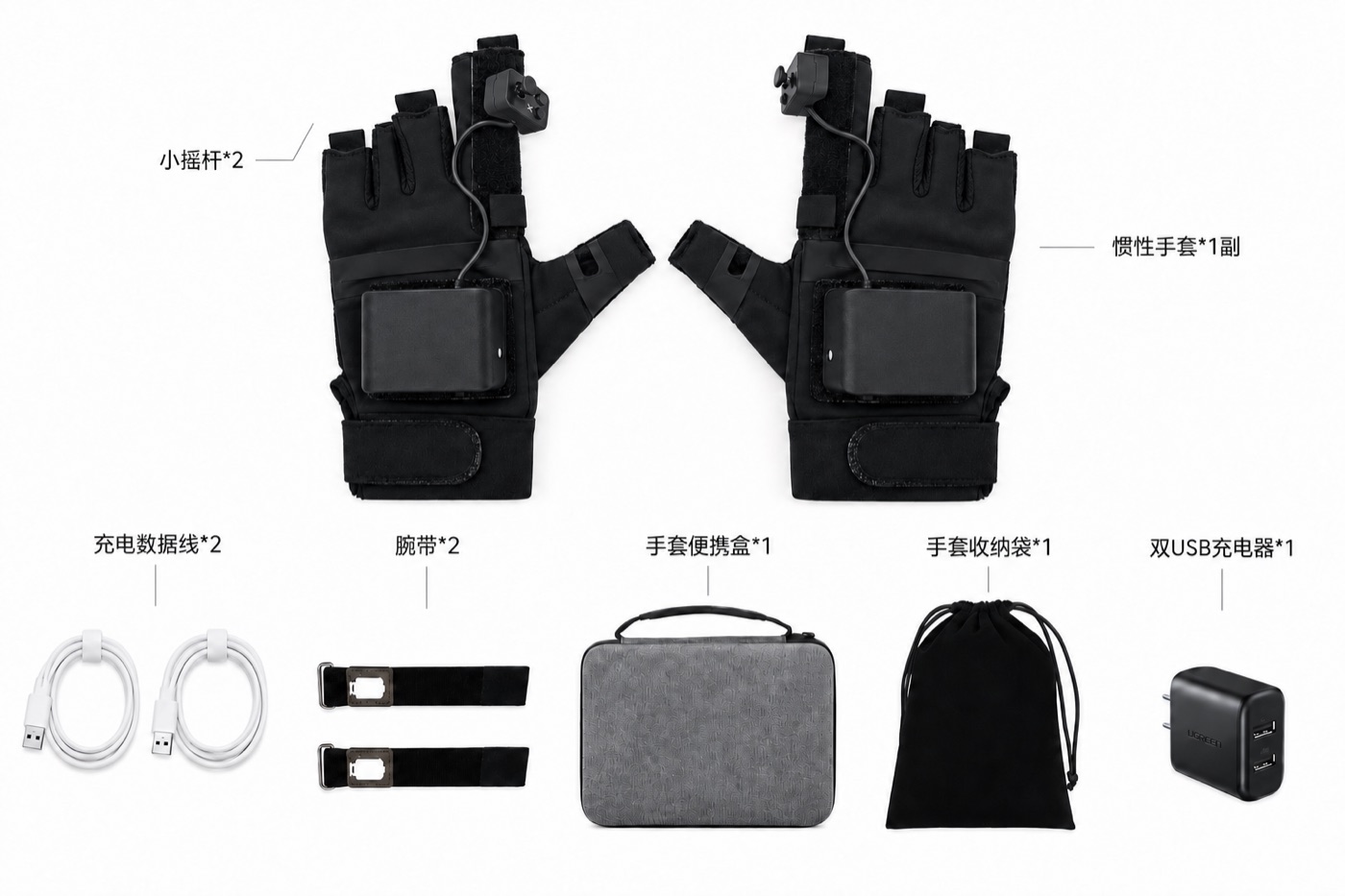
Product materials show wireless gloves, wrist straps, charging cables and storage accessories. Confirm handedness, quantity and size in the current delivery list.
Motion-capture suits, VR/external tracking equipment and interface services are assessed separately and are not included by default.
Robot integration, camera synchronization, schema conversion and acceptance support are assessed per project. Pricing, lead time and services are itemized in the quotation.
07 / QUESTIONS, ANSWERED
Understand capabilities and limits before committing to an integration.
This is a wearable human-hand motion capture input device. A robot hand is the actuator; SDK integration, retargeting and a robot control interface connect the two.
No model-specific robot validation list is published here. Provide the target hand, degrees of freedom, interfaces and task to assess development and testing. Plug-and-play compatibility is not assumed.
Evaluate G7 for fingertip spatial position, including the magnetic environment. Evaluate G2-L for wireless hand-pose capture. Rate and latency definitions differ; validate against your task.
The specifications cited here do not establish tactile sensing, contact-force capture or force feedback. Confirm hardware and peripherals separately if required.
Confirm both clocks, timestamps, alignment method and error criteria. G7 Hub synchronization between hands is not hardware synchronization with an Ego camera. Starting simultaneously is not time alignment.
Hand trajectories can be part of demonstrations but are not automatically robot actions. Validate the action space, robot states, aligned vision, schema and target framework version before conversion and training.
Review the public specifications, then send the model, application and email. Pricing depends on configuration, accessories, quantity and services. Confirm lead time, evaluation availability and warranty in writing.
PROJECT ASSESSMENT
Expect a reply within one working day to discuss the model, interfaces, sizing and delivery scope. Basic specifications are available without a form.
+86 137 5502 0164For robot integration or camera synchronization, include the target equipment and task.