
3840×1200 side-by-side, 1920×1200 per eye, 60 Hz, HEVC. This segment is not the 2328×1748 or 1600×1200 on the spec sheet; refer to the intrinsic and extrinsic parameter files.
In Production · Full Six-Camera Capture Solution
TOBI E6 / SIX-CAMERA EGO CAPTURE
TOBI E6 Six-Camera Ego Data Capture Device
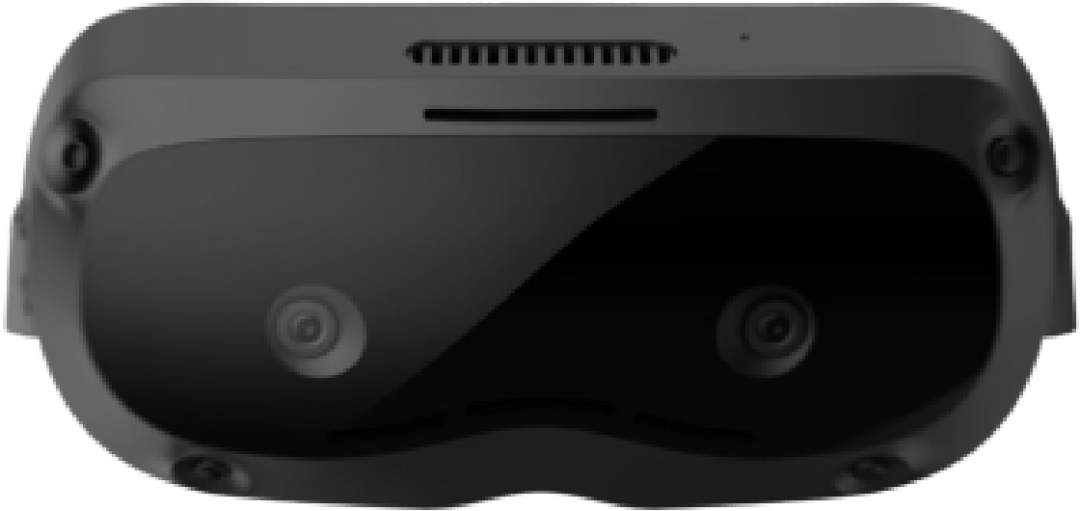
E6 is a Qualcomm-platform head-worn capture device for embodied AI data production: 4 grayscale global-shutter cameras (with infrared recognition) and 2 RGB cameras synchronized in real time, covering a 217° horizontal field of view; built-in SLAM and gesture recognition bring first-person video, trajectory, gesture, and inertial data onto a single time base in one pass.
6 channelsReal-Time Camera Synchronization
5mmSLAM Positioning Accuracy · Nominal
370gComplete Unit (Front Section 150 g)
15 TOPSQualcomm XR2 NPU
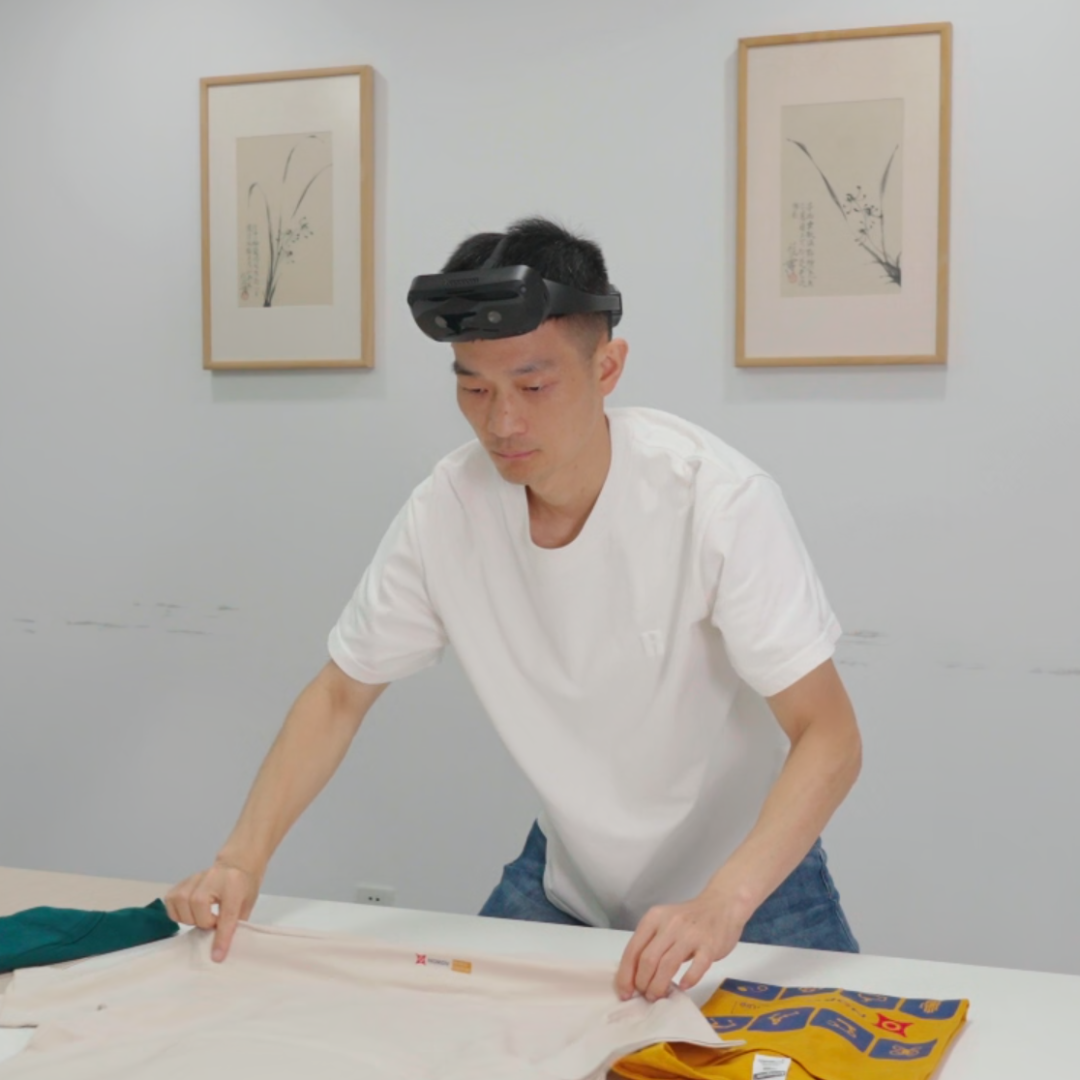
DATA SAMPLE · EPISODE 20260708_155328
A real capture,
split intoTrainable six-camera data package.
This segment is cut from the 22.0-second mark of the original recording to the end. OpenXR 26 joints are overlaid on the left and right RGB views. This is a human first-person observation, not a robot end-effector action, and the 26 joints must not be treated as a 7-DoF gripper. The original RGB is 60 Hz; this clip is a 10 Hz preview and must not be used as a training set.
SOLUTION
Observations and hand state on the same time base
RGB left-right side-by-side, with grayscale split into a horizontal SLAM pair and a downward-facing hand pair. Head pose, both hands with 26 joints, IMU, audio, and three sets of intrinsics/extrinsics are on the same UTC nanosecond timeline. Training reads 60 Hz raw footage and rgb_index.jsonl, feeding the ctrl grayscale into the observation. Hands remain at approximately 19 Hz with dt, without resampling. This video exists only to let people see whether the joints land on the hands.
Tracking is side-by-side 1280×480, 640×480 each, approximately 60 Hz. Used for horizontal environments, not controller pose.
ctrl is also 1280×480 side by side. The extrinsics are angled further downward relative to tracking, covering the tabletop and hands.
OpenXR skeleton, approximately 19 Hz. Each hand has an active flag, and each joint has visibility. The device file has no confidence values. An invalid joint is not a real pose, nor is it gripper open/close.
60 Hz, position plus quaternion. The start and end times of this segment align with the RGB exposure midpoint. 5 mm is still nominal; this segment has no ground truth.
Gyroscope and accelerometer at approximately 1015 Hz, with bias / scale / time alignment. Audio 44.1 kHz mono. Three sets of camera parameters delivered with the package.
RECORDING SPEC · Measured in this segment
- Segment
- 20260708_155328, approximately 32.0 seconds. The demo uses 22.0 seconds of it through to the end.
- Time base
- UTC in nanoseconds. RGB uses mid_exposure_utc_ns. Head pose is aligned to this timestamp.
- Hands
- 26 joints, approximately 19.0 Hz, with visibility and dt. Not 60 Hz, and not a 7-DOF gripper. The device CSV has no per-joint confidence.
- This section does not contain
- Depth, MANUS, object 6DoF, contact force, robot actions. The object file contains only manual annotation segments, no bounding boxes. controller_poses is empty.
Projection uses this package's intrinsics, Camera→Body extrinsics, and equidistant fisheye. In the 23.4–24.6 second scan, the −9.9 ms calibration moved the wrist by 4.7 pixels; a skin-tone proxy cannot resolve milliseconds, so this 10 ms does not apply to this segment. Edge p90 is still about 46 pixels. Training files are on the data description page; do not train on this 10 Hz clip.
DATA SAMPLE · EPISODE 20260708_155328
One real take,
split into a trainable six-camera pack.
This clip runs from 22.0 s to the end. OpenXR 26-joint skeletons are on the left and right RGB views. It is a human egocentric observation, not a robot end-effector action, and 26 joints are not a 7-DoF gripper. Source RGB is 60 Hz. This player file is a 10 Hz preview and is not the training source.
SOLUTION
Observations and Hand State on One Clock
RGB is side-by-side. Grayscale is a lateral SLAM pair and a downward hand pair. Head pose, both 26-joint hands, IMU, audio, and three calibrations share one UTC-nanosecond timeline. Training reads the 60 Hz source and rgb_index.jsonl, which joins the ctrl pair. Hands stay near 19 Hz with dt and are not resampled. This video only shows whether the joints land on the hands.
3840×1200 side-by-side, 1920×1200 per eye, 60 Hz, HEVC. This take is not the 2328×1748 or 1600×1200 brochure modes. Use the calibration file.
tracking pair, 1280×480 side-by-side, 640×480 per eye, about 60 Hz. Lateral views, not controller pose.
ctrl is the same 1280×480 layout. Extrinsics point further down than tracking, toward the desk and hands.
OpenXR skeleton, approximately 19 Hz. Each hand has an active flag and each joint has a visibility bit. The device file contains no confidence value. An invisible joint is not a pose and not a gripper width.
60 Hz, position plus quaternion. Endpoints match RGB mid-exposure on this take. 5 mm remains a nominal figure; this clip has no ground truth.
Gyro and accel at approximately 1015 Hz, with bias, scale, and time alignment. Audio is 44.1 kHz mono. Three camera-parameter files ship with the episode.
RECORDING SPEC · MEASURED ON THIS TAKE
- Episode
- 20260708_155328, approximately 32.0 s. The demo uses 22.0 s through the end.
- Time base
- UTC nanoseconds. RGB uses mid_exposure_utc_ns. Head pose is aligned to that timestamp.
- Hands
- 26 joints at about 19.0 Hz, with visibility and dt. Not 60 Hz, and not a 7-DoF gripper. The device CSV has no per-joint confidence.
- Not in this take
- Depth, MANUS, object 6DoF, contact force, or a robot action. The object file is a human time span, not boxes. controller_poses is empty.
Projection uses this pack's intrinsics, Camera-to-Body extrinsics, and equidistant fisheye. On the 23.4–24.6 s sweep, the factory −9.9 ms shift moves the wrist 4.7 px, and the skin proxy cannot resolve a millisecond, so this take does not apply that 10 ms. Edge p90 is still about 46 px. Training files are on the data note. Do not train on this 10 Hz preview.
PRODUCT OVERVIEW & CORE FUNCTIONS
Make "capture",
Upgrade from video to a data package with trajectories and gestures.
E6 combines two camera types on a single headband: the grayscale global shutter is designed for motion and low-light reliability with infrared recognition, while RGB handles color and texture. Paired with the Qualcomm XR2 Gen1 (NPU 15 TOPS), video, IMU, SLAM trajectories, and gesture recognition are output on the same time base, ready to feed directly into training and evaluation after capture.
4-channel grayscale + 2-channel RGB
4 grayscale global-shutter cameras (640×480@60, with infrared recognition) provide a total field of view of 217° horizontal × 186° vertical; 2 RGB cameras provide color and texture; all run in real time, synchronized.
On-device SLAM and gesture recognition
Supports SLAM data with trajectories and gesture recognition data capture; SLAM positioning accuracy is nominally 5 mm. Algorithm capability and performance are affected by scene texture, lighting, and motion, and must be validated per task.
Qualcomm XR2 Gen1
NPU compute 15 TOPS; Android 12 system. Multi-camera timestamp synchronization and algorithmic preprocessing are performed on-device, reducing post-capture processing costs.
Front/rear counterweight balance
370 g total weight: 150 g front main unit, rear 5500 mAh battery for balanced front-rear weight distribution, more comfortable for extended wear; can be connected to an external power bank.
USE SCENARIOS
One headband, supporting an entire
End-to-end data pipeline.
E6 is suited to tasks that require synchronized outputs of "video + trajectory + gesture" and that need the data package on-site immediately. Whether to choose the RGB rolling-shutter or global-shutter version depends on the task's requirements for dynamic imaging and color.
Imitation Learning Data Production
Produces time-aligned RGB video, SLAM trajectories, gestures and IMU data for teleoperation and imitation learning; the RGB global-shutter version suits faster-moving tasks.
Dexterous manipulation and tool use
Four grayscale channels with a wide field of view cover the hand and tool manipulation area. A vertical 186° field of view provides ample margin for the tabletop, tools, and grasping actions. Infrared recognition supports special lighting environments.
High-fidelity video capture
For tasks requiring higher color detail, a 2-channel rolling shutter RGB option (2328×1748@60) is available for scenes sensitive to texture and color.
Industrial and complex lighting operations
Infrared recognition and a global shutter are suitable for industrial scenarios such as low-light and flickering illumination; the 370 g unit has balanced weight distribution, supporting long-duration on-duty data capture.
WHO IT SERVES
For teams that need to "capture everything in one pass."
E6 is designed for projects centered on a head-mounted first-person viewpoint that require multimodal data produced on a common baseline. Suitability depends on algorithm requirements, budget, and number of production units; pre-sales can run a one-time task-based match.
Embodied AI R&D teams
Teams that need first-person data with trajectories and gestures to train manipulation models; E6's on-device SLAM and gesture recognition can significantly reduce post-capture alignment costs.
SLAM · Gesture · RGB from the same sourceAI Data Company / Capture Base
Producers who continuously deliver high-quality Ego data packages for multiple clients, valuing in-device synchronization, batch operation workflows, and open data interfaces, and able to work with customized capture SOPs.
Full API access · Batch · CustomizableUniversities and key laboratories
For research in dexterous manipulation, navigation, and human-robot interaction, a stable, controllable capture platform with interpretable data is required; documentation scope and acceptance boundaries are clearly defined, facilitating reuse in both academic papers and engineering projects.
Complete documentation · Clear boundariesWHY E6 & DATA BOUNDARY
Flagship specifications,
Delivered against the same acceptance criteria.
E6 is in mass production, with on-device SLAM and gesture recognition capabilities; key parameters and usage boundaries are listed below. Nominal algorithm metrics are affected by texture, lighting, and motion, and project results must be validated with samples from the target scenario.
Six-camera synchronization
6 channels
4 grayscale channels (with infrared detection) + 2 RGB channels running in real-time and synchronized, with microsecond-level timestamp synchronization between cameras.
On-device trajectory estimation
5mm
SLAM positioning accuracy is nominally 5 mm (product documentation value); actual accuracy depends on scene texture, lighting, and motion patterns, and must be verified per task.
On-device compute
15T
Qualcomm XR2 Gen1 NPU at 15 TOPS; on-device algorithmic preprocessing reduces dependence on external compute.
Single reference output
μs
Video, IMU, SLAM, gestures, and intrinsics/extrinsics are output on the same time base, with microsecond-level timestamp synchronization.
Data boundaries:SLAM and gesture recognition are on-device algorithm capabilities; nominal accuracy and recognition performance do not constitute acceptance results under arbitrary tasks. RGB is available in rolling shutter and global shutter versions; task matching must be confirmed separately. Mass production supply, firmware, accessories, quantities, and delivery schedules are subject to the order confirmation document.
- Product model / status
- E6 six-camera Ego data capture device; in mass production.
- Processor
- Qualcomm XR2 Gen1; NPU compute 15 TOPS.
- Camera system
- 6 cameras running in real-time sync: 4 grayscale global shutter (with infrared recognition) + 2 RGB.
- Grayscale camera
- 640×480@60fps; single-camera DFOV 160°, HFOV 142°, VFOV 107°; 4-channel grayscale total FOV = 217° horizontal × 186° vertical.
- RGB version 1 (rolling shutter)
- 2 rolling-shutter RGB channels, 2328×1748@60fps each; VFOV 115°, HFOV 130.8°, DFOV 142.4°. Suited to high-fidelity color scenes.
- RGB Version 2 (global shutter)
- 2 global-shutter RGB cameras, 1600×1200@60fps each; VFOV 139°, HFOV 186°, DFOV 200°. Suited to dynamic scenes.
- Battery and Battery Life
- Built-in 5500mAh; can connect to an external power bank; rear battery balances front-rear weight distribution.
- Storage
- 8GB RAM + 128GB onboard storage (Micro SD not supported); USB wired or Wi-Fi wireless upload/export.
- Sensors
- High-precision IMU with a 1000 Hz sampling rate.
- Wireless and Connectivity
- 2.4G/5G dual-band Wi-Fi 6; Bluetooth 5.3.
- Audio
- Equipped with a microphone and speaker.
- Captured Data
- RGB color video (MP4 / H.265), SLAM data with trajectories, gesture recognition data, IMU data, camera intrinsic and extrinsic parameters, audio; all cameras synchronized to microsecond-level timestamps.
- SLAM / gestures
- Supports on-device SLAM (nominal positioning accuracy 5mm) and gesture recognition; effectiveness is validated per task scenario.
- Weight / system
- Total unit weight 370g, front main unit 150g; operating system Android 12.
- Open and customizable
- All data interfaces are open; customized services are supported.
Note: SLAM accuracy of 5 mm, FOV, and resolution are nominal values from product documentation; actual performance is affected by lighting, texture, motion, and assembly. Define samples and methods in your project acceptance criteria. Documentation parameters are updated with version iterations; the order confirmation document is authoritative.
READY TO PIPELINE
With a single data-chain standard,
Evaluate whether E6 fits your task.
We can jointly confirm the E6 specifications and delivery plan around camera configuration (RGB rolling / global shutter), capture scenarios, and data acquisition workflows. Plan confirmation does not constitute an automatic quotation or a guarantee of data results.
Clarify the task type and required data modalities (video / trajectory / gesture / audio).
Confirm the RGB version: rolling shutter (high fidelity) or global shutter (dynamic imaging).
Clarify the daily capture duration, number of devices, and data retrieval and return process.
Define the acceptance samples and metric definitions for algorithm performance.
DATA & PROJECT READINESS
From specifications to an acceptable capture plan.From specifications to a testable capture setup.
View specifications on this pageRead specificationsReal Capture Samples and Field DescriptionsRecording sample & field notesDeveloper DocsDeveloper documentationDelivery Format GuideDelivery formatCompare other devicesCompare devices
Does the E6 sample prove 5mm accuracy?Does the E6 sample prove 5mm accuracy?
No. 5 mm is a nominal value from product documentation; the sample does not provide ground truth. Actual joint frequency, validity, and video frequency should be verified separately.No. 5mm is a stated specification and the sample has no ground truth. Check joint rate and validity separately from video frame rate.
Can it be used directly for robot training?Is this data ready for robot training?
Device observations do not automatically equal robot action labels. First confirm the data fields, timestamps, coordinate frames, target action space and data quality, then validate the conversion and training pipeline.Device observations are not automatically robot-action labels. Validate fields, timestamps, coordinate frames, target action space and quality before conversion and training.
How do I confirm supply and delivery scope?How do I confirm supply and scope?
Provide the task, quantity and planned delivery date. Confirm the device version, firmware, accessories, support scope and acceptance method in writing. Historical prototypes or production plans do not mean current stock is available.Provide the task, quantity and delivery window. Confirm the version, firmware, accessories, support and acceptance method in writing. Historical production plans do not confirm current stock.
How do I sync with other devices?How is cross-device synchronization verified?
Starting together does not mean clock synchronization. For a combined solution, confirm the clock source, interfaces, timestamp definitions, error statistics and dropped-frame handling; single-device metrics cannot substitute for full-system acceptance.Starting together is not clock synchronization. Confirm clock source, interfaces, timestamp definitions, error statistics and dropped-frame handling for the complete system.