
Lead-in.After the glove deal closes, what the algorithm team actually accepts is the samples, not the packaging. Public research in October 2026 has already defined "trainable" as a set of quantities that exist simultaneously: how the hand moves, whether contact was recorded, and whether these quantities are aligned with vision and robot state. TOBI's G7 and G2-L are responsible for the motion layer among them. This article explains how to write their output into a dataset, not how to disguise motion data as tactile or action labels.
First, write the observation types of both gloves into the data dictionary
G7's observations are the spatial position and orientation after magneto-inertial fusion. The specification sheet gives position 2 mm, orientation 3°, sampling 120 Hz, end-to-end latency wired less than 20 ms, wireless less than 30 ms. The data dictionary should include: identifiers for left and right hands, fingertip modules, and back-of-hand nodes, position units, orientation representation (Euler angles, rotation matrix, or quaternion, per the current SDK), timestamps, missing-value and magnetic-avoidance flags. The 2 mm is the manufacturer's position specification and must be preserved verbatim in the field description; it must not be changed to "end-effector error 2 mm."
G2-L's observations are inertial gestures, knuckle changes and hand pose. Data transmission rate is 50 Hz, signal latency ≤20 ms, and the architecture is 1 + 8 IMU + wrist IMU. The dictionary should contain: left/right hand, joint or sensor ID, pose representation, Bluetooth disconnection, calibration moment, timestamp. Do not name G2-L's fields after G7's spatial points. Mixing the two naming schemes is one of the most expensive errors in later training scripts.
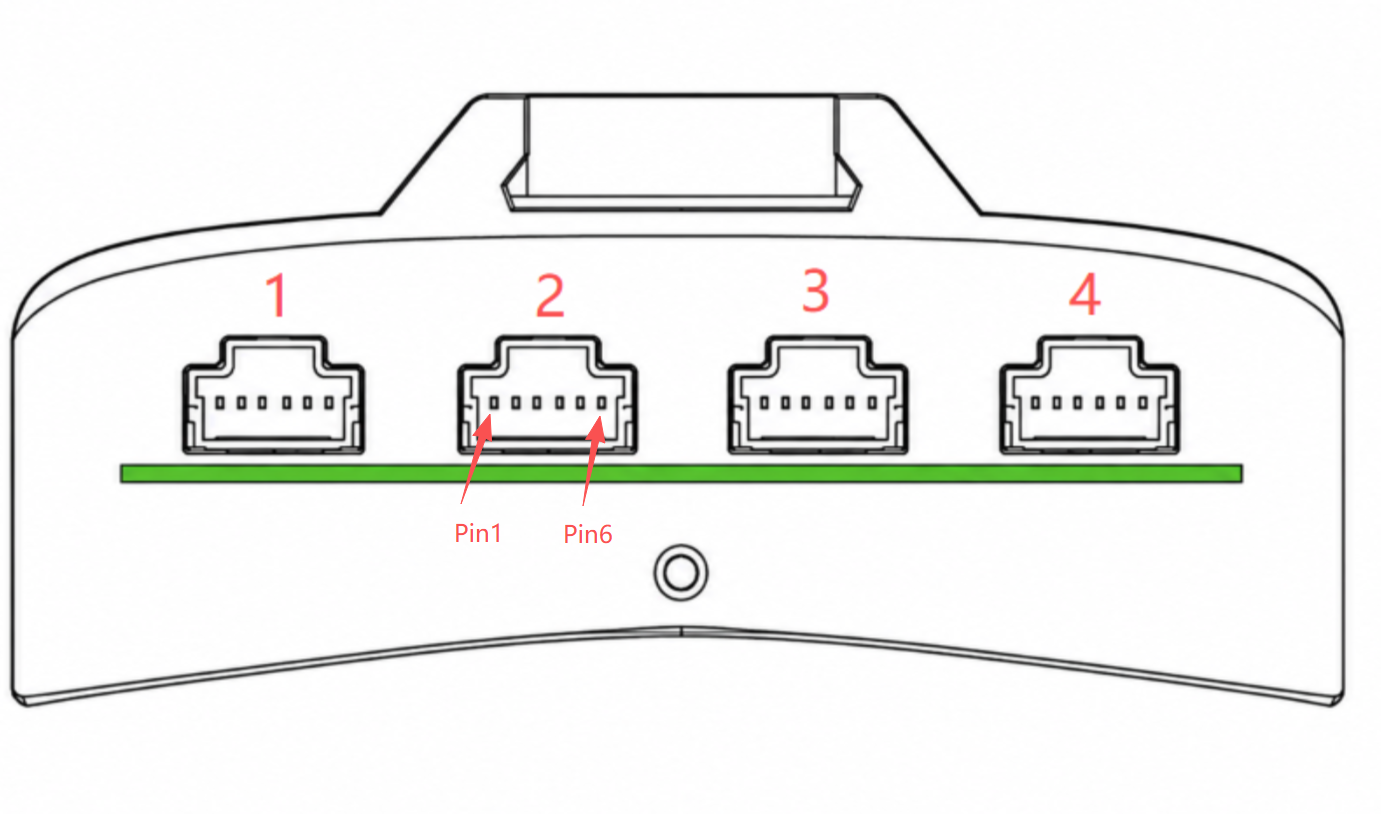
What columns does a sample minimally need
Regardless of the final container format, TOBI recommends that customers first review a column list during evaluation. Identity columns: collector, left/right hand, glove serial number or firmware version, size. Time columns: device time, host time, whether time synchronization was performed. Motion columns: G7's position and attitude, or G2-L's joints and attitude—do not leave empty columns pretending both exist. Quality columns: dropped frames, magnetic avoidance, Bluetooth reconnection, whether calibration has expired. Task columns: phase name, success or failure, failure reason. Optional columns: camera frame number, robot joints, tactile. If optional columns are missing, the sample can still be a qualified hand-motion sample; if the project contract specifies these columns, missing them makes it unqualified. Separating optional from required is a way to reduce disputes in data delivery.
TactiDex's public setup serves as a reference: it synchronizes full-hand tactile data, kinematics, and six-dimensional wrist and object poses, at a scale of 49 objects and 757 sequences, with approximately 120 Hz on the kinematics side, and includes task text. That is a benchmark with contact and object ground truth, not the default export of G7 or G2-L. If a customer wants to reproduce such a benchmark, the motion layer can discuss G7's 120 Hz spatial points, but tactile sensing and object motion capture must be configured separately. DexViTac reports over 2400 everyday manipulation sequences and likewise counts tactile sensing as part of the capture system. When citing these papers, one should cite their structure, not write their success rates into TOBI's glove marketing pages.
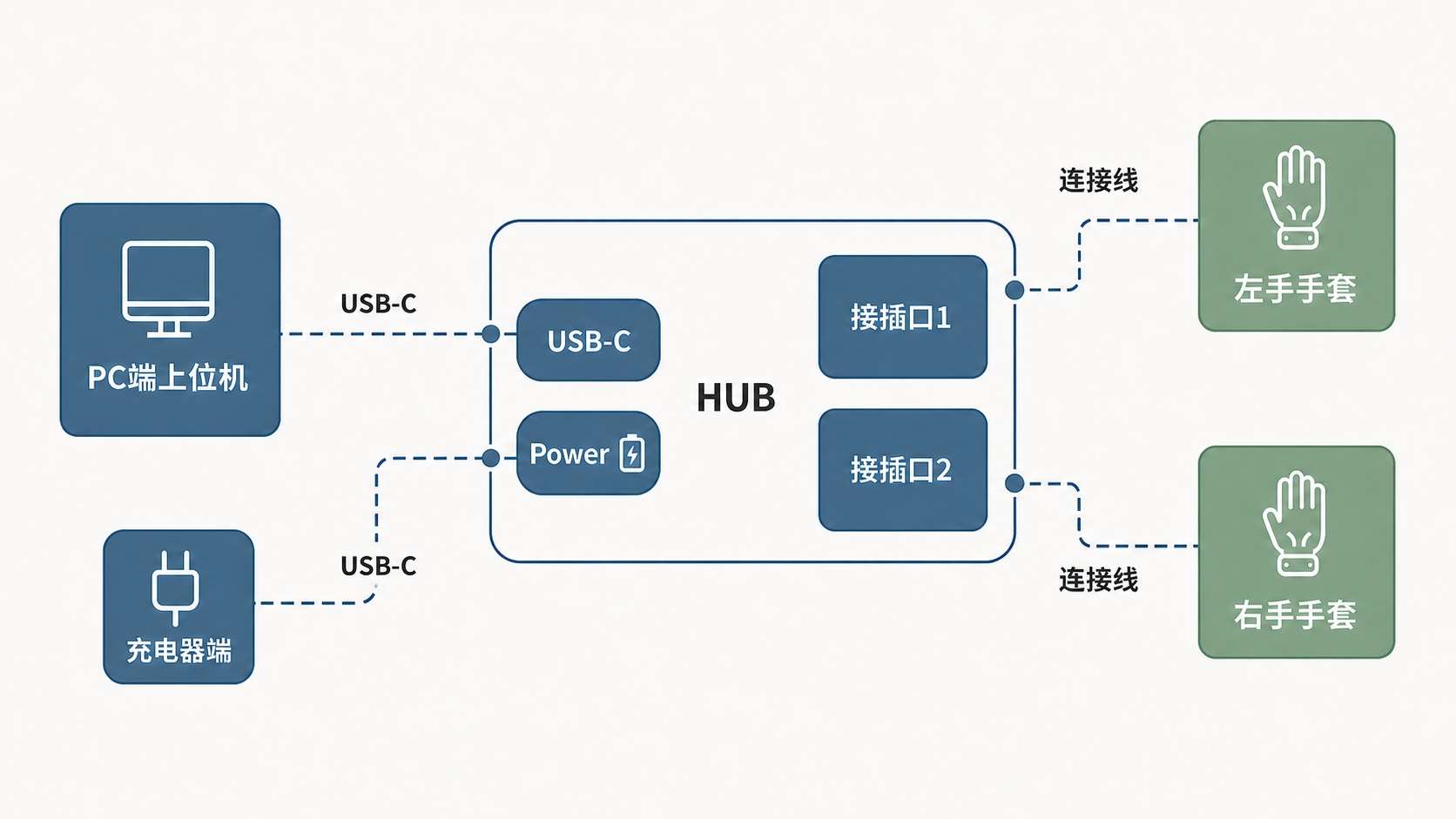
Remapping is the second stage of the dataset, not a hidden feature of the glove
The degrees of freedom of a human hand do not equal the degrees of freedom of a dexterous robotic hand. For the same thumb opposition motion, the joint targets differ completely across a 6-DOF hand, a 12-DOF hand, and a hand with 20 or more DOF. The publicly available T-Rex data even warns that the commanded joints and the measured joints can differ substantially, and that the column consistent with deployment should be selected during training. This lesson applies equally to TOBI's customers. The G7 or G2-L provides observations on the human-hand side. After mapping to the robot, a different column is produced, and the mapping version, joint order, and joint limits must all be saved. A remapping without a version number cannot reproduce the experiment three months later.
RealDexUMI reduces this step by using an isomorphic glove; the paper's self-reported average success rate across eight tasks belongs to that interface. If the customer's goal is that kind of closed loop, it should be stated in the evaluation, rather than demanding that G2-L's Python SDK become an isomorphic teleoperator on site. If the customer's goal is to retain multiple human-hand samples and then map offline to multiple hands, G7's spatial points and G2-L's pose sequences are actually more suitable, because they are not bound to the joint space of a particular hand.
Failure samples, near-failures and "empty grasps"
Multiple tactile solutions in 2026 repeatedly raised the issue of empty grasps and dirty data: the hand is moving, but nothing is actually being grasped. A glove that only records motion cannot tell whether a grasp occurred. In a September seminar, Fulexin Material described this as a structural limitation of motion capture. Therefore, when building datasets with the G7 or G2-L, success labels cannot be generated by the glove itself. Labels must come from human annotation, from task outcomes, or from separately added tactile and visual sensors. Near-failures must be retained: fingertips slipping over an object's edge, hands coming too close together, momentary Bluetooth reconnection. Deleting failure segments will make the model look better on paper curves but will be exposed in the first week on the production line.
Failures with different sampling rates must not be pooled into one statistic. A dropped frame on the G7 at 120 Hz and one on the G2-L at 50 Hz represent different lengths of time. Quality reports should be broken out per device. After resampling to the camera's 30 Hz, the original dropped-frame markers must still be retained; otherwise there is no way to tell whether the smoothness after alignment comes from interpolation or from real motion.
Boundaries when interfacing with VLA and imitation learning
The actions required by vision-language-action models are typically the targets of a robot's actuators, not the sensor readings of a human hand. A hand trajectory can be an observation, part of a demonstration, or—after remapping—an action. These three roles must be assigned one choice on the dataset card. The product page states it plainly: a hand trajectory does not automatically equal a robot action. The content page repeats this sentence because a considerable share of readers searching "dexterous glove data capture" are looking for a shortcut for VLA. If a shortcut exists, it comes from task definition and mapping validation, not from writing a higher sampling rate for the glove.
Time alignment is a separate card. The G7 Hub's two-hand synchronization, the G2-L's Bluetooth stream, and the camera time of the E6 or E2 are different clocks. Pressing start at the same time is not the same as time alignment. During acceptance, a data specialist should see: the time-sync method, how residual error is measured, and how out-of-tolerance samples are excluded. Without these three items, no matter how complete the joint columns are, the data will struggle to enter serious training.
An output checklist that can be appended to a procurement contract
It is recommended that the contract annex use tables rather than adjectives. The equipment column should list G7 or G2-L, along with wired or wireless, size, and firmware. The observation column should specify spatial points or inertial poses, citing the specification sheet terminology. The frequency column should list 120 Hz or 50 Hz. The latency column should specify end-to-end or signal latency, including verbatim text such as "less than 20 milliseconds." The exclusions column should cover haptics, force feedback, compatibility with specified robots, and synchronization with camera hardware. The delivery column should cover file format, left/right hand convention, timestamps, and who generates failure labels. The acceptance column should cover a small-batch pilot: first capture the target scenario, verify fields and wearability, then scale up. TOBI's evaluation encourages this kind of small closed loop. If the dataset still requires TOBI's assistance with annotation or co-wearing, add a separate row in the same table to avoid having data services be understood as included in the glove price.
Readers can go from the G7 or G2-L product page to the spec sheet and verify each number in the table above item by item. Only after verification passes should sample size and robot mapping be discussed — do not reverse the order.
A one-week cadence for the data lead
Monday: freeze the dictionary — field names, units, left/right hand, timestamp source. Tuesday: use one hour of data to check for missing measurements and reconnections, without also pursuing task difficulty. Wednesday: add success/failure labels and confirm the labels are not "grasps read off" the glove curve. Thursday: if a head-mounted device is available, only do start markers and frame alignment — do not claim hardware synchronization. Friday: write a one-page list of known gaps — whether tactile is present or absent, whether a mapping version is present or absent, whether robot state is present or absent. This gap page will do more to justify next week's procurement decision than a polished promotional video. TOBI is willing to respond to this gap page by stating which items can be supplied and which must be scoped as separate projects.
A sample record to help algorithms and procurement agree on column names
The following is not the SDK's official format, but a review-time example of column names, to avoid everyone inventing fields verbally in meetings. Identity can be recorded as operator, hand, size, firmware. Time can be recorded as device_time, host_time, sync_method. G7 motion columns can be recorded as fingertip_position, orientation, magnetic_avoidance. G2-L motion columns can be recorded as joint_pose, calibration_time, link_quality. Task columns can be recorded as phase, success, fail_reason. Optional columns can be recorded as camera_frame, robot_joint, tactile. The value of the example is that "no tactile" becomes a column that is left empty but must not be faked, rather than a verbal statement that gets forgotten.
Units must follow the column name. For position, if it comes from the G7, the units and orientation representation should follow the current output and be specified in the dictionary, while citing the manufacturer's spec of 2 mm position and 3 degrees orientation as device capability — not as a per-frame error bar. Frequency columns should state nominal values: G7 samples at 120 Hz, G2-L transmits at 50 Hz. If the measured arrival rate is below the nominal value, record it in the quality column; do not retroactively change the nominal value in the dictionary. Having nominal and measured values coexist is a basic data-engineering practice, and a way to dispute with suppliers without damaging the relationship.
Failure reasons should use a limited vocabulary: occlusion, disconnection, magnetic avoidance, expired calibration, missed grasp, mapping error, other. If the vocabulary is too long, it cannot be counted; if too short, different problems will all be recorded as "anomaly." Missed grasp exists as a separate entry to remind everyone that the data glove did not measure contact. Mapping error exists as a separate entry to remind everyone not to record reversed project software coordinates as a hardware fault. The limited vocabulary can be printed on a single page for the data collector, placed alongside the four training items mentioned earlier.
Versioning, licensing, and retention period
Every batch of data needs licensing in addition to fields: whether the collector consents to use for training, whether the scene permits filming, whether objects involve customer confidentiality. The glove itself does not solve licensing. TOBI can remind customers to write licensing into metadata when delivering equipment, but does not replace the customer's legal team. The retention period must also be specified: how long raw recordings are kept, how long resampled training packages are kept, and whether old packages remain reproducible after a mapping version is retired. A dataset without a retention policy will, three months later, be nothing but a folder name.
Compared to large-scale teleoperation corpora in 2026, enterprise pilots often have only a few dozen hours, or even a few hours. This is not a defect. T-Rex discusses mid-training coverage; what an enterprise needs in phase one is protocol correctness. Ten hours collected with the correct protocol is more likely to advance to phase two than a hundred hours piled up with ambiguous fields. In the procurement appendix, the phase-one hour count can be written small, while the field completeness rate is written strictly. A small hour count makes the budget easier to approve; strict fields mean phase two does not require starting over.
If the customer also purchases a head-mounted device, add camera columns to the dictionary, but do not mark camera columns as required unless the contract specifies joint capture. Once required and optional are written into the first version of the dictionary, do not silently upgrade them when scaling up the order — otherwise early samples will be discarded by the new script. Upgrading the dictionary should produce a second version, while retaining the program that reads the first version. This is the data lead's job; what the glove supplier must do is not imply in marketing that "export equals training format." The training format is determined by the customer's model.
Three charts for the delivery review meeting
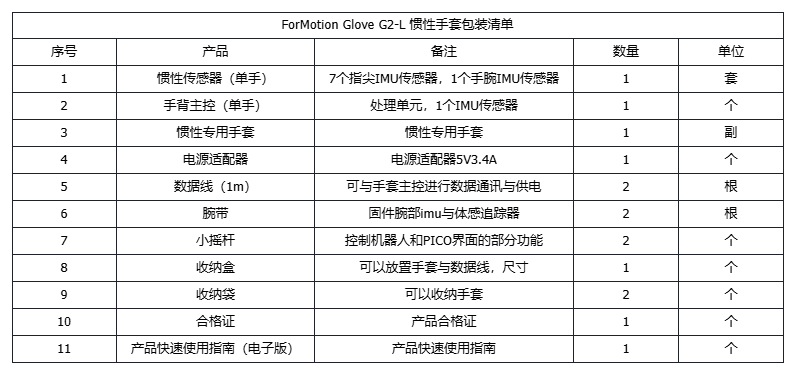
The first image is the hardware list, a specification sheet image from the on-site documentation for G7 or G2-L, proving which version of components the batch uses. The second image is a one-hour arrival rate, proving whether 120 Hz or 50 Hz holds up on this host. The third image is a count of the failure vocabulary, proving that no one kept only the success segments. Three images are more suitable for stage acceptance than a demo video. Video can be used for external communication, but should not be the sole acceptance criterion. TOBI's product page places specifications and boundaries together, in the hope that the customer's acceptance materials will look like the product page: with numbers, and with items that are not included.
Only after the review passes should you discuss whether to scale sample volume from pilot to production line, and whether to include mapping development in the next order. Reverse the sequence, and you will buy large quantities of gloves while the fields are still unstable, ultimately trading storage costs for data value. This pitch aims to lock the sequence down. If the reader agrees with the sequence, they can bring a draft dictionary to schedule an evaluation, rather than bringing only the sentence "we want to build a world model."
Freeze the dictionary before scaling up
As long as a pilot sample can be read by another engineer using the dictionary to identify left/right hand, timestamps, and failure reasons, the dictionary can be frozen. Do not procure a large batch of gloves in parallel before freezing. After freezing, scaling up is simply repeating the same dictionary, and the hour count becomes meaningful. If you scale up before freezing, the new gloves will bring new firmware or fit differences, the dictionary will have to change again, and early data will be discarded. This order is good for finance: the first payment is small, the second payment has acceptance criteria. It is also good for algorithms: the distribution will not be silently swapped mid-collection.
The frozen dictionary should include a link to the spec sheet and a date. For the G7, attach the original source location for 120 Hz and 2 mm, 3 degrees; for the G2-L, attach the original source location for 50 Hz and signal latency. If the spec sheet is updated later, new batches use the new link and old batches keep the old link. Data is thus traceable, and promotional material does not have to pretend parameters never change. This version, dated October 2, 2026, is based on the on-site spec sheet as of that day.
Field completeness comes before hour count
If the weekly report only reports collection hours, management will mistakenly believe that progress equals value. A more useful weekly report is field completeness: the proportion of records where all three items—left hand, right hand, timestamps, and failure reason—are present. When the proportion falls below the pre-defined threshold, stop adding hours and fix the collection procedure first. The nominal frequencies of the G7 and G2-L are only used to check whether the arrival rate is abnormal, not to decorate the weekly report headline. Such a weekly report can be directly attached as an annex to the second procurement order.
If the completion rate meets the target but the total hours are still low, prioritize adding collectors and shifts rather than switching glove models. A model change introduces new field differences and should only occur when the task type changes.
Once the second version of the dictionary is released, the reading program must retain the first version as well. Old batches are not rewritten; new batches are not downgraded. This is the only compatibility method allowed when scaling up.
The second table of the weekly report lists only gaps: whether there is a tactile column this week, whether there is a robot joint column, whether there is a mapping version. A gap existing does not mean the project has failed; a gap being filled into the motion column is the failure. The G7's spatial points and the G2-L's orientation sequence must stay under their own column names. Any script that fills an empty tactile column with estimated values should not enter training. Imputed values may stay in an experimental branch and be indicated in the filename, but must not overwrite the original batch. The read-only property of the original batch protects future papers and deliverables more than ten extra hours of collection.
Continue Reading & Next Steps
- Selection: how G7 and G2-L divide the work
- G7: fingertip spatial position and teleoperation
- G2-L: long-duration wireless hand demonstration
- Data: from glove to trainable samples
- Combination: Glove + E6 / E2 Head-Mounted
- Applications: labs, production lines and research
- Procurement: evaluation form and scope
Back to Product Center View G7 View G2-L G7 specification sheet G2-L specification sheet
This article was written on October 2, 2026, for selection and content acquisition purposes. Device parameters are subject to the on-site specification sheets and product pages and do not constitute a supply commitment. External papers and public reports only illustrate industry context; their success rates and dataset sizes belong to the original authors' experiments, not TOBI's measured results.