
Lead-in.The same pair of gloves has completely different selling points in the lab, on the production line and in research papers. In October 2026, buyers have already split budgets by scenario. Starting from the G7 and G2-L in the TOBI product center, this article writes the three application paths into capture methods that can be project-approved, and indicates which device each path uses and where each boundary lies.
Path 1: Lab teleoperation, G7 preferred
What the lab needs is a test loop that feeds fine human-hand manipulation into a robotic hand. For pointing, pinching, twisting, and placing, decisions occur in the spatial relationships at the fingertips. The G7's magneto-inertial solution provides the spatial position and orientation of the fingertips and the back of the hand, with manufacturer specifications of 2 millimeters and 3 degrees, sampling at 120 Hz, and wired end-to-end latency under 20 milliseconds. The hub aggregates the left and right hands and performs bimanual synchronization. When the workstation is fixed, the cable harness can be routed along the tabletop, and metal interference can be assessed, this is the closer fit in the product center.
This path should not promise three things. First, 2 mm is not the final landing point of the robot fingertip. Mapping, limits, and mechanical backlash are all outside the glove. Second, the magnetic avoidance in the light signals indicates that both hands being too close is one of the normal states; experimental protocols should avoid treating avoidance segments as algorithm negative samples without labeling. Third, there is no tactile sensing. 2026 works like T-Rex put fingertip force and deformation into teleoperation data because contact-rich in-training requires it. If the lab studies slip and pinch force, tactile sensing should be written as Phase 2, rather than letting G7's spatial curves stand in for force.
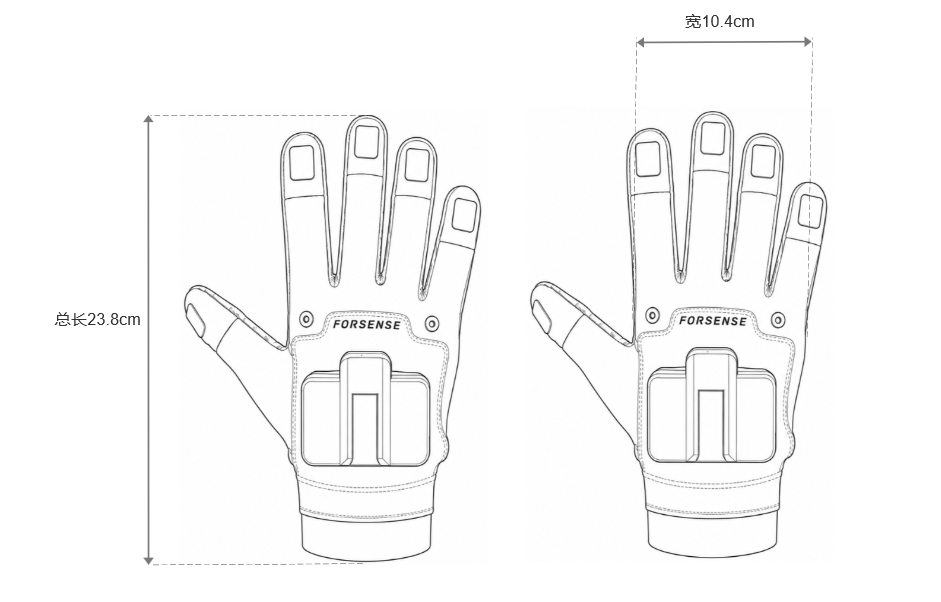
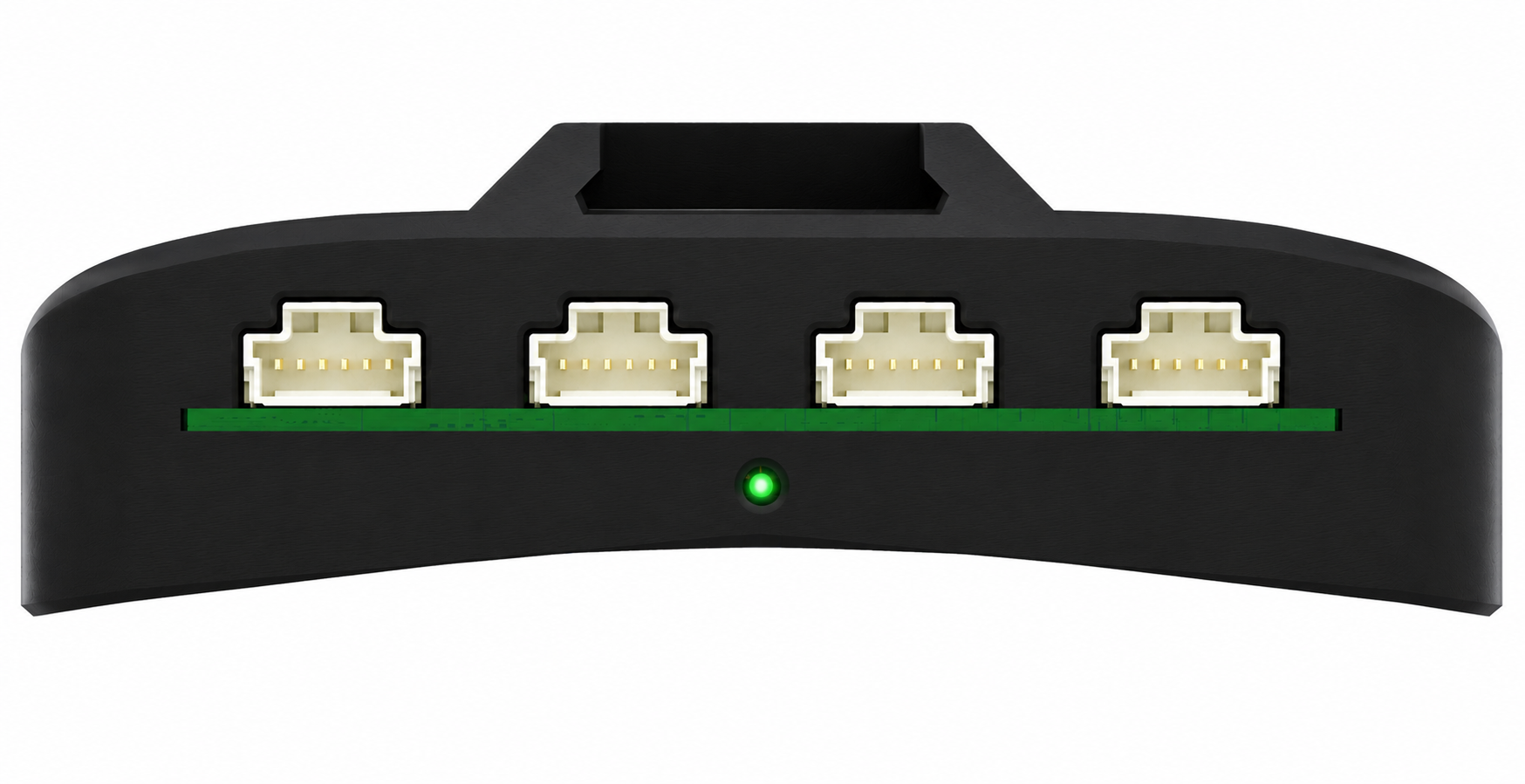
Path 2: Long-duration teaching in production lines and warehouses, G2-L preferred
The constraints of production-line teaching are mobility, multiple rounds and low burden. The G2-L's Bluetooth 5.1, maximum range of 15 meters, 7-hour battery life, 90 ± 5 g and half-finger structure are all written against these constraints. Data transmission is 50 Hz, signal latency ≤20 ms, and sensing is 1 + 8 IMU plus a wrist IMU. It records gestures and postures, suitable for long-term accumulation of picking, pressing, handover and assembly preparation motions, and also suitable as input for digital humans and VR that require finger animation.
The boundaries of the production-line path are equally specific. Inertial pose is not millimeter-level absolute coordinates; if fine hole alignment depends on spatial points, the G7 should be evaluated instead or external measurement added. 15 meters is the maximum distance in the specification; occlusion by shelving and human bodies must be tested in practice. Four-point calibration under 40 seconds and no significant drift over 40 minutes are the manufacturer's experience descriptions; whether recalibration is required at the start of each shift must still be specified. Seven hours cannot be written as calibration-free. Tactile sensing is still absent; a master craftsman's experience of "how much force to apply" does not automatically enter the file. Public discussion of garment processes in September 2026 has already shown that contact and fabric state require both tactile and visual sensing; glove motion is only one layer.
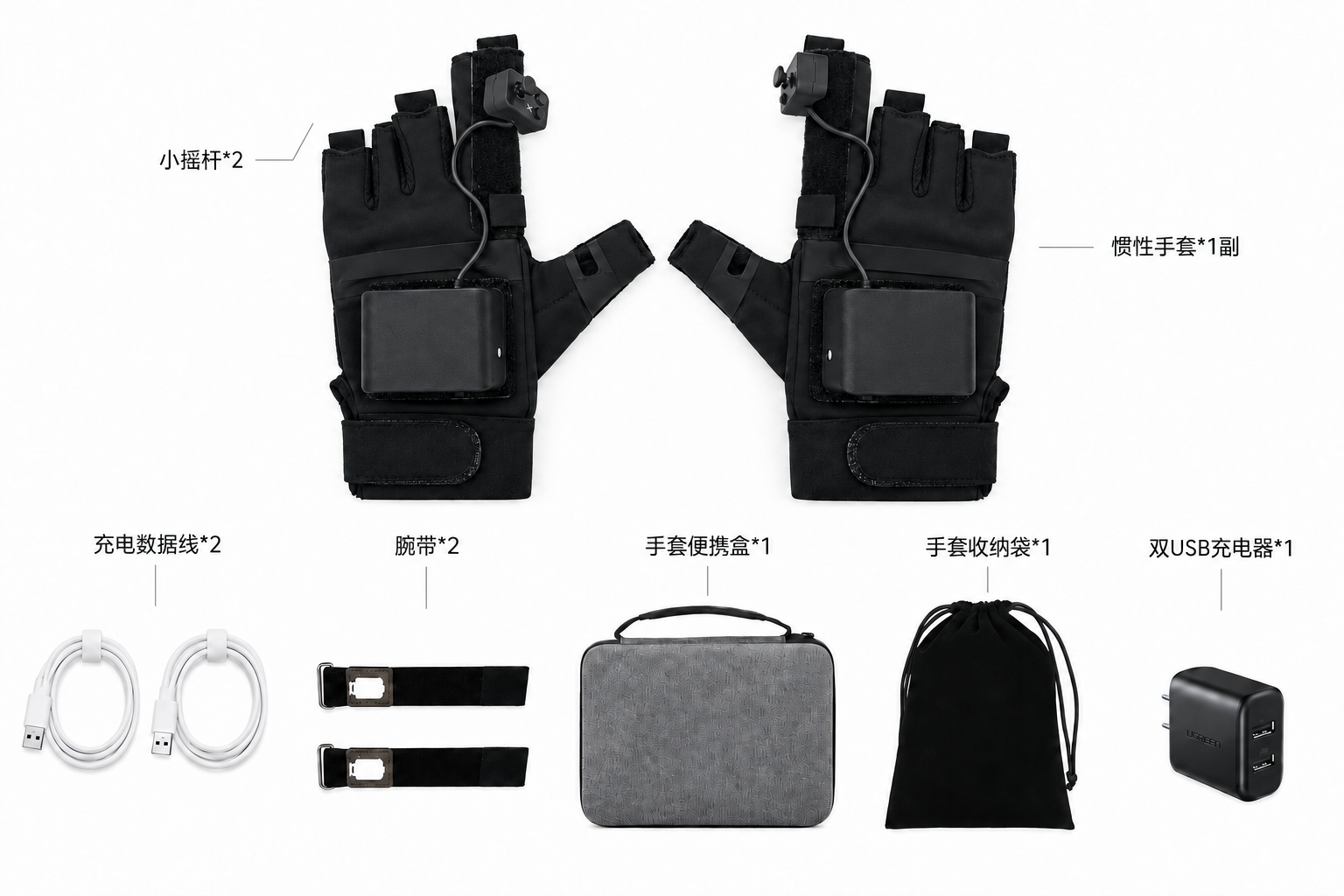
Path 3: research reproduction and benchmark comparison — both options work, but the citation basis must be stated
When universities and labs write papers or proposals, they need citable device descriptions, not poster adjectives. The G7 can be described as: a magnetic-inertial fusion glove manufactured by Forsense, with 5 fingertip EMF+IMU modules, sampling at 120 Hz, position and orientation specifications of 2 mm and 3 degrees, with TOBI providing selection and delivery coordination. The G2-L can be described as: a wireless inertial glove, 1+8+wrist IMU, 50 Hz, Bluetooth 5.1, 7-hour battery life. Do not write it as "internationally leading tactile capture" or "drives a certain dexterous hand out of the box."
When comparing against the 2026 benchmarks, it is recommended to list a separate difference table. TactiDex has full-hand tactile sensing, object six-dimensional pose, and approximately 120 Hz kinematics, while G7 only has a spatial motion layer; the frequency figures are close but the modalities differ. DexViTac has first-person vision and tactile sensing; if TOBI vision is needed, E6 or E2 should be specified rather than attributing it to the glove. RealDexUMI is a isomorphic instruction interface, and G2-L is human-hand inertial capture. T-Rex's 100 hours and 30 Hz package are their teleoperation corpus scale, not a dataset automatically obtained after purchasing G7. Writing the differences into the research proposal will hold up better under peer review than listing all the terms side by side in the acknowledgments.
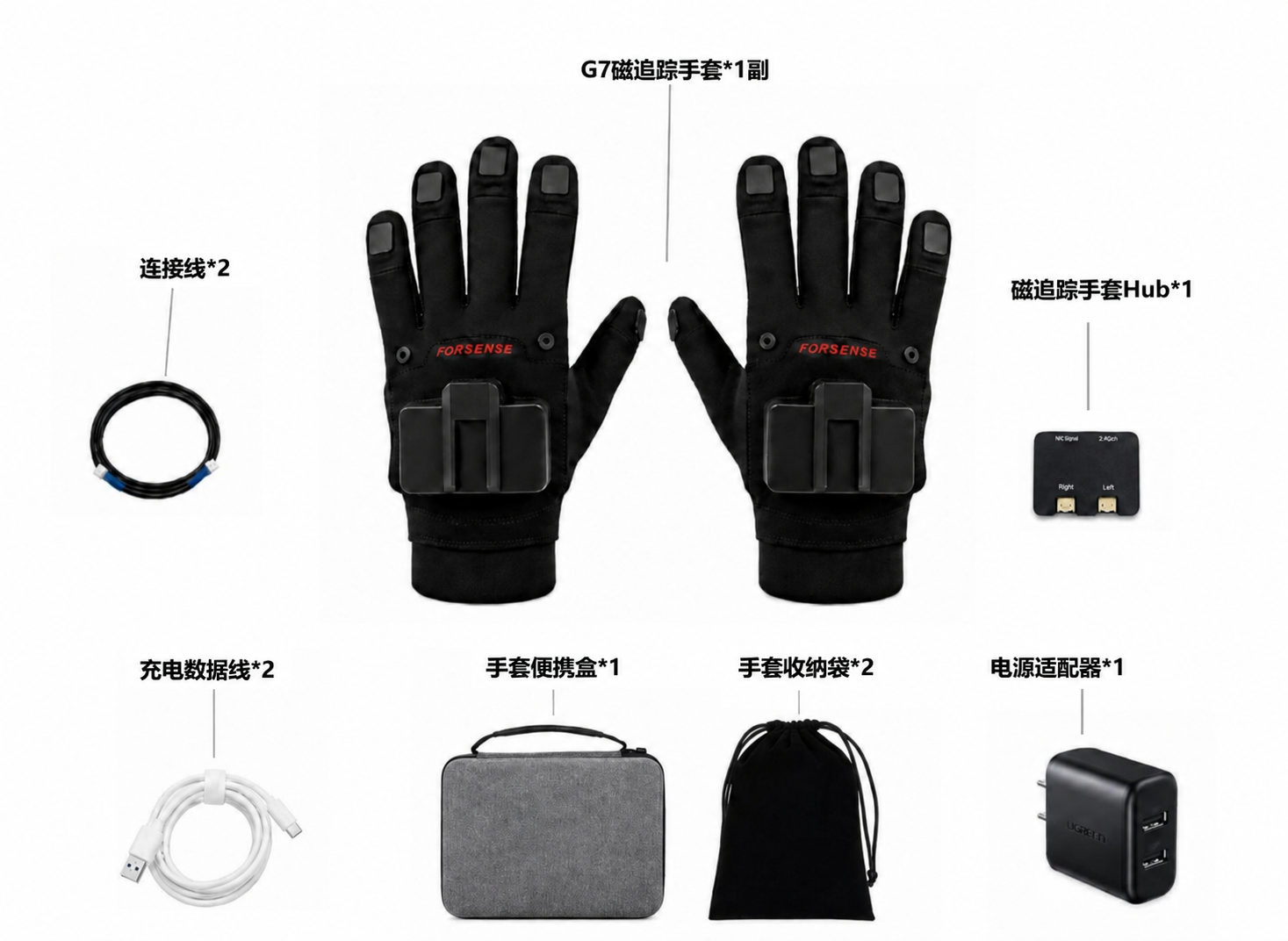
How to find the three paths in the product center
The role of the product center is to separate the three paths before the user clicks in. G7 on the card should be understood as fingertip spatial tracking at a fixed station, and G2-L as wireless long-duration posture tracking. The head-mounted E6 and E2 are the vision layer and do not replace the glove. Readers self-select by task: I need spatial points, open G7; I need mobile recording, open G2-L; I also want to see the scene, add the head-mounted unit; I need force, stop and write the gap into an email. This information architecture converts search traffic into qualified evaluations better than cramming all devices into the six words "embodied AI solution."
Application articles should not replace specification sheets. Whenever each path reaches a number, it should return to G7 specification sheetor G2-L specification sheet. Application articles handle scenarios and boundaries, specification sheets handle tables, product pages handle inquiries. When all three layers are consistent, sales, algorithms and procurement will not each hold a contradictory PDF.
The difference between a factory pilot and a lab pilot
A factory pilot succeeds when: the Bluetooth or wired link is acceptable within one shift, the calibration procedure can be executed by the team leader, data can be archived by workstation ID, and failed motions have not been deleted by the team leader. The device is more often the G2-L; if a workstation involves seated fine assembly, add a separate G7. A lab pilot succeeds when: the coordinate system and mapping version are reproducible, the 2 mm specification has not been miswritten as end-effector accuracy, and latency to the robot is split into the glove link and the full-system loop. The device is more often the G7. Neither pilot should use "we demonstrated it successfully once today" as a basis for procurement.
A successful research pilot differs again: the equipment sentence in the Methods section lets others purchase the same class of observation according to the specification sheet, and the supplementary materials contain the time-alignment method and known gaps. If a paper claims tactile sensing or a policy success rate for a particular hand, those numbers must come from the researchers' own experiments, not from a glove marketing page. TOBI provides equipment and combination evaluation, not success rates published on behalf of clients.
How industry application content serves customer acquisition without exaggeration
Acquisition articles easily drift into an industry panorama, where every section ends up selling everything. A more effective approach is to leave only one primary device per path and give a reason to leave. For readers who are still unsure after reading, ask them to send an email describing a photo of the workstation, left/right hand, whether they move around, and whether they already have a robot model. TOBI replies within one business day with which model to consider, or replies that neither of the current two models covers the need and the gap lies in tactile sensing or in the OEM closed-loop package. Writing "we won't sell" into application copy is a way to improve conversion in product operations, because subsequent calls are no longer wasted on wrong scenarios.
The public landscape as of October 2, 2026 supports this restraint. Tactile gloves, isomorphic teleoperation, head-mounted vision, magnetic-inertial space, and wireless inertial tracking are already distinct papers and distinct product launches. TOBI chose to place the latter two alongside its own head-mounted device in the same product center, and to leave the former two in the boundary notes. An application team procuring according to this map is closer to obtaining trainable data than one procuring by the keyword "dexterous-hand glove."
Scenario sentences you can lift directly when implementing
Lab teleoperation: at a fixed workstation in an evaluable magnetic environment, use G7 to capture fingertip spatial position and orientation, sample at 120 Hz, then perform mapping separately for the target hand. Production-line teaching: use G2-L to record hand orientation within Bluetooth coverage, transmit at a frequency of 50 Hz, plan shifts based on 7 hours of battery life, and specify the calibration strategy separately. Research comparison: cite the original figures from the on-site specification sheet, and state explicitly that there is no tactile sensing and no default robot adaptation. These three sentences can be placed on the front page of the proposal. Readers who want details should go to the corresponding product page, rather than adding unspecced features ad hoc in an application document.
Don't merge the budget categories of the three paths
In a lab teleoperation budget, the G7's standard configuration, the possible wireless option, mapping development, and robot time are four line items. In a production-line teaching budget, the quantity of G2-L units, spare sizes, charging stations, the Bluetooth pilot, and shift training are five line items. In a research-comparison budget, the equipment, specification-sheet archiving, small-sample annotation, and review of the paper's Methods section are four line items. Collapsing them into a single "glove project" line item will cause finance to freeze it midway, because each line item has a different acceptance deliverable. Separating the paths in the content is precisely so that an internal project proposal can copy the line items directly, rather than holding another meeting to reinvent the structure.
Only after the categories are separated can sharing be discussed. What is shared is the evaluation methodology and the product center's entry point, not the same set of accuracy metrics. The lab can borrow the production line's failure vocabulary, and the production line can borrow the lab's reminder that "2 millimeters is not end-effector accuracy", even if the production line's main equipment is the G2-L and does not use 2 millimeters at all. Research can cite the negative sentences from both paths to explain in related work that it did not measure contact force. Share sentences, not sensors that do not exist.
Scenario stories should stop at filmable actions
If an external case study is to be written, write filmable actions: sitting at a workstation touching fingers together, walking along shelving pressing buttons, replaying a trajectory at a lab bench for visitors to see. Do not write things that have not happened, such as "already in mass production at a certain automotive plant" or "policy success rate reaching the level of a certain paper." In October 2026, readers are highly immune to such sentences. Filmable actions plus a link to the specification sheet build more trust than unverifiable case studies. If a client agrees to joint authorship, the case study must still retain the boundary sentence; otherwise the case study will in turn contaminate the product page.
Without client authorization, application content stays at the path rather than the story. This is not insufficient content; it is compliance. The collector's hands, the factory's parts, and the lab's robots may all involve likeness and confidentiality concerns. Product promotion uses specifications and protocols to generate leads, and obtains authorization through an evaluation email before discussing case studies. This order protects both the brand and the client. TOBI's customer acquisition design is therefore: articles are public, data is not public, and evaluation sits in between.
How to choose the primary narrative when crossing paths with the head-mounted route
Some clients arrive from E6 or E2, find that the hand cannot see details clearly, and then add a glove. Some clients arrive from the glove, find they do not know what object the hand is interacting with, and then add a head-mounted device. The main narrative should be based on the problem that came first. If the vision gap came first, the solution title should say head-mounted, with the glove as supplementary observation. If the hand gap came first, the solution title should say G7 or G2-L, with the head-mounted device as the scenario layer. If the title is chosen wrong, the client will think they are being pitched a different product line. The product center places them side by side so that both entry points exist, not so that every article promotes all models equally.
Cross-solution pilots are still recorded with six numbers, of which frame rate and glove cadence must be listed separately. The application article does not repeat the full protocol of the joint-capture article; it only reminds readers to read that one. The division of labor among the series is part of the acquisition structure: selection articles route traffic, equipment articles build specification trust, data articles build delivery trust, joint articles establish boundaries, application articles establish scenarios, and procurement articles establish contract language. Readers do not need to read them all in order, but sales should send the one matching the reader's question by email, rather than attaching seven links at once so the recipient does not know where to start.
Path Selection Card for Solution Managers
When you see "lab, needs to pinch small parts, fixed table," choose G7 and ask about magnetic environments and whether a target hand already exists. When you see "warehouse, needs to walk, needs to record all day," choose G2-L and ask about occlusion and shift length. When you see "needs to write a paper, needs to be citable," either model works, but require the client to accept the original wording. When you see "needs slip detection, needs pinch force," do not select these two models as the primary equipment. When you see "trade show next week, needs the robot to follow movement," split the demonstration and the data capture into two separate orders. This selection card can be printed on the first page of the sales manual; it reduces mismatches more effectively than five adjectives on a product brochure. When mismatches decrease, evaluation conversion rises.
The back of the selection card carries only two links: the product center and the on-site specification sheet. No third-party documentation sites on the back. The site strategy for October 2026 is business independence; sales tools should be consistent with the website. The address a customer scans at a meeting should still resolve to the same set of digits when opened afterward. If an outdated promotional PDF is placed on the back, the selection card has failed.
Application paths and equipment paths keep the same names
In external materials, the lab path is called the G7 path, the production-line path is called the G2-L path, and the research path is called a caliber reference. Do not invent names like "flagship edition" or "youth edition" that cannot be found in the spec sheet. The benefit of consistent naming is that the customer walks from the article to the product center to the quote and arrives at the same line. The cost of inconsistent naming is having to re-explain it every time a different department is involved. In 2026, product operations treat naming as part of conversion, not as free rein for copywriting.
Sharing a name does not mean the two models are interchangeable. Once a path name carries a model number, any substitution must go through a change-selection process, rather than deleting the model number from the sentence and continuing to use the original promise. This prevents application stories from losing the equipment boundary as they spread.
The path selection card is reviewed once per quarter, checking only whether the specification sheet has been updated, and does not revise its own accuracy statements based on competitor posters. The review date is printed in the card's footer, keeping it traceable alongside the article's October 2, 2026 date.
If the specification sheet updates the sampling rate or latency wording, the application article and the quotation exclusions are revised on the same day, so that sales are not still forwarding old sentences from old links.
When sales forwards an article, forward only the one that matches the customer's own words. If the customer mentions lab and pinching, forward the G7 device article — not all seven into the email. If the customer mentions warehouse walking, forward the G2-L article. If the customer mentions pairing with a head-mounted device, forward the joint protocol article. If the customer mentions placing an order, forward the procurement article. One email at a time, one article per email, so that the reply still carries a task sentence. When seven links appear at once, the recipient usually just replies "received," and evaluation cannot begin. The operational metric for product content can therefore be defined as: whether the sent email contains only one primary link, and whether the reply mentions the G7 or G2-L model number.
The subject line of the forwarded email should also contain only one model name, such as "G7 fixed station" or "G2-L mobile teaching", to make it easy for the recipient to search for replies and for internal tracking of which pipeline is generating evaluations.
Do not include two model numbers in the same subject line.
Continue Reading & Next Steps
- Selection: how G7 and G2-L divide the work
- G7: fingertip spatial position and teleoperation
- G2-L: long-duration wireless hand demonstration
- Data: from glove to trainable samples
- Combination: Glove + E6 / E2 Head-Mounted
- Applications: labs, production lines and research
- Procurement: evaluation form and scope
Back to Product Center View G7 View G2-L G7 specification sheet G2-L specification sheet
This article was written on October 2, 2026, for selection and content acquisition purposes. Device parameters are subject to the on-site specification sheets and product pages and do not constitute a supply commitment. External papers and public reports only illustrate industry context; their success rates and dataset sizes belong to the original authors' experiments, not TOBI's measured results.