
Lead-in.The biggest concern with long-duration hand demonstration is not insufficient single-shot accuracy, but wanting to take off the glove after twenty minutes, losing connection when moving to the next table, and a calibration process longer than the task itself. The ForMotion Glove G2-L, available in the TOBI product center, is a wireless inertial glove designed around this constraint: half-finger, lightweight, Bluetooth, with battery life written per the specification as 7 hours. It does not claim millimeter-level absolute positioning, nor does it count tactile sensing as a default capability.
The device in the specification sheet is not "a lightweight G7"
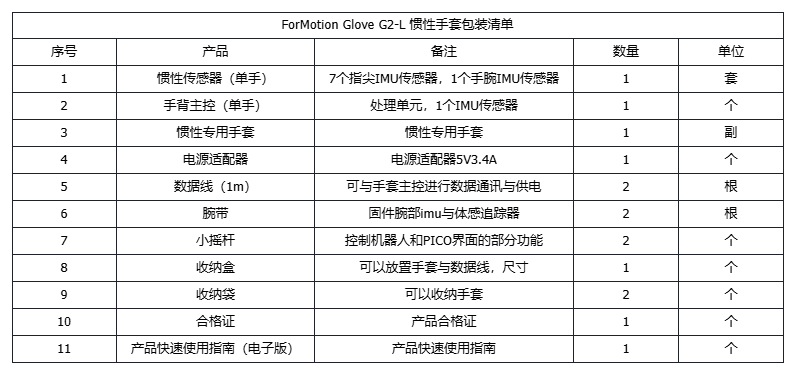
The G2-L's sensing architecture is 1 + 8 IMU + wrist IMU; the finger sensor is a 6DOF inertial sensor, gyroscope range ±4000 dps, accelerometer range ±8 g. The signal latency definition is ≤20 ms, and the data transmission rate is 50 Hz. These two statements and the G7's "end-to-end, 120 Hz" cannot be placed in the same column to compare which is more advanced. One is the transmission cadence and signal latency of inertial data; the other is the sampling and end-to-end latency of magneto-inertial fusion. The product center separates them into two cards precisely to prevent this kind of erroneous comparison.
Power and communication are both specified for walking use. Battery life is 7 hours, charging time is 3.5 hours, charging interface is USB-C. Wireless communication is Bluetooth 5.1, up to 15 m. A single glove weighs 90 ± 5 g. Fabric sizes M, L, XL. The SDK lists C++ and Python. The specification sheet also describes the user experience: 40 minutes of continuous use with no noticeable drift; calibration completed in only four motions, taking less than 40 seconds in total. These two statements are manufacturer claims; before writing them into acceptance criteria, they should be spot-tested at the target site. The 7-hour battery life in particular must not be translated as "7 continuous hours without recalibration." The product page already includes this reminder as an evaluation caveat.
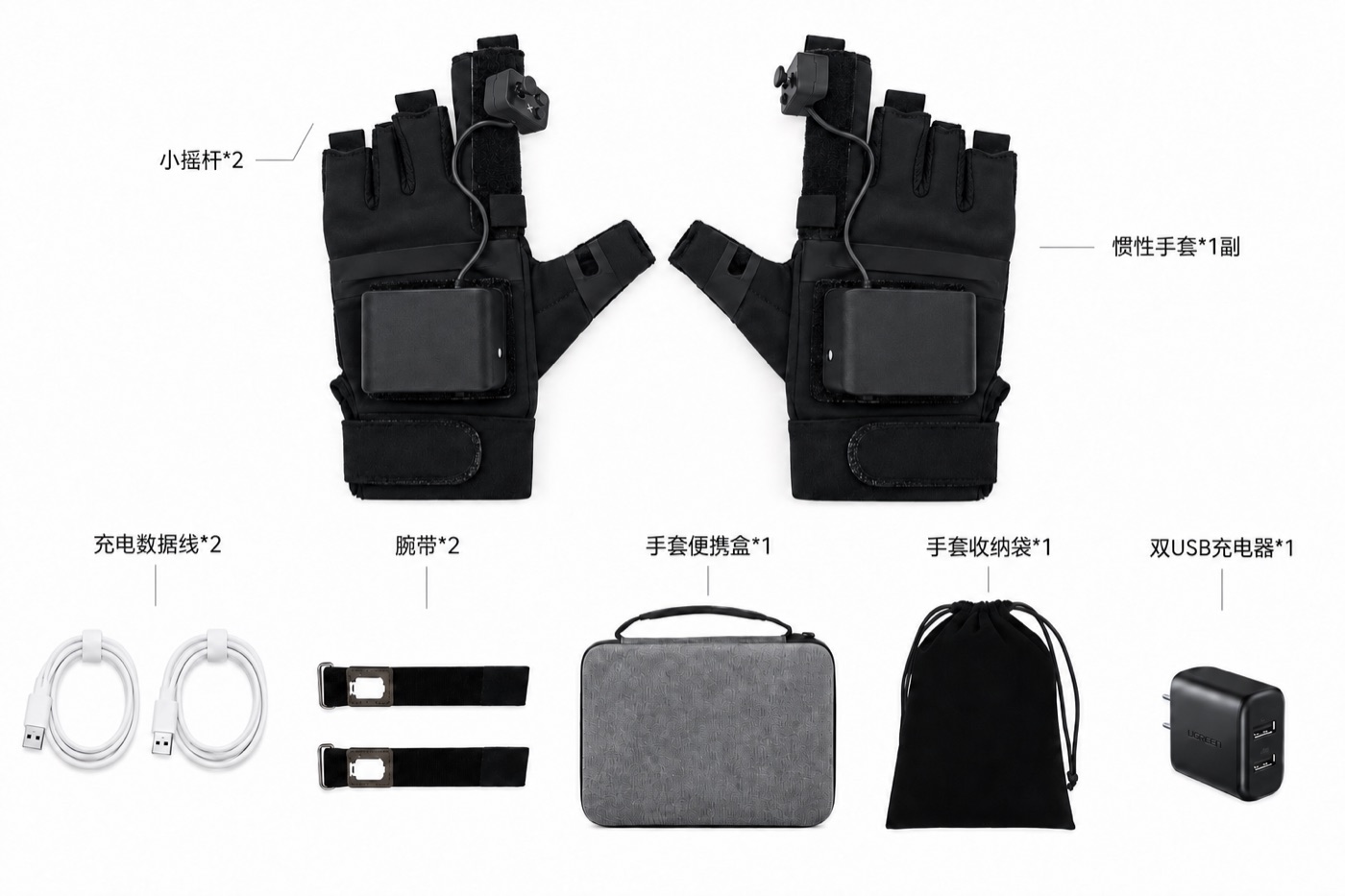
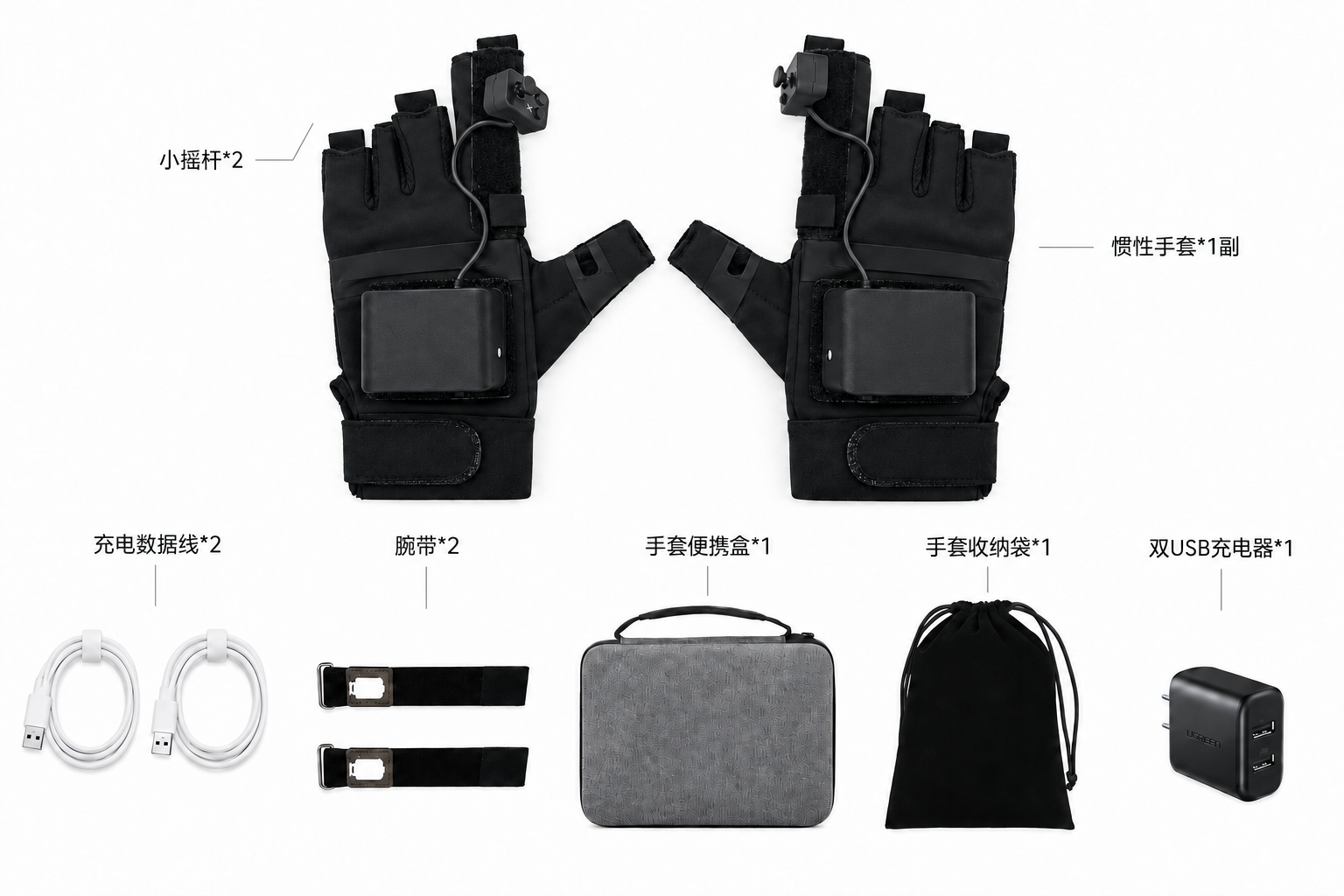
Half-finger design and light weight are methodological questions for data acquisition
If the device changes the gesture in demonstration data, the model learns "how to work while wearing thick gloves" rather than the master's original technique. The specification sheet lists the half-finger design and skin-friendly fabric as product advantages: close fit to the skin, improved consistency between sensors and motion, while retaining wearing comfort. The weight of 90 ± 5 grams should be recorded separately from G7's 115 grams ± 5 grams. Lightness serves multi-round, mobile, and long-duration recording; it does not automatically confer absolute spatial accuracy.
DexViTac's 2026 work emphasizes that the capture system must not impede natural movement, and brings egocentric capture, tactile sensing and kinematics together into kitchens, retail and offices. That system includes high-density tactile sensing; its success rate and dataset size are claims of the paper itself. What G2-L can align with is "wearable and free of an optical capture volume." Inertial solutions are not confined to an optical capture volume, an advantage acknowledged in both the spec sheet and the product page. Bluetooth range, occlusion and body occlusion still affect stability; in outdoor or large-workshop settings, link measurements must be performed on site, and "up to 15 meters" cannot substitute for an on-site heat map.
It suits digital humans and VR, and also robot teaching, but its output is not an action
The spec sheet's introduction lists the scenarios as robot teleoperation, VR interaction and digital-human driving. The full-body linkage section states that it can be paired with a motion-capture suit to capture body and hand data, and can also be combined with PICO, trackers and IK solutions to cover head and neck, torso, limbs and fingers. These are combination possibilities, not a motion-capture suit or headset delivered by TOBI in the box. The product page accurately lists the motion-capture suit, VR and external tracking as peripherals evaluated separately.
For hand teaching data, G2-L provides gestures, knuckle changes and hand pose. To turn this into robot motion, the target hand's degrees of freedom, joint order, limits and protocol still need to be confirmed. RealDexUMI avoids part of the remapping by using an isomorphic glove, which is a different product form factor. G2-L is human-hand inertial capture. The same trajectory can drive a digital-human skeleton or serve as part of teaching data, but it does not automatically equal joint commands for any particular dexterous hand. If a VLA or imitation-learning team treats the glove output directly as action labels, they will have to redo work when it does not match the robot's state. A correct data package contains at least hand pose, timestamps, task phase, and success or failure. Vision and robot state, if needed, come from E6, E2 or robot-side logs, not conjured up by the glove alone.
How 50 Hz is written in the 2026 data protocol
Many of T-Rex's modalities are aligned with 30 Hz, TactiDex's kinematics mention approximately 120 Hz, G7's sensor sampling is 120 Hz, and G2-L's data transmission frequency is 50 Hz. The protocol should state "G2-L transmission frequency 50 Hz", not "high-frame-rate hand ground truth 120 Hz". When resampling to the camera frame rate, the original cadence and processing records must be preserved. The signal latency ≤20 ms must likewise retain the term "signal latency" to avoid conflating it with G7's end-to-end latency or the robot's full-loop latency.
The SDK supports C++ and Python; details are subject to the current SDK documentation. In the documentation center, the G2-L help page preserves the reading order: first consult this site's spec sheet to confirm composition and core parameters, then review coordinate systems, software usage, data formats and the SDK. If the project needs the coordinate system and software workflow, request the version number separately during evaluation. Do not interpret "has an SDK" as "the sample projects already include your robot brand."
Recommended phrasing when appearing in a solution alongside G7
If a production line has both fine fingertip alignment at fixed stations and long-duration recording while moving along a line, both models can be evaluated, but they should be split into two capture protocols. For fixed stations where fingertip spatial points matter and the Hub and magnetic environment can be handled, use G7, sampling at 120 Hz, with a position spec of 2 mm and attitude of 3 degrees. For walking, where battery life and wearability matter and inertial attitude is acceptable, use G2-L, 50 Hz, Bluetooth 5.1, 7-hour battery life, 90 ± 5 g. The two datasets should not be merged directly into a single training set without documenting resampling. Close-proximity two-handed use and metal environments affect G7 more; Bluetooth occlusion affects G2-L more. An evaluation table with two columns looks more like 2026 procurement than writing "several gloves."
Calibration must also be listed separately. The four-point calibration of the G2-L takes less than 40 seconds, which is the manufacturer's description of the onboarding threshold. The G7 has its own indicator light sequence for initialization and does not share these four actions. Using the wrong calibration procedure when training collectors will produce an entire segment of data that appears continuous but has an incorrect coordinate frame. Writing this clearly on the content page is intended to reduce support costs during the first week after delivery and to let the buyer's operations manager know in advance what training is required before procurement.
What kind of customer should stay on this page
Customers who stay typically can already describe their task: walking between a warehouse or multiple stations to record hand pose during picking, pressing buttons and handing over parts; or providing sensor input for finger animation for digital humans and VR interaction; or accumulating teaching data with lower wear burden in the early stages of a robot project while accepting subsequent remapping. They can accept that the spec sheet has no tactile sensing. They are willing to write Bluetooth coverage and calibration retesting into the pilot, rather than demanding out-of-the-box support for a particular dexterous hand.
Customers who should leave are equally clear: those who need millimeter-level spatial coordinates at the fingertips should look at G7; those who need pressure distribution, slip or force feedback should establish tactile sensing as a separate project; those who need the kind of isomorphic teleoperation closed loop from the paper should not treat G2-L's SDK as that closed loop. TOBI provides an evaluation entry point on the product page, with a target of responding with a framework within one business day. Include left/right hand, size, whether the site has occlusion, whether it is connected to a headset, and the target robot or digital-human software in the email, and the reply can be quoted by configuration rather than by adjectives.
The manufacturer is Forsense. TOBI provides selection, combined evaluation with E6 / E2, and delivery coordination. Full specifications are at On-site G2-L specification sheet, and the product narrative is at G2-L product page. The figures in both are consistent; the promotional copy does not invent a third set of parameters.
Pilot week recommendations
Day one is only about wearing and Bluetooth: three collectors with different hand lengths each wear the gloves for thirty minutes, recording disconnections, occlusion and charging. Day two tests the repeatability of four-point calibration, checking whether under 40 seconds holds at this site, and recording how often recalibration is needed. Day three aligns the 50 Hz data with a segment of headset or scene video using manual markers, confirming that the fields are sufficient for the algorithm team to understand. Day four then discusses whether to map to a robot. Using four days to reject a wrong project is more valuable than using four days to demonstrate an unreproducible success video. This is also the action product content should guide: first verify constraints, then scale the order.
How to calculate shifts, charging and headcount together
Production lines often write G2-L as "one pair per person, all day long," which usually falls apart by the third day. The spec sheet states 7 hours of runtime and 3.5 hours of charging. If a shift is 8 hours plus handover, one glove's battery cannot cover the "put it on and never take it off" expectation. Scheduling should be written as: collection window under 7 hours, or prepare replacement gloves and charging stations. When replacing, the left and right hands and sizes must match, otherwise wearing errors between samples before and after will be mistaken for motion differences. Charging cables are part of the checklist; the pilot checklist should specify quantities clearly to avoid five people sharing one cable while reporting insufficient runtime in daily reports.
Headcount also affects Bluetooth. A maximum of 15 meters is a range specification, not a concurrency specification for "fifteen people online at once." When multiple gloves are active at the same station, the pilot should count the packets actually reaching the host rather than using the spec sheet's distance as a substitute for over-the-air quality. If concurrency exceeds the on-site receiver or host software's capability, that is a system integration issue and must be written into the evaluation separately; it cannot be written back as false claims about glove battery life or sampling rate. The 50 Hz transmission rate remains each glove's own cadence when multiple users are present; when merging storage, use device IDs rather than flattening everything with a single shared clock.
In digital human and VR projects, the glove stops at skeletal input
Digital-human teams often understand the glove as a plugin for animation software. G2-L's SDK is C++ and Python; the spec sheet does not list a store plugin for any particular DCC software or headset as a deliverable. PICO, trackers and motion-capture suits are composable directions in the spec sheet, and the product page lists them as peripherals evaluated separately. Therefore, the solution homepage can say "hand pose can enter the digital-human pipeline," but cannot say "supports out-of-the-box driving of a certain engine version." The intermediate coordinate conversion, skeleton naming and dropped-frame interpolation belong to the project. If the under-40-second four-point calibration is used in live broadcasts or performances, it must also be specified who has the authority to recalibrate on camera; otherwise performers will skip calibration and the data cannot be aligned after the performance.
VR interaction likewise requires distinguishing observation from command. The operator's finger pose can drive a virtual hand or be recorded as research data. The former cares about perceived latency; the spec sheet gives a signal latency of ≤20 ms, while perceived latency also includes rendering and the headset. The latter cares about repeatability; the spec sheet gives 50 Hz and a 40-minute drift description. Both goals can coexist, but the acceptance table must be split into two rows. Substituting the subjective smoothness of an interaction demo for dropped-frame statistics of the dataset is the most common acceptance mismatch in this kind of project.
When connecting to robot teaching, deliver pose first, then discuss skills
In a factory, saying "teach the robot to grab parts" sounds like a single procurement item, but broken down it is five things: pose capture, vision, contact, mapping, and safety. G2-L only reliably covers the hand-pose portion of the first item, and it is pose in the inertial sense, not absolute points in the workbench coordinate frame. If part positioning is already guaranteed by fixtures, the pose sequence may be sufficient; if the part position changes every time, vision or external measurement is still needed — that belongs to the E2, E6, or other sensor rows, not to strengthening the accuracy adjectives of G2-L. Whether a skill is learned depends on the failure ratio in the pilot data and the mapping version, not on whether the glove weighs 90 grams.
It is recommended to add a stop condition to the procurement appendix: if any one of the Bluetooth heat map, calibration count or field completeness rate fails to meet the threshold specified by both parties within three days of the pilot, it does not automatically proceed to volume production. This stop condition protects both parties. It also allows sales to raise it proactively during customer acquisition rather than waiting until the customer is disappointed. In October 2026, buyers have seen too many "deploy the equipment first, fill in the data definition later" projects; suppliers who proactively write stop conditions are more likely to make the shortlist.
When training collectors, teach only four things
The first is sizing. If hand length and palm circumference do not match, do not start recording. The second is four-point calibration, and record the start time so you can judge whether the 40-minute drift description still applies within this session. The third is to record failures to completion and verbally mark the reason, such as occlusion, reconnection, or a missed grasp. The fourth is to remove the glove to charge, not treating 7 hours as a personal-heroism wearing contest. All four can be covered on the day of delivery. Mapping and robot safety that cannot be covered should not be crammed into collector training; otherwise the site will use the wrong level to explain every data anomaly.
The supervisor's checklist is equally short: today's firmware or software version, today's calibration count, today's disconnection count, today's effective minutes. If these four items are stable over four weeks of data, then discuss expanding to the next process step. The content page writes training as four things so that the customer's shift leader feels the project is executable. Only executable projects move from an article to an evaluation email, rather than staying in a bookmark folder.
Turn interest into an email that can be replied to
Four lines in the email are enough: whether the task is walk-around teaching, digital human, or VR; left/right hand and approximate hand length; whether the site has shelf occlusion; and whether E6 or E2 needs to be worn simultaneously. Do not write "please send the highest-precision solution." TOBI will reply in four lines whether G2-L is suitable, and which of 50 Hz, Bluetooth 5.1, 7 hours, and 90 ± 5 grams will become part of this acceptance sentence. If suitable, it enters the pilot calendar; if not, switch to G7 or point out the haptics gap. A short email gets a framework reply within one business day more reliably than a long specification document.
If the site is not yet determined, first agree on an indoor unobstructed control, then agree on the real shelving. Keep both segments, to avoid committing to the workshop based only on Bluetooth results from a conference room. The control experiment does not need new hardware specifications; it only needs to write 15 meters as "data is still received under what kind of occlusion." This is the cheapest risk reduction in G2-L procurement.
Finally, limit the acceptance statement to four items: the 50 Hz transmission rate, the original wording of signal latency, on-site spot-checking of Bluetooth 5.1 and the maximum 15 meters, and the fact that 7-hour battery life does not mean no calibration is needed. Only when all four are written into the pilot minutes is this long article actually used rather than bookmarked.
One more note for the pilot minutes: whether calibration is redone at the start of every shift is determined on site and is not automatically derived from the 7-hour battery life.
Continue Reading & Next Steps
- Selection: how G7 and G2-L divide the work
- G7: fingertip spatial position and teleoperation
- G2-L: long-duration wireless hand demonstration
- Data: from glove to trainable samples
- Combination: Glove + E6 / E2 Head-Mounted
- Applications: labs, production lines and research
- Procurement: evaluation form and scope
Back to Product Center View G7 View G2-L G7 specification sheet G2-L specification sheet
This article was written on October 2, 2026, for selection and content acquisition purposes. Device parameters are subject to the on-site specification sheets and product pages and do not constitute a supply commitment. External papers and public reports only illustrate industry context; their success rates and dataset sizes belong to the original authors' experiments, not TOBI's measured results.