
Lead-in.Once hand trajectories leave the scene view, it becomes very difficult to answer "what was the person doing to what object at that time." TOBI's E6 and E2 handle head-mounted vision, while G7 and G2-L handle the hands. The four devices can appear in the same solution, but they are not a hardware bus aligned out of the factory. This article presents joint capture as a protocol, not as a completed integrated system.
Head-mounted device and glove each answer one question
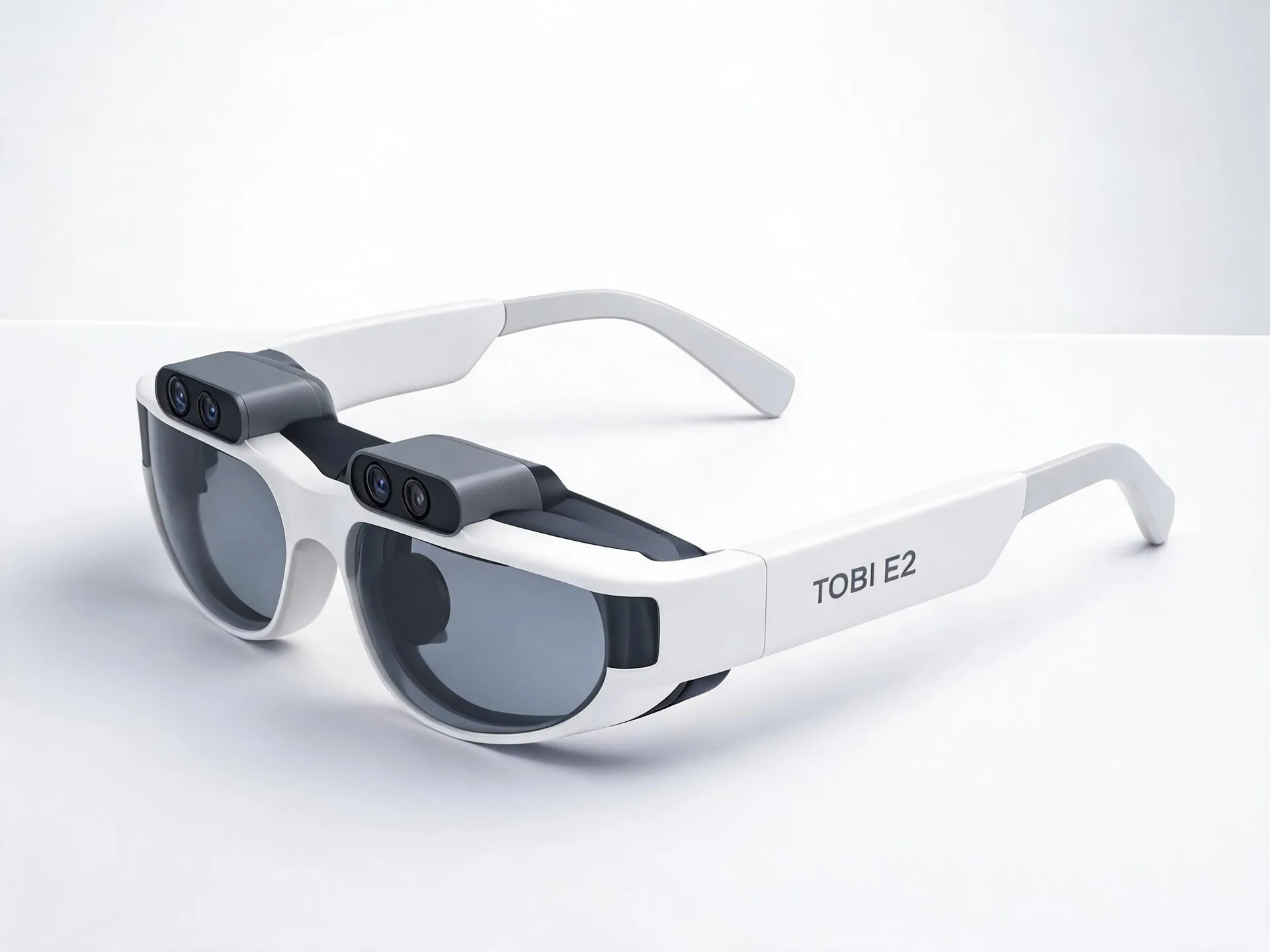
E2 is a lightweight binocular Ego capture device. Per the current product specification: two RGB global-shutter channels, 1600×1200, 30 fps, per-camera horizontal FOV 139° and vertical FOV 111°, baseline 65 mm, IMU sampling 800 Hz, built-in battery 1600 mAh, runtime over 5 hours, weight under 150 g, no on-device SLAM. Video, IMU, per-channel timestamps, and intrinsics/extrinsics can all be exported; the customer performs downstream reconstruction on a computer. It is suited to long-duration, motion-critical, open-output wearable capture.
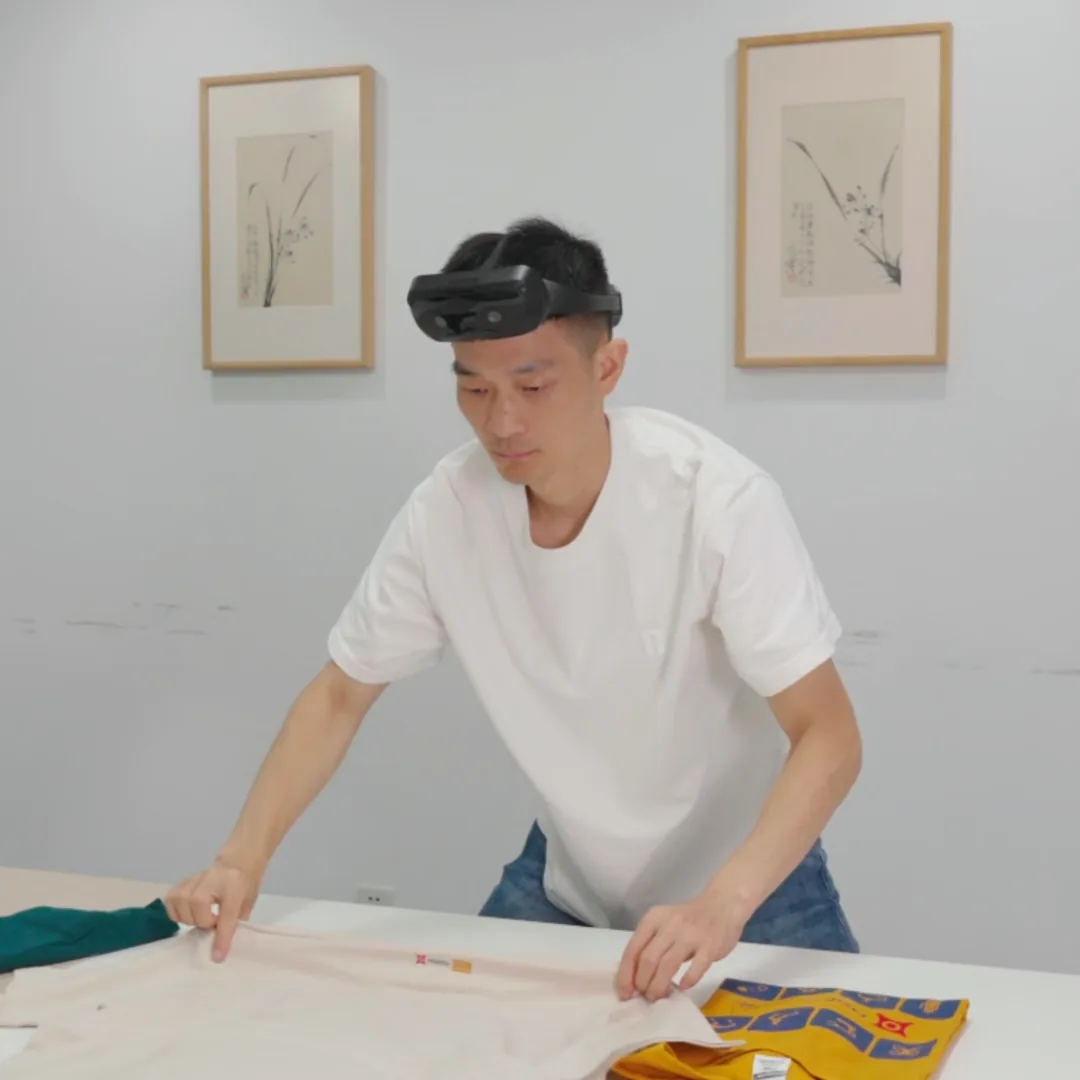
E6 is a six-channel capture headband: 4 grayscale global-shutter channels and 2 RGB channels, on-device SLAM, multi-camera synchronization down to the microsecond level, aimed at tasks that need trajectories and gesture preprocessing on site. Weight is approximately 370 grams. E6's microsecond-level synchronization is synchronization between cameras, not synchronization between cameras and gloves. This sentence must occupy its own line in the joint solution.
Why pressing start at the same time is not enough
G7's two-hand synchronization happens at the Hub. G2-L's data goes over Bluetooth 5.1. E2's video and IMU are local to the headband. E6's multiple cameras are aligned inside the headband. The four clock sources are different. An operator hearing a verbal cue and starting together only gets manual markers roughly within the same second; it does not give fingertip positions and image pixels a shared hardware timestamp. The product page has stated: simultaneous startup is not time alignment. The acceptance item for a joint project should be residual error — for example, spot-checking 100 motion starts and measuring how many milliseconds apart the contact moment in the image and the inflection point in the glove curve are, and how out-of-tolerance samples are excluded.
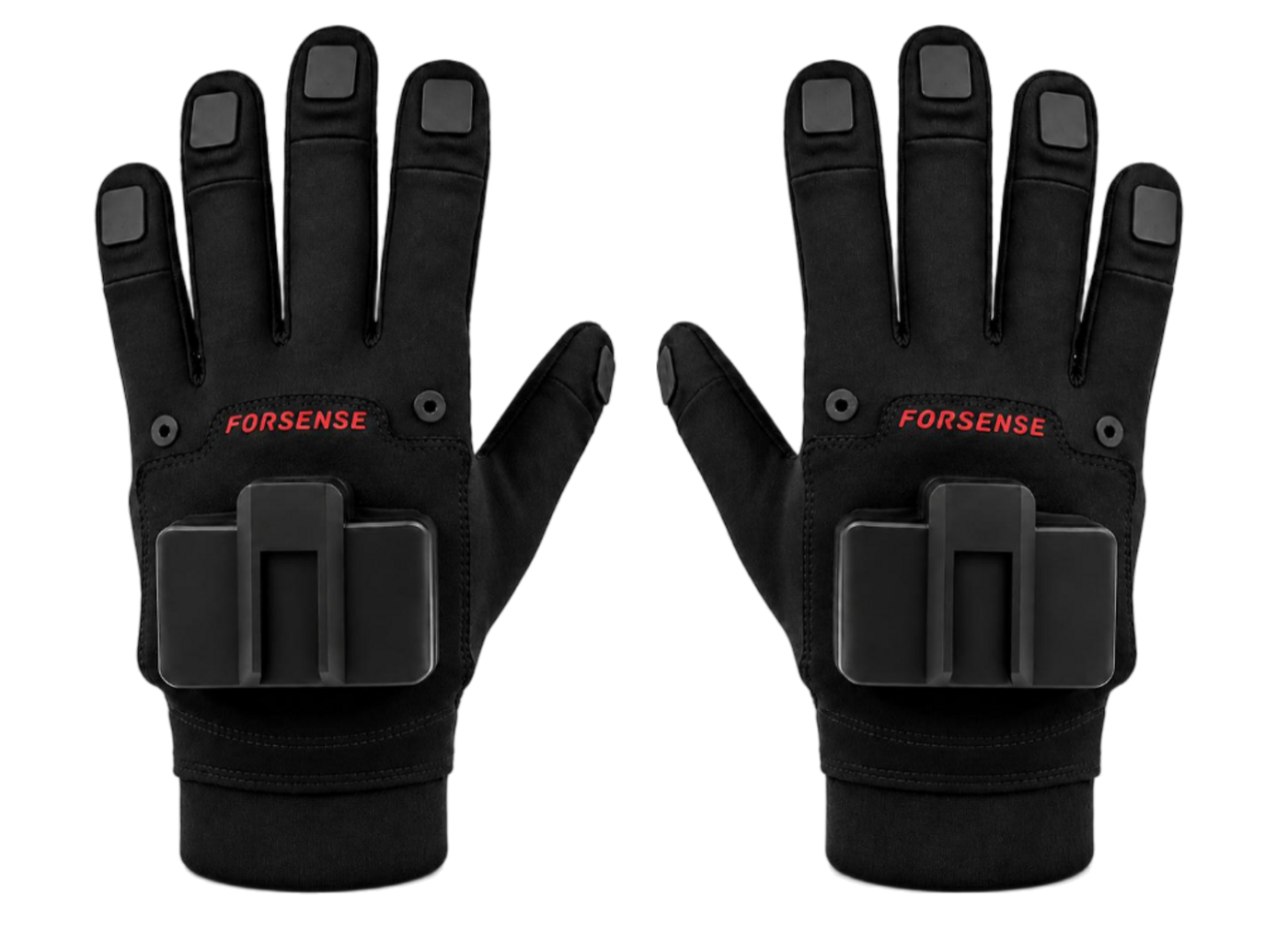
G7 wired end-to-end under 20 milliseconds and wireless under 30 milliseconds describe the glove link. E2's camera runs at 30 fps. One camera frame is approximately 33 milliseconds; the glove latency specification and the frame period are not the same physical quantity and cannot be subtracted to declare "sync error under 20 milliseconds." G2-L's signal latency ≤20 ms and 50 Hz transmission likewise cannot be directly subtracted from the camera frame. The protocol must state the subject of every number in full for the review to pass.
Four common combinations, and what each does not promise
| Combination | Suitable problem | Additional confirmation required |
|---|---|---|
| E2 + G7 | Lightweight head-mounted depends on the scene, magnetic-inertial gloves provide fingertip spatial points | E2 has no on-board SLAM; G7's 2 mm is not camera depth error; the two clocks are separate |
| E2 + G2-L | Long-duration walking, head-mounted video with inertial gestures | 50 Hz and 30-frame resampling records; Bluetooth occlusion; no claim of absolute position |
| E6 + G7 | On-site head-mounted trajectory needed, plus fingertip spatial data | E6 camera synchronization is not glove synchronization; magnetic environment and Hub wiring |
| E6 + G2-L | On-site trajectory plus wireless hand pose | Start marker still required; G2-L does not provide G7's spatial specifications |
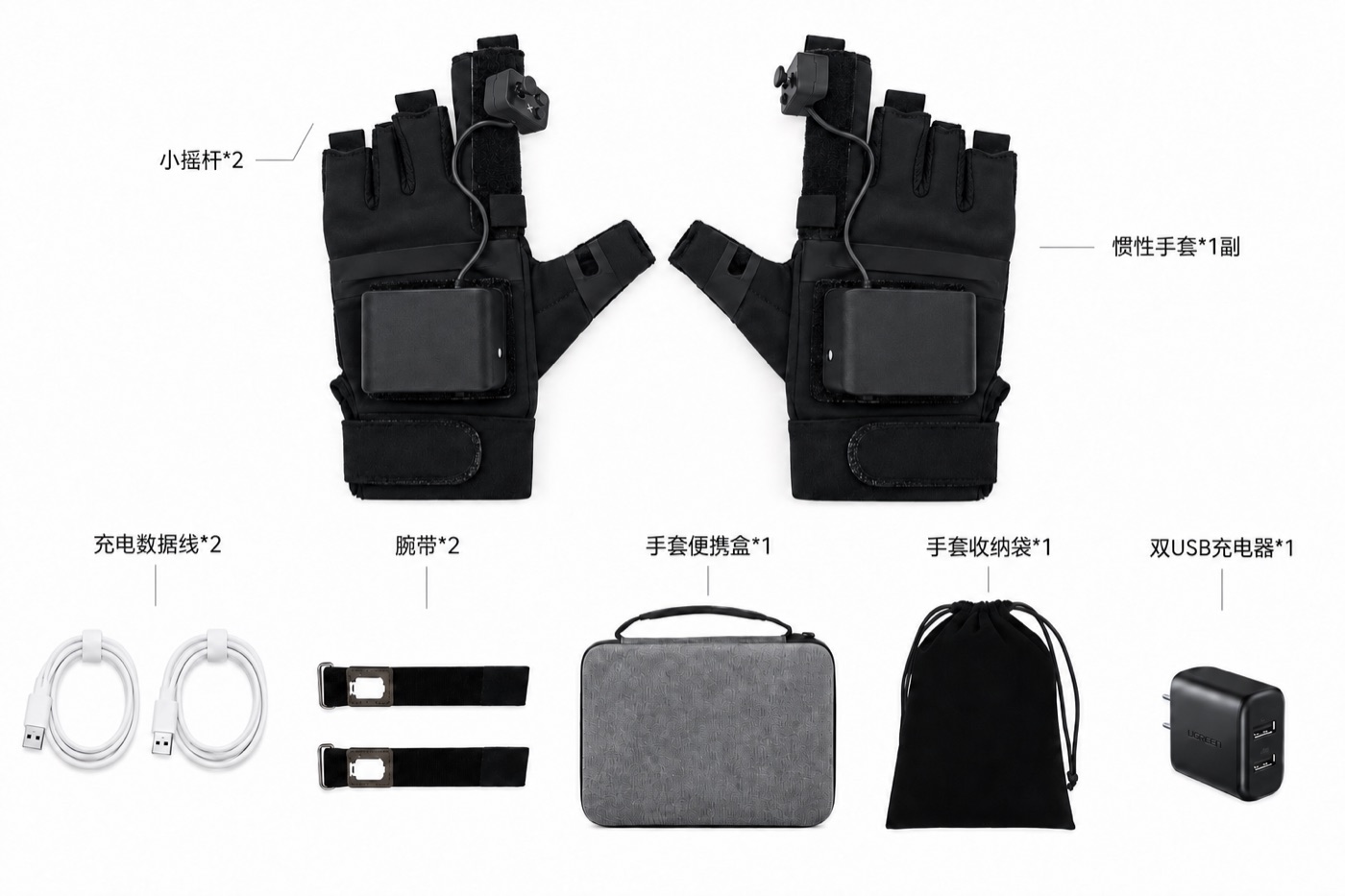
All four combinations can be opened from the product center by going to each device page, then written up as a table in the evaluation. It is not recommended to draw a "microsecond-level full chain" in external materials, because microsecond-level currently corresponds to E6 multi-camera, not the glove. The G7's indicator lights, Hub, and pin diagram show it is a standalone device; the G2-L's Bluetooth and 7-hour battery life show it is also a standalone device. Standalone is exactly why a protocol is needed.
What joint capture looked like in 2026 papers
T-Rex packages the head-mounted stereo camera, wrist camera, proprioception, wrist pose, fingertip tactile sensing and language commands into a 30 Hz packet, with the teleoperation glove as one layer of it. DexViTac puts fisheye or first-person vision, tactile sensing, end-effector pose and kinematics into a portable system. What they have in common: vision and hand data are not aligned after the fact by filename, but are designed for alignment at capture time. The design materials TOBI can provide are the timestamps and start-marker methods of each device, plus the cameras already aligned within the E6. TOBI cannot claim that the wrist camera, tactile skin and optical motion capture described in papers are accessories of the G7 or G2-L. If a wrist camera is needed, confirm it as a TOBI peripheral item; the appearance of the word "joint" in this document does not mean it is included by default.
Moxian's September 2026 coverage promotes tactile sensing and pose on the same sampling cadence; Tujian places the tactile glove and subsequent IMU, EMF and binocular ego vision on its product roadmap. The industry direction is multimodal. The multimodal combination TOBI can currently deliver and verify is vision from E6 or E2 plus hand motion from G7 or G2-L, together with an alignment protocol that states the gaps. Tactile sensing remains a gap unless a separate device is selected in the evaluation.
Recommended on-site protocol
Before capture, the host reads out the device list and each device's frequency: E2 is 30-frame video plus an 800 Hz IMU, or E6 is multi-camera with on-board trajectory; G7 is 120 Hz, or G2-L is 50 Hz. During capture, a marker visible to both parties is made at the start and end of each task—for example, a brief pause of the palm in front of the camera—and an event is left in the glove stream. After capture, sample ten segments to check the marker difference. If the difference exceeds the threshold the team wrote down in advance, the entire segment is downgraded to untrainable rather than hidden by interpolation. Firmware version, size, left/right hand and operator ID are written into the same metadata. Magnetic avoidance or Bluetooth reconnection is written into the quality column.
This protocol does not depend on new hardware commitments, so it can be executed on existing product pages. It also explains why the quote for a joint solution must be broken down into equipment, alignment verification, and optional mapping development. Combining the three into a single "bundle price" without listing boundaries is the most common source of scope disputes in joint data collection projects.
How to order this combination from the product center
Step one: go to ProductsConfirm the head-mounted model and the glove model; do not just bookmark the single term "data acquisition." Step two: open the corresponding product page and copy into your internal notes the sentences that cannot be included by default: E2 does not include on-board SLAM, the glove does not include tactile sensing, the G7 Hub synchronization is not camera synchronization, and the G2-L's 7 hours does not mean no calibration is needed. Step three: place the link to the on-site specification sheet into the review attachments. Step four: submit an evaluation stating the scenario, left/right hand, whether the operator will walk, and whether the target robot has been determined. TOBI replies to these four steps on whether the combination is reasonable and which layer is still missing. A reasonable combination enters the pilot; an unreasonable combination is broken apart before purchase. This better meets 2026 buyers' requirements of suppliers than buying four devices only to discover the clocks do not align.
When images and hand data are finally fed into training, return to the data dictionary article: observations, optional robot actions, failure labels and alignment records are stored in separate columns. The success criterion for joint capture is not "it looked like they moved together," but the time difference and field completeness rate on the spot-check sheet.
Six numbers recommended for recording during the pilot
First, the actual head-mounted frame rate: verify E2 at 30 frames; do not write it higher. Second, the actual cadence at which the glove reaches the host: check G7 against 120 Hz and G2-L against 50 Hz. Third, the difference between the start markers on the two timelines, recorded in milliseconds. Fourth, the number of disconnections or magnetic avoidances. Fifth, the number of effective minutes and mid-wear discomfort aborts, used to judge whether the weight of the E6 or the cable harness of the G7 affects the task. Sixth, the proportion of failed segments. All six numbers can be measured on existing equipment and do not require waiting for new sensors. A solution review proceeds to discussing scale-up only when these six numbers are stable for three consecutive days; if any one number cannot be explained, revise the protocol or the device combination first.
Four spaces to reserve on the workstation sketch
Failures in joint data capture are often about physical space, not algorithms. Head-mounted gear occupies the head as well as the space for a backpack or local storage. The G7 additionally requires a Hub, a power adapter, and cables routed along the table edge; the cables must not trip the operator during hand changes. The G2-L does not require a Hub, but leave room for Bluetooth reception and the host within a 15-meter discussion radius, and avoid dead zones behind metal cabinets. The capture operator also needs space to make start markers so the palm appears in the camera. If these four areas overlap on the sketch, the table will be rearranged within the first hour of the pilot. Counting the time spent rearranging the table into the evaluation is closer to the truth than complaining afterward that the equipment is hard to use.
Power must also be separated. The E2 has more than 5 hours of battery life with a 1600 mAh battery, which is not the same battery as the G2-L's 7 hours, and they cannot power each other. The G7 Hub operates at 4.6 to 5.5 volts. If only one power strip is used on site, it should be marked on the sketch to avoid recording a power outage as a synchronization failure. Weight also affects duration: the E6 weighs about 370 g on the head, and a single G7 weighs 115 g ± 5 g on the hand; the combined fatigue from both does not appear on any specification sheet and can only be measured by the number of aborts in the pilot. The E2 is under 150 g, making it more suitable for long sessions together with the glove, but it also relies more on offline SLAM or post-processing because there is no on-board trajectory.
Alignment spot-checks can be done entirely in a table
Prepare ten actions: clap, touch fingers, pick up, put down, two-handed handover, walk to a marker point, return, occlude Bluetooth once or approach a magnet, redo calibration, finish. Each action has a visible event in the camera and a curve event in the glove. Record the median and maximum of the time difference between the two. The median is used for the protocol; the maximum is used to find individual bad segments. Do not substitute one best alignment result for ten. If any of the ten involves magnetic avoidance or disconnection, exclude that one individually and count it; it does not participate in the median, so that anomalies are not averaged away.
The threshold is set by the project itself; this document does not invent an "official synchronization accuracy." The reason is that the glove's latency specification and the camera frame period cannot be subtracted to obtain this accuracy. The team may temporarily set the threshold at one camera frame or two camera frames, write it into the pilot contract, and tighten or loosen it after three days based on the ten spot-checks. Once the threshold is stated, out-of-tolerance samples are downgraded. Downgrade is not a failed project; it is the protocol working. In external communications you may say "we exclude samples according to the stated threshold," but you may not say "end-to-end hardware synchronization."
Who is responsible for which line of the joint solution
TOBI provides an assessment of device specifications and suitability for the combination: the vision capability of E2 or E6, the hand capability of G7 or G2-L, and the fact that the two clocks differ. The customer is responsible for thresholds, capturer training and task labels. If mapping to a robot is needed, responsibility for the third line falls on project development, which may be done by the customer or purchased as a separate service. The three lines of responsibility are written at the end of the assessment reply, so that phone calls do not repeatedly debate "didn't you say they could be used together?" Used together means captured in the same session; it does not mean a single timestamp is hard-wired at the factory.
If the customer already has their own wrist camera or tactile finger sleeve, add a line to the joint protocol rather than merging those devices' specifications into TOBI's. The 2026 external tactile finger sleeve is designed precisely to be strapped onto an existing glove. It can become the customer's phase two, but until a joint spot-check has been done, it does not appear in this phase's synchronization commitment. This way the four devices in the product center remain verifiable, the customer's own sensors have a place, and the solution does not balloon into an unacceptably verifiable "full-modality platform."
One external sentence and ten internal sentences for joint collection
Externally, keep just one sentence: the head-mounted device is responsible for seeing the scene, the glove is responsible for recording how the hand moves, and the time alignment between the two is accepted according to the project protocol. Internally, write an appendix covering the spot-check of the ten actions, thresholds, downgrade rules, who is responsible for markers, whether E2 includes on-board SLAM, what the microsecond-level specification of the E6 refers to (the cameras), what the G7 Hub synchronization refers to (both hands), how the G2-L's 50 Hz is resampled, how fatigue aborts are counted, and whether failed segments are retained. One external sentence is for customer acquisition; ten internal sentences are for delivery. Sending only the external sentence will cause the project to blow up in week two; sending only the ten internal sentences means nobody will click in from search. Product content needs both layers, with a clear statement of which layer may be forwarded to customer groups.
Materials forwarded to customer groups should use on-site links. The specification sheet, product page, and this protocol are on the same domain; when the other party clicks, they will not leave TOBI. If there are robot manufacturers in the group at the same time, it should be noted that mapping is not in this phase, to avoid them thinking the protocol already includes their controllers. The biggest risk with joint data collection is everyone in the group chat adding a sentence of "included by default", until no one can point to the original contract text. The purpose of the appendix is to stop the group chat from adding things.
Do not draw a synchronization line on the solution diagram
If an architecture diagram draws a solid line between the head-mounted device and the glove and labels it microseconds, it misattributes the internal capability of the E6 camera to the glove. The correct diagram draws two clocks, with a dashed line between them representing start markers and spot-checks. The dashed line looks less convincing than a solid line, but it will pass technical review. The solid line will be asked to prove itself at acceptance. The professionalism of a joint solution is often reflected in whether you are willing to draw a dashed line. Neither the product page nor the specification sheet has that solid line; the solution diagram should not be bolder than the specification sheet.
The dashed-line solution can still be sold. What it sells is executable same-session capture, not an impossible factory bus. A customer who accepts the dashed line is buying a data workflow; a customer who insists on the solid line is buying a different kind of system, and you should stop promising with the existing four devices.
The last question of a solution review should be: is there a solid synchronization line on the diagram that has no basis in a specification sheet? If there is, change it to a dashed line before passing the review. Only if there is none should it enter pilot scheduling. This question requires no new equipment—only a facilitator willing to pause the meeting once.
The schedule lists spot-checking ten motions as a day-one task rather than "do it when there is time." If no spot-check is done on day one, all subsequent collection hours lack a qualified definition.
The suggested schedule for the first day of the pilot is: wiring and fitting in the morning, only the spot-check of the ten actions in the afternoon, and no formal capture in the evening. In the morning, confirm that E2 or E6 can record, that the glove arrives at the nominal frequency, and that both parties can see the start marker. In the afternoon, fill the ten time differences into the table. In the evening, use this table to decide whether task capture is allowed the next day. If the table is empty, continue spot-checking the next day rather than recording unacceptably verifiable hours to keep up the pace. Progress in a joint project is the number of qualified samples, not power-on hours. Power-on hours are the easiest thing to misreport as an achievement at weekly meetings.
A blank row in the spot-check table is itself an incomplete item; "the device is powered on" cannot substitute for filling it in. Power-on only confirms the hardware is present; it does not confirm that the two timelines are comparable.
If the spot-check is not completed, the day is not counted as an effective capture day. This is written into the day's completion conditions.
Continue Reading & Next Steps
- Selection: how G7 and G2-L divide the work
- G7: fingertip spatial position and teleoperation
- G2-L: long-duration wireless hand demonstration
- Data: from glove to trainable samples
- Combination: Glove + E6 / E2 Head-Mounted
- Applications: labs, production lines and research
- Procurement: evaluation form and scope
Back to Product Center View G7 View G2-L G7 specification sheet G2-L specification sheet
This article was written on October 2, 2026, for selection and content acquisition purposes. Device parameters are subject to the on-site specification sheets and product pages and do not constitute a supply commitment. External papers and public reports only illustrate industry context; their success rates and dataset sizes belong to the original authors' experiments, not TOBI's measured results.