
HEVC 1600×1200, exactly 30 Hz. The calibration group is labeled tracking. Baseline 65.94 mm. The p50 of the left/right exposure start offset is 198 microseconds. Pinhole-estimated horizontal FOV is approximately 117°, without using distortion coefficients. The spec sheet horizontal FOV is 139°; this estimate does not follow the spec sheet definition.
In mass production and on sale · Specifications subject to the order confirmation document
TOBI E2 / LIGHTWEIGHT BINOCULAR EGO CAPTURE
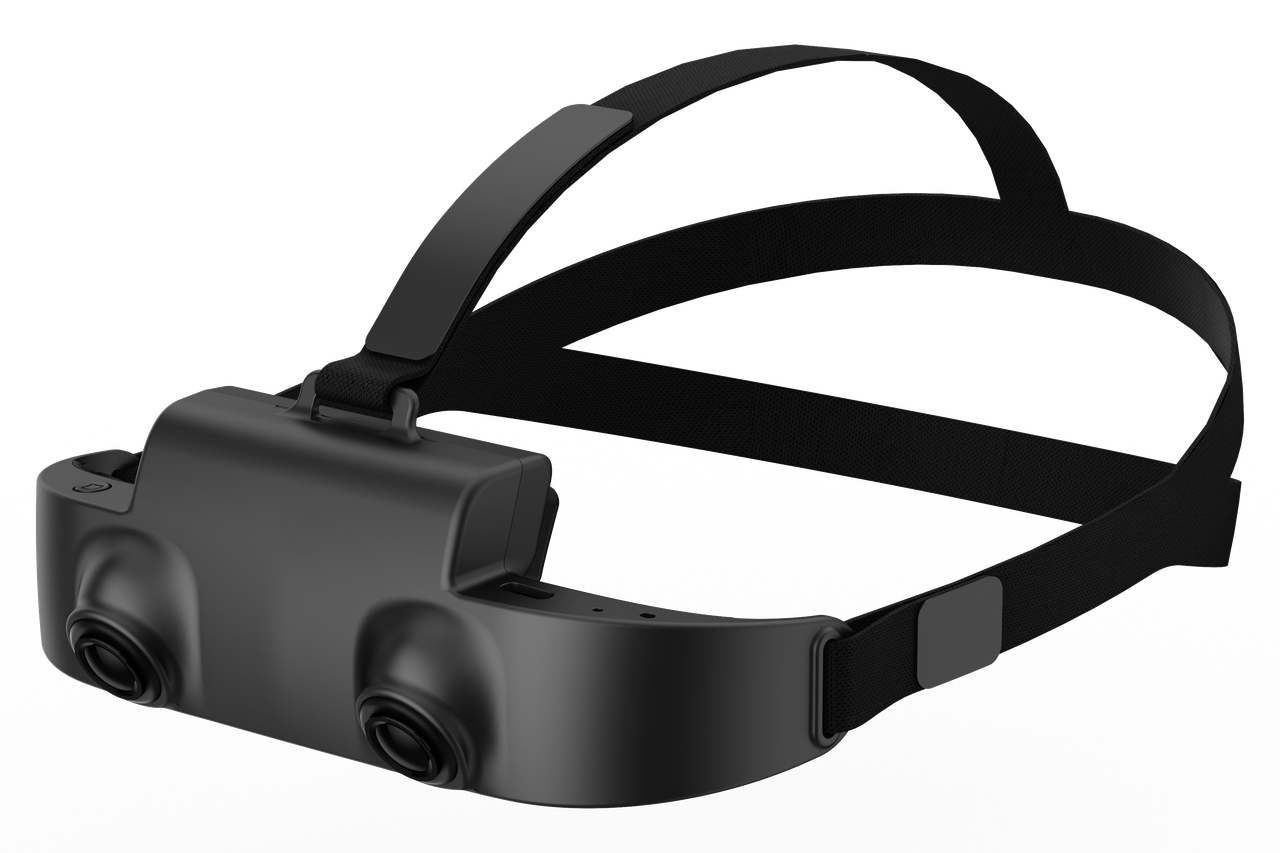
E2 lightweight stereo Ego capture device
E2 is a binocular RGB capture headband for first-person data acquisition: 2 RGB global-shutter cameras, 1600×1200@30fps, 65mm binocular spacing, per-camera horizontal FOV 139° and vertical FOV 111°; total weight under 150 grams, built-in 1600mAh battery, battery life over 5 hours. The 4 Hz preview on this page cannot substitute for the original training footage.
<150gTotal unit weight
>5hBuilt-in battery life (nominal)
65mmBinocular imaging baseline (nominal)
139°Single-camera horizontal FOV
DATA SAMPLE · EPISODE 20260917_133640
A real stereo segment,
split intoVerifiable data layer.
Below is actual binocular E2 footage 20260917_133640 (UID d36997d92fc9), duration 11 minutes 22 seconds. The device files contain only left and right eye, IMU, magnetometer, and 16 kHz stereo audio. The skeleton, mosaic, and color block in the upper right on the left and right eye views are post-processing estimates, not hand, pose, or depth output from this device. This clip is a 4 Hz preview and cannot be used as a training set. The actual measurements in this segment are 1600×1200@30 Hz and gyroscope approximately 798.9 Hz. The parameter table lists 1600×1200@30fps, IMU 800Hz, per-camera HFOV 139° / VFOV 111°, binocular spacing 65mm; the pinhole-estimated field of view is not the parameter table's specification.
SOLUTION
Stereo, inertial, and post-processing viewed separately
Training reads the 30 Hz raw footage from Camera0 and Camera1, as well as stereo_index.jsonl. Preview is only used to check whether the skeleton falls on the hands and whether wall markers are detected. The audio is device stereo, starting 97 ms later than the left camera's exposure start. This device has no head pose; the bottom angles are gyroscope integration and will drift. Nominal specifications are listed in the specification table below; this section only verifies this single capture.
The accelerometer and gyroscope are approximately 798.9 Hz. The magnetometer is 200 Hz. The accelerometer is 124 ms earlier than frame 0 of the left eye. The 1.5 ms in the calibration was not applied because there is no head pose to verify against.
PCM 16 kHz stereo. Packet 0 is 96.6 ms later than the left-eye exposure start. The player overlays it into the annotation clip at 97 ms.
Vision 21 points. Left hand green, right hand orange. Not the device OpenXR 26 joints, and no per-joint confidence.
Faces, distant human bodies, text with confidence reaching 0.40, bright screens, and blue wall markings. Very faint text on glass may still remain.
The top right is unrectified disparity, not a depth camera, and cannot be used as metric depth.
RECORDING SPEC · Measured in this segment
- Segment
- 20260917_133640, 682.17 seconds. Device UID d36997d92fc9.
- Time base
- UTC nanoseconds. Left and right eyes are aligned by exposure start time. Preview time matches source time.
- Hands
- Not in the device files. The hands in the player are visual estimates.
- This section does not contain
- Head pose, SLAM, depth camera, object categories, contact force, robot actions. There are also no on-device hand joint files.
- Compared to Nominal
- The parameter table lists 2 RGB global-shutter cameras at 1600×1200@30fps, IMU 800Hz, per-camera HFOV 139° / VFOV 111°, binocular spacing 65mm. The original footage in this segment is 1600×1200@30 Hz, gyroscope approximately 798.9 Hz (consistent with 800Hz); the pinhole-estimated horizontal field of view is approximately 117°, not the parameter table's 139°. The measured baseline is 65.94 mm, while the parameter table lists 65mm.
Around 2:17, the cropped wall sign reads "SKYWORTH XR"; the full frame has used SKYWORTH. At 10:28, the same blue sign is blurred, and OCR at this second returns a low-confidence misread. The training file is on the data description page — do not train on this 4 Hz clip. This preview does not replace prototype acceptance testing in the nominal mode.
DATA SAMPLE · EPISODE 20260917_133640
One real stereo take,
split into layers you can check.
This is a real binocular E2 take, episode 20260917_133640 (UID d36997d92fc9), 11 minutes 22 seconds. The device files are the two eyes, IMU, magnetometer and 16 kHz stereo. The skeleton, mosaic and corner patch are later estimates, not device hands, pose or depth. This file is a 4 Hz preview and is not the training source. This take measures 1600×1200 at 30 Hz and about 799 Hz gyro. Source video matches the datasheet camera mode (1600×1200@30fps). Datasheet IMU is 800 Hz; per-camera HFOV is 139° and VFOV is 111°.
SOLUTION
Stereo, inertial, then estimates
Train on the 30 Hz Camera0 and Camera1 files, joined by stereo_index.jsonl. The preview only shows whether the skeleton sits on the hands and whether the wall mark is masked. Audio is the device stereo, 97 ms after the left-eye exposure start. This package has no head pose. The heading in the bar is integrated gyro and it drifts. Brochure figures are in the spec table. This block only checks this take.
HEVC 1600×1200 at 30 Hz. The calibration group is named tracking. Baseline is 65.94 mm. Inter-eye exposure-start difference is 198 µs at the median. A pinhole horizontal field is about 117°. Distortion was not applied. Datasheet HFOV is 139°, so this estimate is not the datasheet field of view.
Accel and gyro are about 798.9 Hz. Magnetometer is 200 Hz. Accel starts 124 ms before the left eye. The factory 1.5 ms alignment was not applied: there is no head pose to check it against.
PCM, 16 kHz, stereo. Packet 0 is 96.6 ms after the left-eye exposure start. The player applies 97 ms.
Vision, 21 points. Left is green, right is orange. Not the device OpenXR 26 joints, and there is no per-joint confidence.
Faces, distant people, text at confidence 0.40 or above, bright screens, and the blue wall mark. Faint glass lettering can remain.
The corner patch is unrectified disparity, not a depth camera, and not metric depth.
RECORDING SPEC · MEASURED ON THIS TAKE
- Episode
- 20260917_133640, 682.17 s. Device UID d36997d92fc9.
- Time base
- UTC nanoseconds. The eyes join on exposure start. Preview time matches source time.
- Hands
- Not present in the device files. Hands in the player are a vision estimate.
- Not in this take
- Head pose, SLAM, a depth camera, object classes, contact force, or a robot action. There is also no on-device hand-joint file.
- Against the datasheet
- Datasheet: two RGB global-shutter cameras at 1600×1200@30fps, IMU 800 Hz, per-camera HFOV 139° / VFOV 111°, baseline 65 mm. This take is 1600×1200 at 30 Hz, gyro about 798.9 Hz (consistent with 800 Hz), and a pinhole horizontal field of about 117° that is not the datasheet 139°. Measured baseline is 65.94 mm against a 65 mm datasheet figure.
Around 2:17 the crop of the wall mark reads SKYWORTH XR and the frame accepts SKYWORTH. At 10:28 the same blue mark is masked, and OCR falls back to low-confidence errors. Training files are on the data note. Do not train on this 4 Hz preview. This preview does not replace acceptance of a brochure-mode sample unit.
PRODUCT OVERVIEW & CORE FUNCTIONS
Designed for bulk data capture,
Weight-reduced for all-day wear.
E2 is positioned as a lightweight first-person acquisition solution that "can be worn comfortably, can record for long durations, and can be exported directly": 2 RGB global-shutter cameras at 1600×1200@30fps, per-camera horizontal FOV 139° and vertical FOV 111°, IMU 800Hz; the 65mm binocular spacing preserves effective structure for depth estimation; data is written completely to local storage and can be retrieved via USB or Wi-Fi.

Global-shutter binocular
2 RGB global-shutter cameras, 1600×1200@30fps, binocular spacing 65mm, per-camera horizontal FOV 139° and vertical FOV 111°. The sample original footage on this page is 1600×1200@30fps, consistent with the parameter table.
65mm human eye baseline
The nominal binocular spacing is 65mm, close to the human eye observation structure, preserving effective binocular geometry for depth estimation and subsequent 3D reconstruction. The sample extrinsic baseline on this page is approximately 65.94 mm.
IMU inertial recording
High-precision IMU with a sampling frequency of 800Hz, recorded on the same device as the video; timestamps from each camera are synchronized. This device does not run SLAM; video can be exported and processed on a computer. The sample gyroscope on this page is approximately 798.9 Hz, consistent with 800Hz.
MP4 / H.265 standalone output
Color video is in MP4 format, H.265 encoded, with independently output frames; IMU, camera intrinsics/extrinsics, and audio are also included, with all interfaces fully open.
USE SCENARIOS
From a single production line,
to a batch of collectors.
E2 is centered on lightweight design, long battery life, and convenient storage access, covering a wide range of first-person capture tasks from individual development to batch delivery. Combined solutions and task samples must be confirmed in the project.
Batch First-Person Capture
Designed for long-duration, multi-person, multi-device data production: under 150g for low wearing burden, battery life over 5 hours to reduce device-swap interruptions, Micro SD per-device recording with batch retrieval.
Long-duration tasks and multi-round operations
Suitable for tasks requiring continuous recording such as assembly, sorting, and inspection; the built-in battery lasts through the majority of a single shift, and a power bank can be connected to extend a single continuous capture session.
Robot Manipulation Data Production
Provides first-person operation video and inertial data for robotic-arm teleoperation and imitation learning; video can be exported so you can build your own SLAM and trajectory processing pipeline on a computer.
Teaching, Research, and Algorithm Development
For university labs and algorithm teams performing multimodal data collection and algorithm iteration: all data interfaces are open, with dual-channel data retrieval over USB wired and Wi-Fi wireless.
WHO IT SERVES
Designed for first-person visual data-collection teams.
E2 is suitable for teams and individuals whose primary data source is first-person vision. Whether it is a match depends on task type, duration, and the post-processing pipeline; a brief scenario evaluation can be done during pre-sales.
Data Capture Team
Field teams that need to continuously produce first-person RGB video + IMU data for training and evaluation; they value lightweight wearability, long battery life, and batch deployment.
Lightweight · Long Battery Life · Batch ProcessingRobotics / Embodied AI R&D
Engineers developing algorithms around teleoperation, imitation learning, and 3D reconstruction need a first-person input with an open data format that supports independent post-processing.
All interfaces open · Independent H.265 outputUniversities and research institutions
Lab users who need controllable collection, a clear budget, and data they retain; supports customization and open interfaces for easy integration with their own collection and annotation workflows.
Customizable · Data Retained In-HouseWHY E2 & DATA BOUNDARY
Do what can be done,
Express it as an acceptable number.
The following are the product-level parameters and boundary descriptions for E2. This device does not include SLAM algorithms: E2 provides first-person video, IMU, and timestamp-synchronized data; trajectory, depth, and semantic results must be generated through post-processing on a computer.
Lightweight wearability
<150g
Total weight under 150 grams; with the headband, long-term wearing burden is lower, suitable for batch continuous acquisition.
Built-in battery life
>5h
Built-in 1600mAh battery with over 5 hours of battery life; an external power bank can extend a single acquisition session. Actual battery life is affected by temperature and load.
Wide-angle coverage
139°
Spec sheet: single camera horizontal FOV 139°, vertical FOV 111°. The pinhole estimate on this page's sample is approximately 117° (distortion coefficients not applied), which does not match the spec sheet figure.
Open dual-channel data retrieval
2×
Two data acquisition channels: USB wired and 2.4G/5G Wi-Fi 6 wireless; all data interfaces can be opened up.
Data boundaries:The E2 device does not run SLAM algorithms and does not produce trajectory or point-cloud results; customers can export video and process it on a computer. Parameter table: 2 RGB global-shutter cameras at 1600×1200@30fps, IMU 800Hz, per-camera HFOV 139° / VFOV 111°, binocular spacing 65mm, total weight under 150g, built-in 1600mAh battery with over 5 hours of battery life. The sample on this page, 20260917_133640, measured 1600×1200@30 Hz and gyroscope approximately 798.9 Hz; the skeleton, redaction, and disparity on the preview are not device output. Specific tasks, durations, device counts, memory card capacity, and delivery acceptance for batch acquisition are subject to the order confirmation document.
- Product Model
- E2 lightweight binocular capture headband (first-person Ego data capture device).
- Main processor
- Dual-core processor with a maximum clock frequency of 1.0GHz.
- Camera Configuration
- 2 RGB global-shutter cameras; 1600×1200@30fps; stereo baseline 65mm. The sample raw footage on this page is HEVC 1600×1200@30fps, with a baseline of approximately 65.94 mm (the specification table lists 65mm).
- Field of view
- Spec sheet: single camera horizontal FOV 139°, vertical FOV 111°. The pinhole estimate on this page is approximately 117° horizontally; distortion coefficients were not used, so this is not on the spec-sheet basis.
- Sensors
- High-precision IMU with a sampling rate of 800Hz, recorded in synchronization with the video. In the sample on this page, the accelerometer/gyroscope run at approximately 798.9 Hz, consistent with 800Hz; the magnetometer at 200 Hz was measured in this section, and the specification table does not list the magnetometer separately.
- Battery and Battery Life
- Built-in 1600mAh battery with more than 5 hours of runtime; supports external power-bank supply.
- Storage
- Local storage on an external Micro SD card; upload and export via wired USB or wireless Wi-Fi.
- Wireless and Connectivity
- Wi-Fi 6 (2.4G / 5G), Bluetooth BT5.4.
- Audio
- Supports microphone (MIC) and speaker (Speaker).
- Captured Data
- Color video (MP4 format, H.265 encoding, independent image output), IMU data, synchronized timestamps for each camera, camera intrinsics/extrinsics, audio data.
- SLAM Notes
- This device has no onboard SLAM algorithm and does not produce trajectory metrics such as 5 mm accuracy; video can be exported, and the customer can perform SLAM and other post-processing on a computer independently.
- Systems and customization
- Software system: Linux; all data interfaces can be opened, with support for project-based customization.
- Total unit weight
- Overall device weight under 150 grams.
Note: The table above is compiled from the "Skyworth EGO E2 Specifications": 2 RGB global-shutter cameras at 1600×1200@30fps, per-camera horizontal FOV 139° and vertical FOV 111°, IMU at 800Hz, stereo baseline 65mm, overall device weight <150g, built-in 1600mAh battery with >5 hours of runtime. The sample 20260917_133640 on this page is used to verify the layering between raw acquisition and post-processing; the pinhole-estimated field of view and gyroscope frequency were measured in this section and are not a separate set of nominal specifications. The 4 Hz preview cannot be used as a training set. The page does not list the default Micro SD capacity, included accessories, or firmware version; the order confirmation documents take precedence in all cases.
READY TO SCALE
For batch first-person capture,
Start counting from “can be worn.”
We can work with you to confirm the E2 procurement and delivery plan around task duration, number of capture devices, storage retrieval, and data access workflows. Plan confirmation does not constitute an automatic quote or a guarantee of data performance.
Define the task type, duration per session, daily device hours, and number of capture personnel.
Clarify the data retrieval method (USB download / Wi-Fi upload) and memory card management.
Clarify the post-processing pipeline: whether you need to export the video and build SLAM yourself.
Specify supply quantities, delivery dates, included accessories and acceptance criteria.
DATA & PROJECT READINESS
From specifications to an acceptable capture plan.From specifications to a testable capture setup.
View specifications on this pageRead specificationsReal Capture Samples and Field DescriptionsRecording sample & field notesDeveloper DocsDeveloper documentationDelivery Format GuideDelivery formatCompare other devicesCompare devices
Does E2 include on-device SLAM or hand joints?Does E2 include on-device SLAM or hand joints?
This device provides raw recordings such as binocular video and inertial data; on-device SLAM is not included. The hand skeleton and disparity in the samples are post-processing estimates; the 4 Hz preview cannot replace the 30 Hz training source footage.E2 records stereo video and inertial data without on-device SLAM. Sample hand skeletons and disparity are post-processing estimates; the 4Hz preview is not the 30Hz training source.
Can it be used directly for robot training?Is this data ready for robot training?
Device observations do not automatically equal robot action labels. First confirm the data fields, timestamps, coordinate frames, target action space and data quality, then validate the conversion and training pipeline.Device observations are not automatically robot-action labels. Validate fields, timestamps, coordinate frames, target action space and quality before conversion and training.
How do I confirm supply and delivery scope?How do I confirm supply and scope?
Provide the task, quantity and planned delivery date. Confirm the device version, firmware, accessories, support scope and acceptance method in writing. Historical prototypes or production plans do not mean current stock is available.Provide the task, quantity and delivery window. Confirm the version, firmware, accessories, support and acceptance method in writing. Historical production plans do not confirm current stock.
How do I sync with other devices?How is cross-device synchronization verified?
Starting together does not mean clock synchronization. For a combined solution, confirm the clock source, interfaces, timestamp definitions, error statistics and dropped-frame handling; single-device metrics cannot substitute for full-system acceptance.Starting together is not clock synchronization. Confirm clock source, interfaces, timestamp definitions, error statistics and dropped-frame handling for the complete system.