
After the main body and kit are selected, the system is still not fully set up. The operator needs a workstation with video and status displays, the kit needs power and network access according to its column, and the site needs a work area, charging spot, and network. The October 2026 deployment plan condenses this into seven steps. Each step checks only the column and unit that have actually been purchased.
What Is on the Workstation
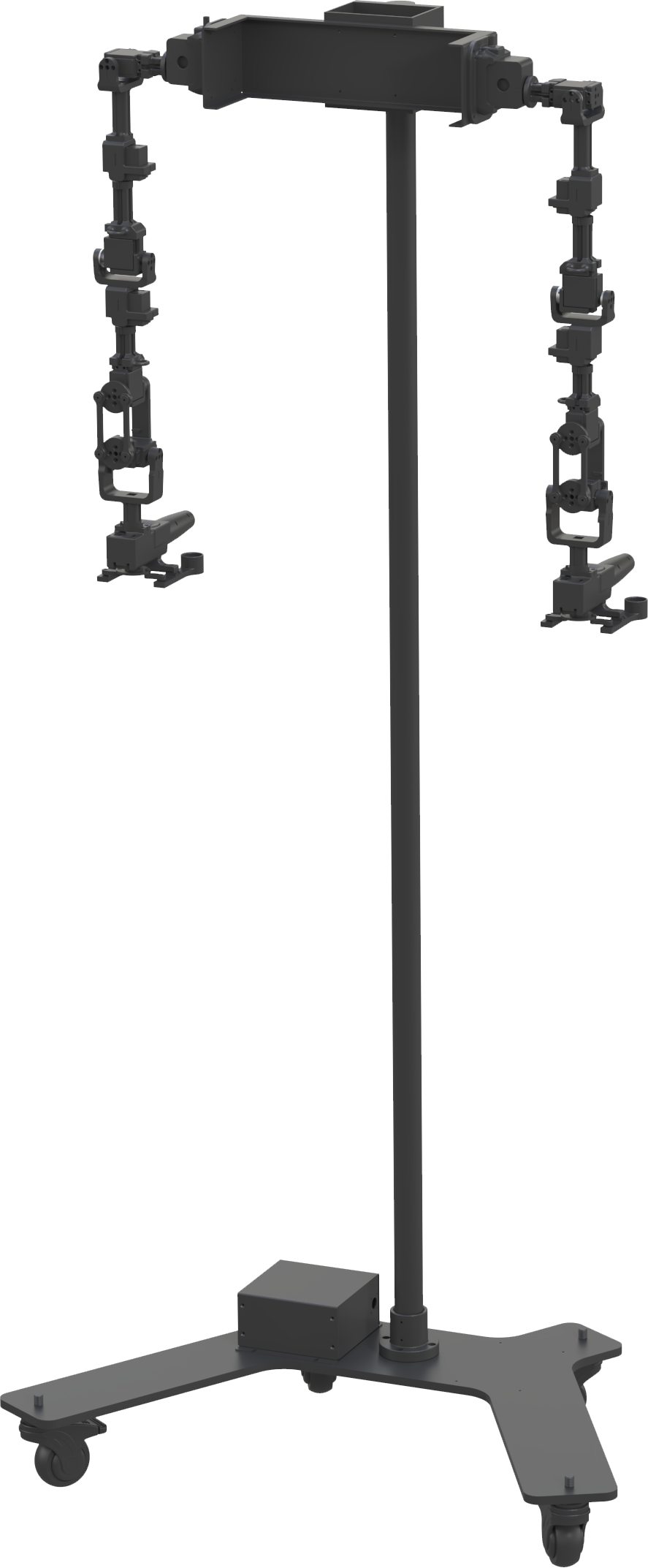
The display system uses multiple screens or a large screen to present multiple video feeds, a localization map, and robot status. The control end is the master arm; the plan also states that gamepad control and keyboard control in the client can be switched. The keyboard is a software operating mode; it is not another name for the local column's rail-type ring fixture.
Power is supplied by column, not by a blanket "all teleoperation devices use DC24V." GLN-RX75 and GLN-RX71 are DC24V, with power limits of ≤200 W and ≤100 W respectively. The local isomorphic kit is DC12V, rated 84 W. For communication, the first two columns use RJ45; the local column uses RJ45 or a 10-pin aviation connector. The workstation drawings must specify the voltage and connector of the selected column, to avoid connecting a 24-volt power supply to the 12-volt local column.
Network and Site
The robot site must have wired or sufficiently high-quality wireless connectivity to ensure the transmission of video and control commands. The platform side connects via the public internet or a dedicated line. For sensitive intranet scenarios, the plan states that dual-network deployment is possible, separating the site network from the external network. This article does not give latency figures in milliseconds; the plan does not publish a unified latency metric, and no unmeasured millisecond value should be added in the contract.
The site also needs a charging or maintenance spot, a work station, and a safety protection zone. Charging time is only stated on the wheeled humanoid page as approximately 2 hours; that is charging, not battery life. The folding model states approximately 6 hours of battery life. The lift model does not state hours. The dimensions of the protection zone should be drawn according to the outline of the selected main body: folding 614×552×1700 mm, lift model stowed 640×450×1780 mm, wheeled humanoid 570×465×1680 mm.
Seven steps
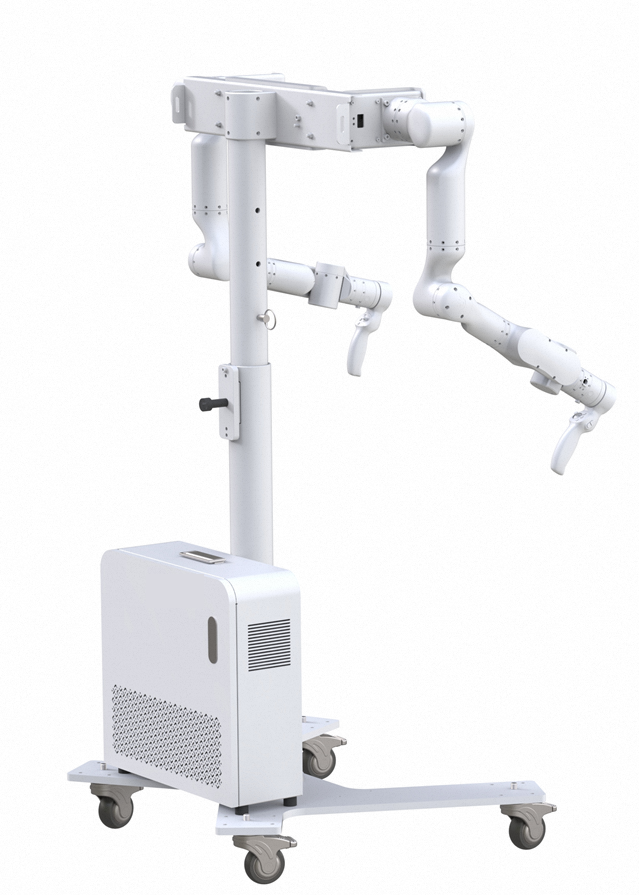
Step 1: Mark out the work area, charging/maintenance area, and operator workstation, and confirm that both the site and the main control end have stable network connectivity. Step 2: Unbox and power on the main body, connect it to the site network, and complete registration and authorization binding in device management. Step 3: Install the selected kit, connect Ethernet and power according to the column, set up the display, install the teleoperation client, and complete account authorization.
Step four: in the admin backend, create tenants, users, and roles, bind the robotic platform with the master control terminal, and configure task rules. Step five, integration testing: whether multi-channel video comes back, whether the map appears, whether the dual arms follow the master arm. For the chassis or lift, only test the mechanisms stated on that robotic platform's product page. Force feedback is only tested on GLN-RX75 or GLN-RX71; the local list should not record "no force feedback" as a fault.
Step 6: Issue a test task and complete the full cycle of receiving, executing, and submitting for acceptance. Step 7: Train the operator and administrator separately, then transition to daily operation. The plan's client includes a SLAM localization map and waypoint navigation with obstacle avoidance. Localization accuracy is still governed by the main body page: the lift model publicly states ±10 mm / ±3°; the other two units do not have this set of localization figures, so do not borrow them for the integration test records.
Continue Reading
- Break Teleoperation into Three Parts: Robot Body, Kit, and Software Platform
- Order the three robot bodies separately: folding, lift, and wheeled humanoid
- Kits Sold by Column: Force Feedback in the First Two Columns, None in the Local Column
- A Day in the Loop: Task Dispatch, Teleoperation, Storage, and Acceptance
- Full Teleoperation Delivery Now, Autonomy Written into Later Phases
Device page:Folded Arms, Lifting Dual-Arm RMC-AIDAL, Wheeled Humanoid, Isomorphic teleoperation kit, Two-finger gripper RMG22-65. The main entry point isProducts.
This article was written on October 4, 2026, based on that month's teleoperation system build plan, and published after being rewritten according to the parameter tables on the in-site product pages. Figures that conflict with the product pages do not enter external messaging. The software platform is described according to the delivery scope of the plan, not written as a TOBI manufacturing claim, nor rewritten as another company's brand. Phase 2 and Phase 3 are evolutionary directions and do not constitute a commitment to already-delivered autonomous operation. Phone: +86 137 5502 0164.