
The primary arm on the operator side is not "a single teleoperation unit."Kit PageThere are three columns: GLN-RX75, GLN-RX71, and the local isomorphic kit. For remote operation with force feedback, look at the first two columns. If the operator is physically in the data capture facility and accepts no force feedback and DC12V, look at the local column. All three columns have 7 degrees of freedom, but they cannot be merged into a single device on that basis.
Three-Column Comparison
| Projects | GLN-RX75 | GLN-RX71 | Local Isomorphic Kit |
|---|---|---|---|
| Main arm model | RX75 | RX71 | YDS-DAP-75/65/RX75S |
| Force feedback | Supported | Supported | Not supported |
| Configuration / Grip | Humanoid, Handle | Humanoid, Handle | Same as the slave arm; rail-mounted ring fixture. |
| Motion radius | 709 mm | 474 mm | 599 mm |
| Degrees of Freedom | 7 | 7 | 7 |
| Angular resolution | ±0.003° | ±0.003° | 0.088° |
| Main arm weight | 7.8 kg | 3.8 kg | Approximately 1.5 kg (including fixture) |
| Drag / Speed | Zero-force drag, 30 RPM | Zero-force drag, 30 RPM | Zero-force drag, 110 RPM |
| Motor / communication | Integrated joint, RJ45 | Integrated joint, RJ45 | Bus servo, RJ45 or 10-pin aviation connector |
| Voltage / Power | DC24V,≤200 W | DC24V,≤100 W | DC12V, rated 84 W |
Zero-force drag is listed in all three columns. It describes the feel when dragging the master arm; it is not force feedback. Only the "force feedback" row in the first two columns states support. The local column states not supported. If "all three columns have force feedback" appears in the contract, strike out the local column.
How to Choose Between Remote and On-Site
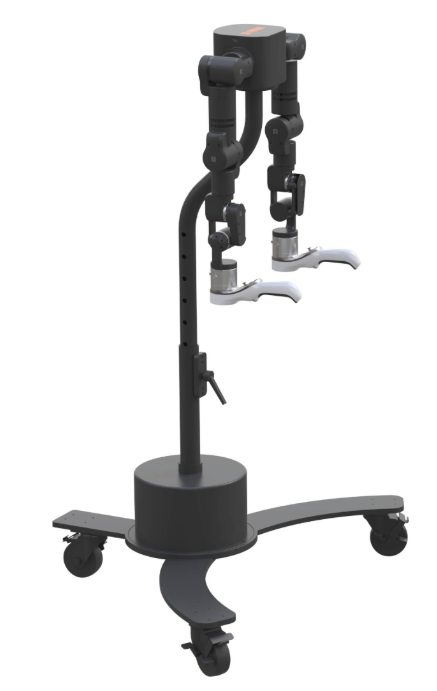
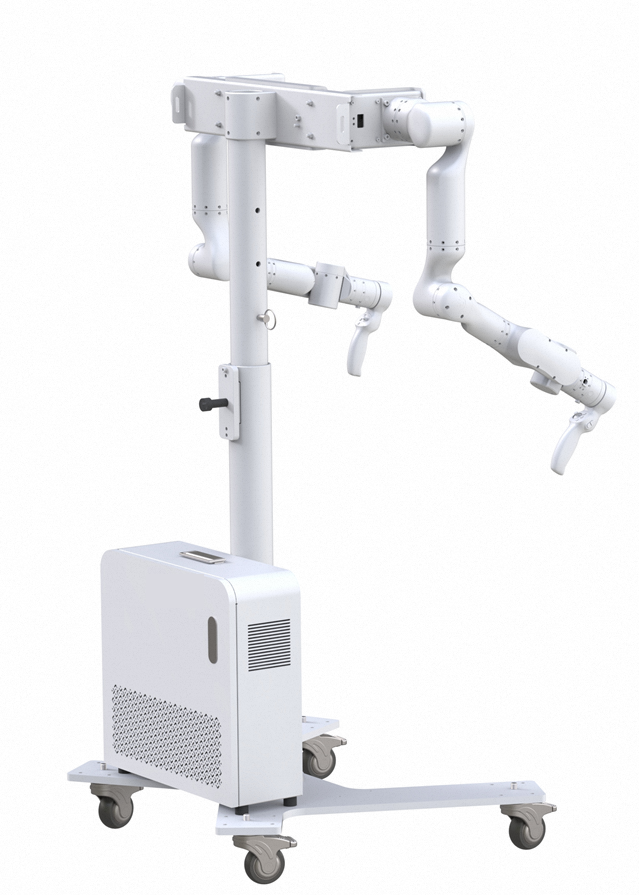
For cross-site operation, the proposal recommends choosing between GLN-RX75 and GLN-RX71. Both support force feedback, both have an accuracy row of ±0.003°, both use a handle for gripping, and both use RJ45 for communication. The differences are in scale and power budget: 709 mm vs. 474 mm, 7.8 kg vs. 3.8 kg, ≤200 W vs. ≤100 W. The workstation must provide DC24V according to the selected column; do not prepare power based on the local column's DC12V.
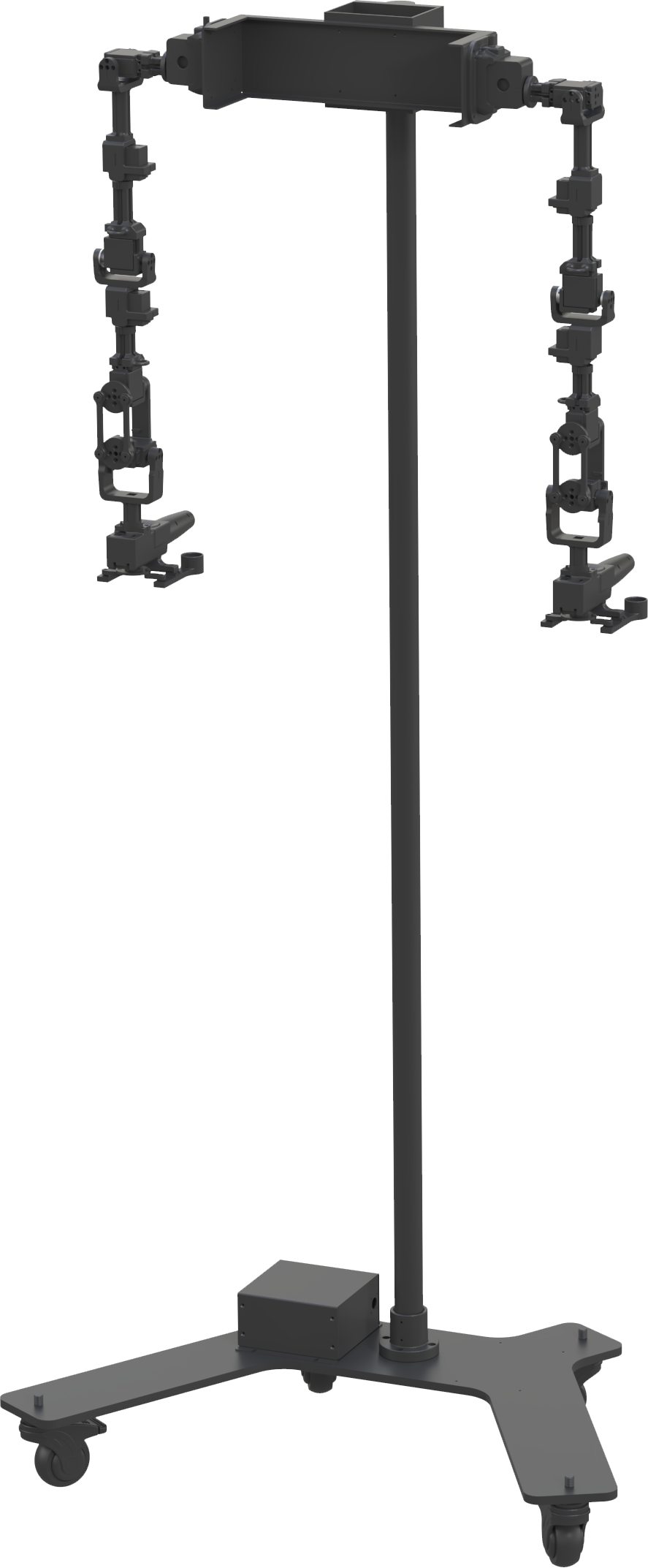
When the operator is already at the data collection site and wants a lighter master arm, the proposal places the local isomorphic kit at this tier. Its working radius is 599 mm, maximum operating speed is 110 RPM, the motor is a bus servo, and the grip is a rail-type ring fixture. This fixture is used to hold the master arm; it is not the RMG22-65 on the slave end. The local column has no force feedback, and the voltage is DC12V.
Do not write it up as paper results
Isomorphic master-slave data acquisition has been discussed in industry articles. The success rates and data scales in those papers belong to the original authors' experiments; they are not acceptance results for these three columns, nor do they indicate that any particular column implements any particular paper. Externally, retain only the column names, interfaces, and presence or absence of force feedback from the table. The master arm's self-weight is also not the robot's single-arm rated payload; the slave end's 5 kg is still governed by the main body page.
Which Column Does the Configuration Sheet Go Up To
A qualified kit description on one line must include at least the column name, master arm model, presence or absence of force feedback, voltage, and connector. For example, "GLN-RX71, master arm RX71, force feedback supported, DC24V, RJ45", or "local isomorphic kit, master arm YDS-DAP-75/65/RX75S, force feedback not supported, DC12V, RJ45 or 10-pin aviation connector". Writing only "one isomorphic teleoperation kit" can be interpreted as any of the three columns, and the mismatch in speed (30 RPM vs. 110 RPM) will only be discovered during integration testing.
Kits do not arrive with the main body by default. Orders for the folding, lift, and wheeled humanoid models must list the kit separately. The wheeled humanoid page stated compatibility with the RX75, RM75, and RM65 platforms; compatibility does not mean the master arm is already included in the box. The slave-end gripper is also listed separately: the CTAG2F90-D in the lift model's recommended configuration column is not the local column's ring fixture, and the RMG22-65 is certainly not a master-arm grip component. The flanges, wiring harnesses, and protocols between master and slave are confirmed on the configuration sheet; do not write "RJ45 plug-and-play" as requiring no adaptation.
Continue Reading
- Break Teleoperation into Three Parts: Robot Body, Kit, and Software Platform
- Order the three robot bodies separately: folding, lift, and wheeled humanoid
- Seven Steps to Deploy a Workstation: Display, Power, Network, and Integration Testing
- A Day in the Loop: Task Dispatch, Teleoperation, Storage, and Acceptance
- Full Teleoperation Delivery Now, Autonomy Written into Later Phases
Device page:Folded Arms, Lifting Dual-Arm RMC-AIDAL, Wheeled Humanoid, Isomorphic teleoperation kit, Two-finger gripper RMG22-65. The main entry point isProducts.
This article was written on October 4, 2026, based on that month's teleoperation system build plan, and published after being rewritten according to the parameter tables on the in-site product pages. Figures that conflict with the product pages do not enter external messaging. The software platform is described according to the delivery scope of the plan, not written as a TOBI manufacturing claim, nor rewritten as another company's brand. Phase 2 and Phase 3 are evolutionary directions and do not constitute a commitment to already-delivered autonomous operation. Phone: +86 137 5502 0164.