
Monocular Wide-Angle View
Documentation specs are 1280×1024, 30/60fps; vertical 148°, horizontal 174°, diagonal 200° FOV, covering the near-range manipulation workspace.
TOBI WRIST CAMERA / END-EFFECTOR VIEW
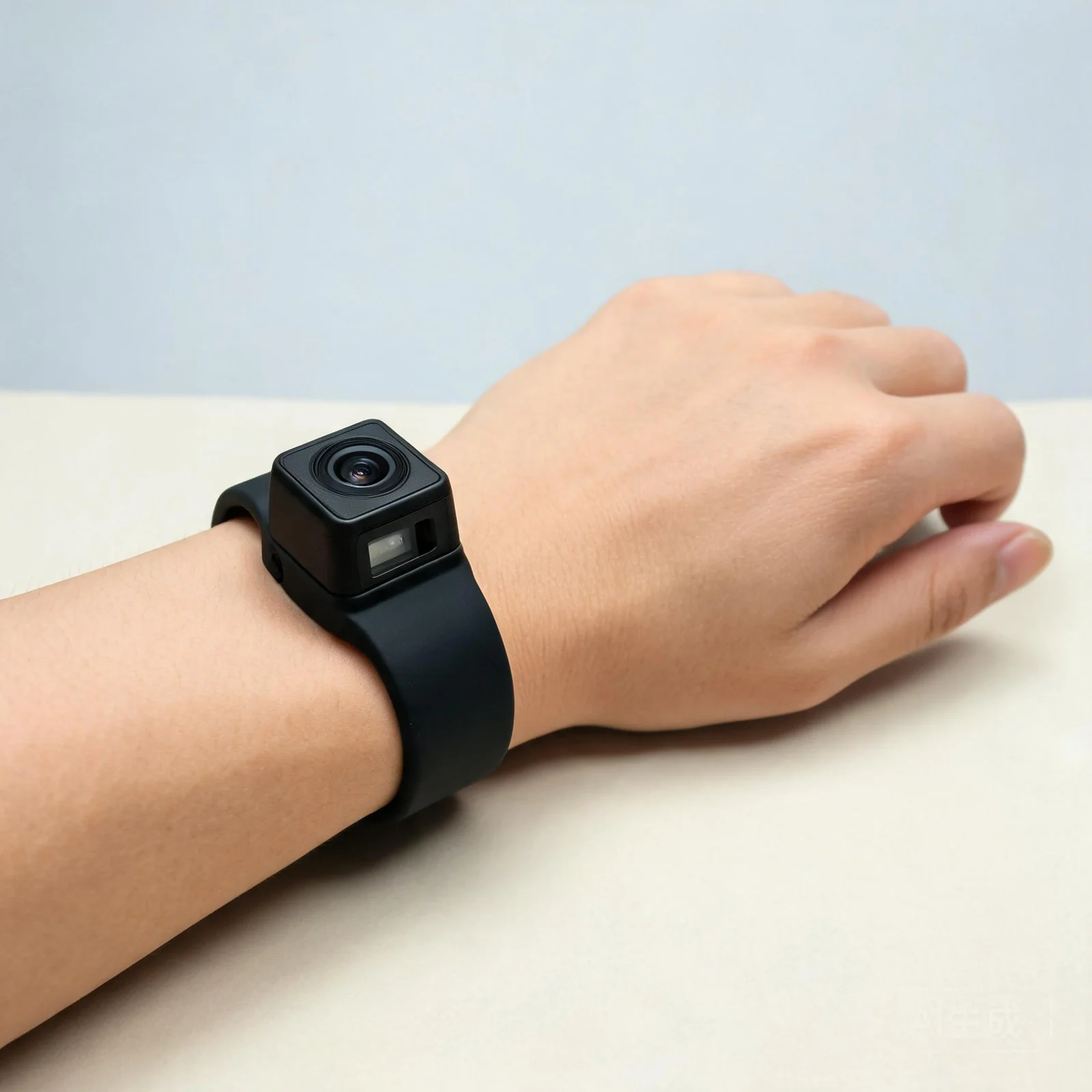
The wrist camera supplements the first-person capture system with an end-effector view close to the hand and tools. It forms an integrable data node composed of monocular wide-angle video, IMU, camera parameters, and audio, suitable for detailed recording of manipulation processes such as grasping, placing, tool use, and dexterous hands. It can be combined with E6/E2 or used for standalone capture.
PRODUCT OVERVIEW & CORE FUNCTIONS
The wrist camera does not replace the headset; it supplements end-effector manipulation with visibility closer to the hand, gripper, and tools. It can capture independently or be used in combination with the E6/E2; the combination method, clock input, and peripheral connections must be confirmed for each specific project.
Documentation specs are 1280×1024, 30/60fps; vertical 148°, horizontal 174°, diagonal 200° FOV, covering the near-range manipulation workspace.
Documented depth of field is 7.2 cm to infinity. Actual clear range is affected by lens, mounting, lighting, and target material.
Built-in IMU (metrics subject to version documentation); supports MP4/H.265 video, IMU, parameter, and audio data.
Supports expansion with 2.4G, BLE, infrared positioning lights, and external perception devices such as grippers/data gloves; interfaces, protocols, and firmware versions are confirmed per project.
USE SCENARIOS
The wrist camera is suited to scenarios where fine end-effector motion details determine task success or failure. Whether to capture independently, whether to combine with E6/E2, and whether infrared positioning lights and gripper extensions are needed will be confirmed item by item during the solution phase.
Close-range recording of fingertip, gripper, and material contact, filling blind spots occluded by hands in the head-mounted view, preserving key action context for imitation learning.
In combination with external perception devices such as glove tracking, hand poses and tool interactions during dexterous manipulation can be recorded; synchronization accuracy is documented as less than 1 ms, confirmed per combined configuration.
For precision tasks such as assembly, tightening, plugging, and quality inspection, capture operational footage and audio near the tool end.
The head-mounted device provides global motion, while the wrist camera provides end-effector detail; once connected to host time synchronization, both data streams can be aligned on a single time base.
WHO IT SERVES
The wrist camera is suitable for teams whose primary research or production focus is end-effector manipulation data, and it typically combines with a head-mounted capture device to form a complete solution. Whether it fits the task can be determined in a single combined technical evaluation.
Teams researching grasping, plugging/unplugging, and tool use need to incorporate end-effector vision and hand motion into training data; typically combined with E6/E2 head-mounted devices.
End-effector view · ComposableFor collection projects that need to record both global and local manipulation details and require an open, verifiable data format, the wrist camera can be configured as a standardized data node in bulk.
All interfaces open · BatchLabs researching human-computer interaction, grippers and soft manipulation need a lightweight, scalable end-effector data acquisition unit that supports external perception integration.
Customizable · Peripheral expansionWHY WRIST CAMERA & DATA BOUNDARY
Documentation records that the wrist camera provided a prototype in July 2026, with mass production planned for August. The page discloses planned status, combination capabilities, and unverified capabilities separately, to avoid describing a single peripheral node as a complete standalone perception system.
The overall device weight is approximately 100 g, so as a wrist node it imposes a low long-term wearing burden and does not interfere with end-effector manipulation.
Diagonal FOV 200° (vertical 148° / horizontal 174°), with a depth of field down to 7.2 cm covering grasping and tool-manipulation ranges.
When connected to E6/E2, outputs host synchronization information (PPS+UART TX); when used standalone, supports PPS+UART RX/TX. Peripheral synchronization accuracy is documented as less than 1 ms.
Supports 2.4G, BLE, and infrared positioning lights; can be extended to connect external perception devices such as grippers and glove tracking.
READY TO SPECIFY
The technical evaluation will jointly confirm the solution around task actions, wrist mounting, host combination, peripheral synchronization, data formats, and sample collection. This process does not constitute an automatic quote, supply commitment, or data performance guarantee.
DATA & PROJECT READINESS
Device observations do not automatically equal robot action labels. First confirm the data fields, timestamps, coordinate frames, target action space and data quality, then validate the conversion and training pipeline.Device observations are not automatically robot-action labels. Validate fields, timestamps, coordinate frames, target action space and quality before conversion and training.
Provide the task, quantity and planned delivery date. Confirm the device version, firmware, accessories, support scope and acceptance method in writing. Historical prototypes or production plans do not mean current stock is available.Provide the task, quantity and delivery window. Confirm the version, firmware, accessories, support and acceptance method in writing. Historical production plans do not confirm current stock.
Starting together does not mean clock synchronization. For a combined solution, confirm the clock source, interfaces, timestamp definitions, error statistics and dropped-frame handling; single-device metrics cannot substitute for full-system acceptance.Starting together is not clock synchronization. Confirm clock source, interfaces, timestamp definitions, error statistics and dropped-frame handling for the complete system.