Introduction
In September 2026, public discourse in embodied AI has shifted from "whether we need egocentric data" to "whether egocentric data possesses measurable stereo geometry, verifiable timelines, and auditable delivery semantics." From the dual perspectives of an embodied AI data acquisition expert and a chief scientist, this article reviews the hard constraints that international frontier papers and open-source systems impose on "embodied capture data" as of September 15, 2026, and compares them against widely adopted industry delivery specifications for binocular egocentric capture, explaining how TOBI turns binocular egocentric capture into a tradable, acceptable production-grade capability. The names Ego-OSCAR, EgoDex, Ego4D, DROID, Open X-Embodiment, and others mentioned in this article are used solely to describe the public research context and specification language, and do not indicate that TOBI owns or distributes these datasets.
I. Why "binocular first-person view" suddenly became a hard requirement
Over the past few years, first-person (egocentric) video has been widely regarded as scalable fuel for robot imitation learning: humans can operate naturally in real-world settings without being constrained by the teleoperation bandwidth of a robot body. Ego4D demonstrated scale feasibility with thousands of hours of cross-regional daily activities; EPIC-KITCHENS deepened action granularity within a single domain. But when the policy objective advances from "understanding what is being done" to "completing contact and assembly tasks in metric space," monocular rolling-shutter corpora lacking calibration and per-frame timestamps turn the supervision signal into irreproducible correlated noise.
From the chief scientist's perspective, the data bottleneck in embodied AI is not merely hours of footage, but whether observations can recover relative depth, hand-object relative pose, and contact phase. The value of binocular (stereo) egocentric capture lies in bringing human-eye-level baseline geometry into a head-mounted coordinate frame: independent left and right imaging, calibratable extrinsics, and back-projectable disparity. From the data acquisition expert's perspective, the real challenge is not "attaching two cameras to a head," but packaging left and right video, IMU, timestamps, calibration, and compliance materials into an asset that downstream training pipelines can read and procurement terms can verify.
This is why frontier work in 2025–2026 has begun to explicitly emphasize stereo sensing, native 3D hand trajectories, cross-camera hardware synchronization, and open, reproducible capture stacks. For industry, the significance of these papers lies not in restating the authors' claims, but in distilling acceptance language that can be written into tender annexes: minimum resolution and frame rate, whether left and right are independent files, upper bounds on synchronization error, IMU sampling rate, and whether fabricating missing fields post hoc is permitted.
II. What International Papers Are Saying: Stereo, Synchronization, Native 3D
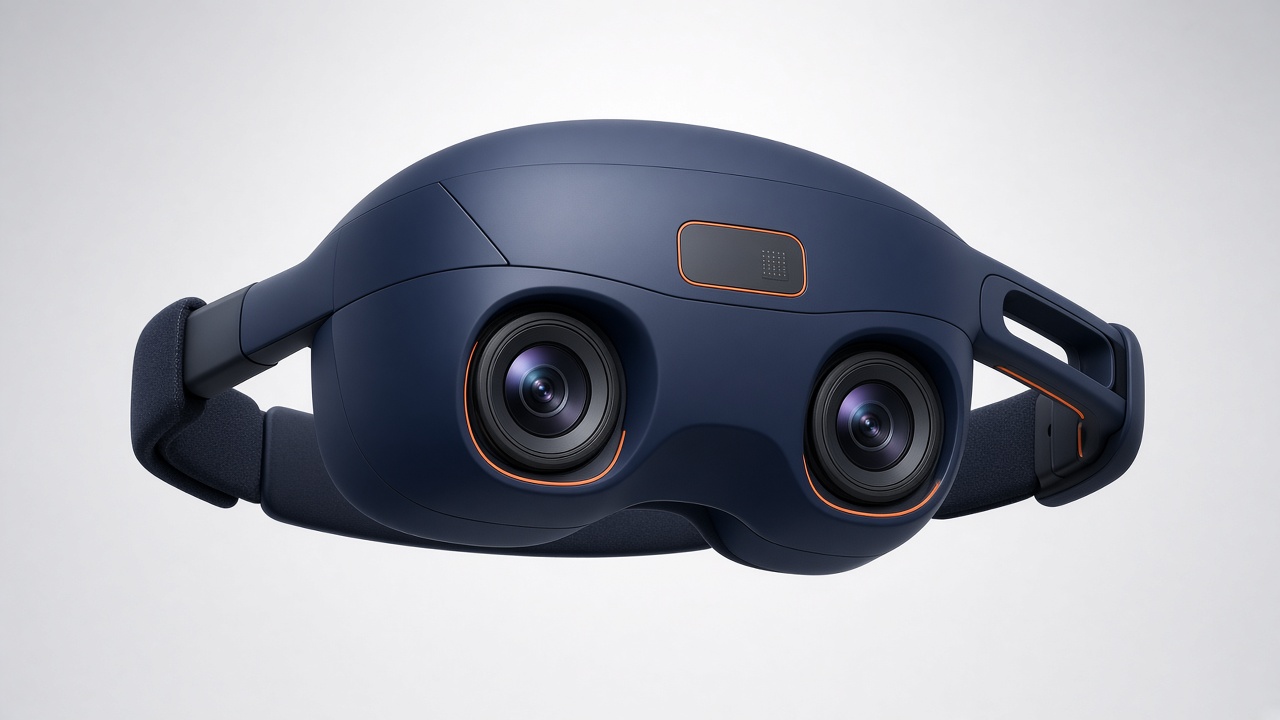
Represented by the open-source stereo-inertial first-person capture system Ego-OSCAR (arXiv:2608.08285, 2026), the research community has made clear: monocular vision alone cannot reliably recover camera pose at metric scale, and many classic Ego corpora, despite their massive size, are monocular rolling-shutter, lack per-session calibration, or use a tracking-friendly configuration of "one RGB + two grayscale SLAM cameras" — good for localization, but not equivalent to calibrated RGB stereo. Ego-OSCAR's engineering proposition is straightforward: a low-cost, replicable head-mounted stereo-inertial device, globally synchronized stereo RGB, an IMU on the order of 120 Hz, calibration and recording firmware delivered as one package, plus an extensible in-the-wild dataset. The methodological takeaway for industry is: if you claim "stereo Ego," you must be able to answer whether the left and right are phase-aligned, whether calibration is verifiable, and whether the IMU is frame-synchronized and alignable.
EgoDex (2025), released by an Apple team, brings another axis to the forefront: dexterous manipulation requires large-scale, native 3D hand and finger trajectories, rather than "guessing hands" from weakly annotated video after the fact. EgoDex reports approximately 829 hours, approximately 90 million frames, and first-person video covering approximately 194 categories of tabletop dexterous tasks, with multi-camera calibration and device-side SLAM-supported 3D hand joint data obtained at capture time. For the data acquisition expert, the key phrase on this axis is "native at capture time," not "reconstructed with algorithms after delivery." For the chief scientist, it proves that when the goal is finger-level policies, the data contract must include hand pose or equivalent high-fidelity observations — internet weakly supervised video alone cannot close the loop.
On the robotics side, DROID (RSS 2024 / arXiv:2403.12945) is known for large-scale in-the-wild manipulation data; its capture stack uses three synchronized stereo RGB streams: two external stereo pairs and one wrist-mounted stereo pair, with control and observation aligned at approximately 15 Hz. Open X-Embodiment, meanwhile, drives cross-embodiment datasets into a unified container. These works may not be head-mounted human-eye binocular systems, but together they reinforce an industry consensus: stereo streams, extrinsics, synchronization, and reproducible hardware protocols are the standard language of "trainable manipulation data." Translating this language to human-worn binocular egocentric capture yields the seemingly stringent fields found in today's vendor delivery specifications.
It is important to emphasize boundaries: Ego4D / Ego-Exo4D, Aria Everyday Activities, Nymeria, and others remain important foundations for understanding and skill transfer; they demonstrate the value of diversity and exo-ego viewpoint pairing. The frontier does not negate these corpora but layers more demanding geometric and temporal constraints on top of them. TOBI's position is: public research provides specification language and failure modes; production-grade vendors are responsible for turning specifications into spot-inspectable deliverables — neither overstating ownership of public datasets nor avoiding alignment with public methodologies.
III. From Papers to Delivery Specifications: How Fields Become Acceptance Criteria
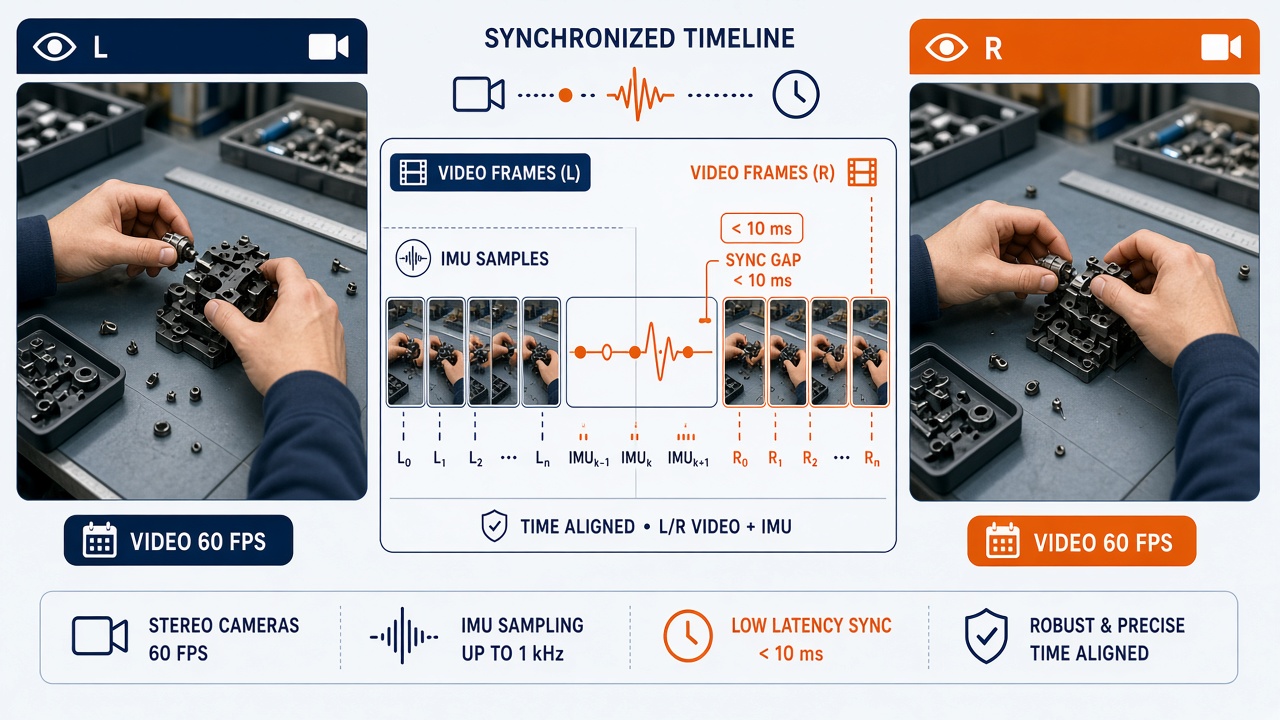
A vendor delivery specification for approximately thousand-hour-scale, head-mounted binocular egocentric capture typically decomposes the "tradable asset" into four layers: directory structure, hard specifications, metadata, and compliance. The directory layer requires each asset to be one continuous recording of one task: independent left and right MP4 files, optional audio, raw IMU stream, per-frame timing table, device metadata, and original calibration files. Common hard specification requirements include: each of left and right at no less than 1080p, nominal frame rate at no less than 30 fps and stable, left-right temporal synchronization error under 10 milliseconds; IMU at no less than 200 Hz, outputting interpretable acceleration, angular velocity, and (if available) orientation; timestamps must be machine-readable, with units and epoch clearly stated.
The sentence most critical to algorithm teams is often written in a prominent place: leave missing fields empty and state the reason — it is forbidden to fill gaps with estimated values, default zeros, or numbers that "look reasonable." This is consistent with the spirit of EgoDex's "native at capture time" and Ego-OSCAR's "openly auditable calibration": fabricated calibration or fabricated time offsets are more dangerous than missing data, because they contaminate the entire training and evaluation pipeline and are difficult to audit. Device metadata must specify rolling or global shutter, the original names of the camera model and distortion model, the order of uncorrected intrinsic parameters and distortion coefficients, left-right extrinsics and camera-to-IMU extrinsics, and measured time offsets (if never measured, declare as unmeasured rather than filling in 0).
Scene and task metadata are likewise elevated to first-class status: the task's macro-environment and sub-environment, a full task description, city / company / address and a stable site ID, anonymized operator ID, handedness and age bracket (if available), and a recording start time accurate to the second with time zone. The compliance layer requires informed consent from adults and portrait / voice authorization, site-owner permission, and a handling procedure for identifiable passersby, and excludes minors, ID documents and receipts, confidential screens, and similar content. These clauses look like a legal appendix, but are in fact a prerequisite for embodied data to enter a major client's training budget — without compliance, no amount of clean stereo stream can be ingested.
The data acquisition expert translates the above clauses into on-site SOPs: deliver a validation batch first, then roll out uploads after format approval; perform binocular calibration using ChArUco or equivalent methods, and camera-IMU calibration using Kalibr-class tools; export per-frame tables such as frame_timing.csv, specifying capture time / exposure window / receipt time; pseudo-stereo formed by "concatenating one stream and splitting it back into two" is prohibited for left and right files. The chief scientist will ask: how do these fields feed into data cards and training diagnostics? Do synchronization health scores, reprojection error, and IMU-camera offset become rejection criteria? If the answer is no, the specification is merely a PDF, not a system.
IV. TOBI's Binocular Egocentric Capability: Productizing the Specification
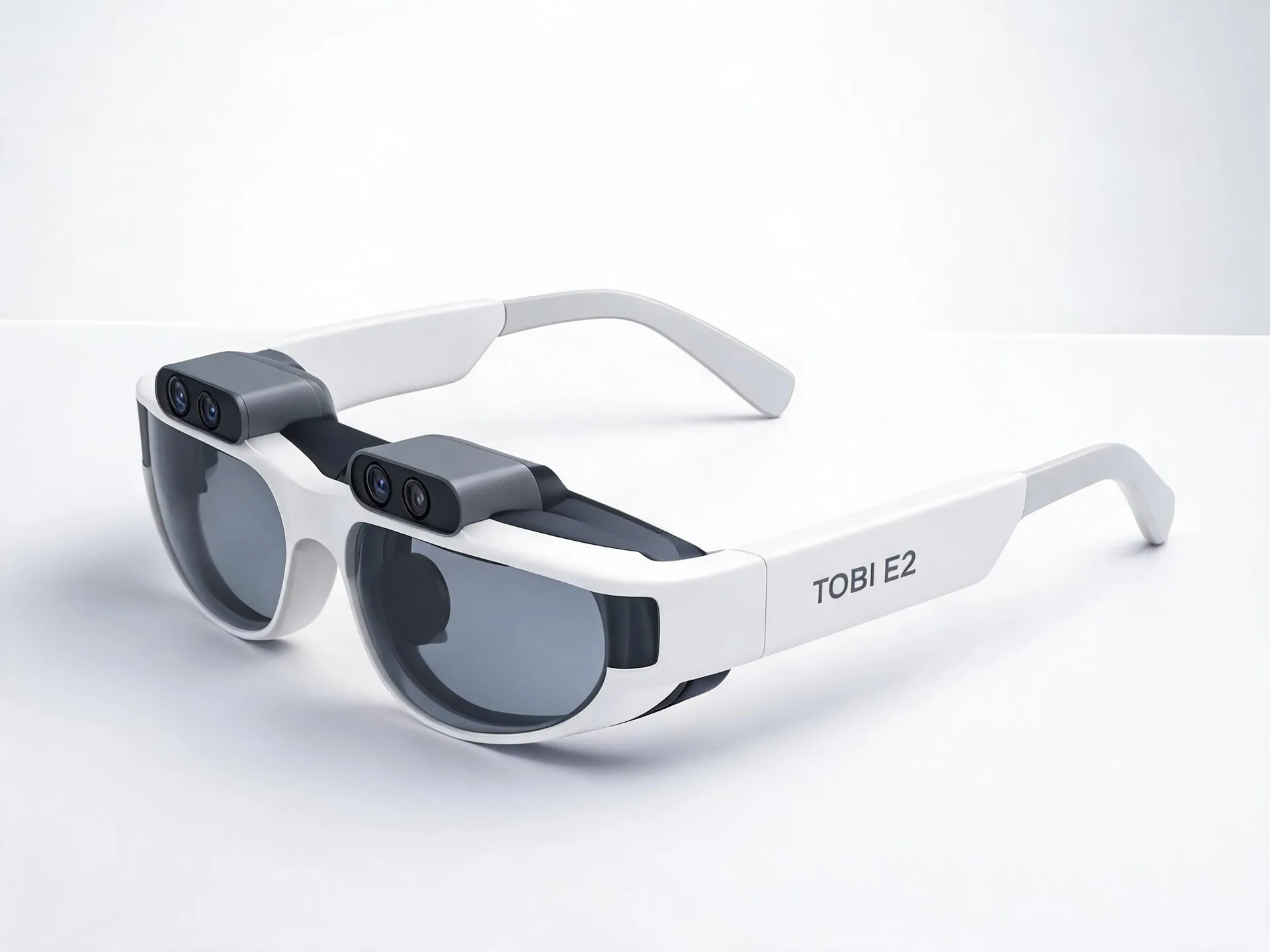
TOBI implements binocular egocentric capture capability in purchasable hardware and acceptable data delivery. E2 is designed as a lightweight, verifiable binocular egocentric entry point and mass-production capture front end, emphasizing independent left and right imaging, stable frame rate, and exportable temporal semantics; when higher-density multi-camera and wrist detail are needed, E6 / E8 and wrist camera solutions extend the same time base to multiple viewpoints, avoiding the soft stitching of "one clock on the head, another on the wrist." The core of the product narrative is not piling up sensor terminology, but enabling customers to reproduce acceptance on site: measuring left-right offset with a flashing test rig, spot-checking contact-frame consistency while worn, and validating directory structure and required fields with ingestion scripts.
Against the hard requirements of international papers, TOBI's capability claims can be summarized in four points. First, stereo measurability: left and right channels are delivered as independent files, with extrinsics and intrinsics traceable to verifiable calibration originals, not "stereo support" on a marketing image. Second, temporal auditability: the goal is to compress left-right synchronization error into the millisecond-level upper bound common in delivery specifications, while retaining per-frame timing tables and refusing to silently smooth over dropped frames with interpolation. Third, inertial alignability: the IMU accompanies the video at a sufficient sampling rate, with time offset reported honestly; if it is not calibrated, we do not pretend it is. Fourth, scene scalability: targeting real workstations such as automotive repair, commercial kitchen, retail pharmacy, and warehouse picking, supported by stable on-site IDs and task descriptions to enable thousand-hour rolling collection, rather than a one-off laboratory desktop demonstration.
For procurement, this means the quote can list "raw recorded hours" and "quality-passed effective hours" side by side: segments with minors in frame, severe frame drops, synchronization violations, expired calibration, or missing compliance materials do not count toward the effective volume. For algorithm leads, this means training bucketing becomes possible: hard-synchronized stereo subsets for contact-sensitive policies, and diverse monocular or weakly calibrated subsets (if used) only for representation pre-training. TOBI also provides an entry point from capture hardware to the dataset marketplace, helping teams establish specification language first and then scale — reverse the order, and the budget becomes inexplicable experimental noise.
V. Turning paper conclusions into a 2026 procurement checklist
It is recommended that algorithms and procurement share the same checklist. Sensing: Is it head-mounted binocular RGB stereo? Is the shutter type specified? Are left and right independent MP4 files? Is resolution / frame rate stably meeting the standard? Time: How is the left-right synchronization error measured? Is the 95th percentile below the agreed upper bound (e.g., 10 ms)? Are there per-frame timestamps with correct units? Inertial: Is the IMU sampling rate ≥ the agreed rate? Are the camera–IMU extrinsics and time offset derived from actual measurements? Geometry: Are the calibration date, method, software version, and reprojection error reviewable? Are the originals delivered with the assets? Semantics: Is each segment "one continuous recording, one task"? Are the site and operator IDs stably anonymized? Compliance: Is the authorization chain complete? Were the screening items executed? Integrity: Are missing fields left blank with an explanation rather than filled with zeros to fabricate data?
A qualified data card should also provide jitter histograms, frame drop statistics, calibration residual distributions, and scenario hour distributions. Public papers use tables to compare "monocular vs. stereo," "with or without per-session calibration," and "whether the hardware is reproducible"; industrial delivery applies the same columns, simply replacing "Paper Table 2" with "Contract Appendix A." When a supplier cannot fill in these columns, it is usually not a matter of business rhetoric, but that the capture stack has not yet been productized.
Experimentally, teams can use inexpensive sensitivity tests to demonstrate the value of stereo and synchronization: on the same set of demonstrations, artificially shift the right-eye or wrist stream by 0/20/40/80 milliseconds and observe the success rate of contact tasks such as insertion, cap screwing, and cable plugging. Once the curve shows a cliff, the budget committee will more easily understand: synchronization and stereo are not fastidiousness—they are part of the loss function. TOBI recommends writing such tests into supplier onboarding, alongside accuracy metrics.
VI. Organization and Governance: Making Binocular Egocentric Capture a Continuous Delivery Capability
Production-grade binocular egocentric capture requires roles, not just hardware. It is recommended to designate a "timeline and calibration owner" with veto authority over firmware changes, calibration expiration, and synchronization incidents. Establish a cross-repository time contract: capture export, transcoding and de-identification, and training ingestion must all assert on the same golden sample that timestamps are monotonic, units are consistent, and left-right offset is within threshold. De-identification and transcoding must not silently discard temporal semantics — this is a hidden incident that many teams only discover after legal approval, just before training begins.
For multi-day, multi-site capture, enforce power-on self-checks and trigger self-checks to avoid "perfect on a single day, collapsing across days." When training with mixed data from multiple vendors, bucket or re-weight by vendor ID and synchronization tier to prevent high-quality stereo subsets from being diluted by soft-aligned commodity data. When mixing with simulation, write real jitter distributions into domain randomization rather than assuming perfect simulation synchronization. These governance actions are precisely what translate the reproducible spirit of Ego-OSCAR and the native 3D spirit of EgoDex into enterprise engineering culture.
From a market narrative perspective, thought leadership in 2026 should be rewritten: no longer comparing who publicizes more hours, but who can clearly explain in customer due diligence "how stereo is calibrated, how time is measured, and how missing data is honestly declared." TOBI's choice to make binocular egocentric capture into demonstrable, spot-inspectable, contractable products and data services is a direct response to this narrative shift.
VII. Next Steps: Training the Next Season's Policies with Acceptable Binocular Assets
If your team is evaluating a head-mounted binocular Ego pipeline, or wishes to procure verifiable first-person/robotic datasets according to international frontier specification language, it is recommended to first align task scenarios and synchronization/calibration thresholds before deciding on equipment density and rolling capture hours. You can start from TOBI product line (E2 / E6 / E8 and wrist camera) To learn about binocular and multi-camera front ends, start with Embodied Data Solutions to explore scenario-based capture and delivery, or directly inquire about binocular egocentric dataset procurement.
Notes
The names Ego-OSCAR, EgoDex, Ego4D, Ego-Exo4D, DROID, Open X-Embodiment, EPIC-KITCHENS, Aria, Nymeria, etc. in this article are used to describe the context of publicly verifiable research and datasets before September 15, 2026; they do not indicate that TOBI owns, exclusively operates, or redistributes these data. Specific product specifications, synchronization metrics, and dataset catalogs are subject to the official website and the version confirmed by business. The supplier delivery field descriptions synthesize common industry production-grade requirements and are used to illustrate acceptance language; they do not constitute a verbatim reproduction of any third-party document.
Appendix: A Reading Map for Algorithm Engineers
If your daily work involves training VLA or diffusion action heads, it is recommended to read the public literature along three lines and map them to your own data cards. Geometry line: stereo calibration, left-right extrinsics, reprojection error, global shutter or not — ask yourself whether training uses rectified or raw images, and whether the coordinate frame is consistent with the extrinsics. Temporal line: left-right and IMU offset distribution, frame drop policy, exposure timestamp semantics — ask yourself whether the loss aligns on receipt time or exposure midpoint. Manipulation line: whether tasks cover contact phase transitions, whether native hand / wrist detail exists, whether failure segments are retained — ask yourself whether evaluation metrics are sensitive to synchronization error. Write the answers to the three lines into a technical memo within a week, then schedule a specification review with your hardware and data vendors — this is cheaper than placing an order for a thousand hours first.
Data collection specialists can also build a "stereo health dashboard": daily spot-checks on whether the left-right disparity histogram has abnormally collapsed (which may indicate left-right stream misalignment or extrinsic drift), IMU saturation and packet loss rates, the proportion of motion-blurred frames while worn, task description completeness, and compliance screening rejection rate. A dashboard surfaces systemic problems earlier than quarterly reports. When the rejection rate suddenly spikes, check firmware and calibration first, on-site execution second, and only then suspect "the annotator wasn't careful." Writing this order into the SOP is what allows first-person stereo capture to move from project-based work to production-line work.
The chief scientist should push to turn the comparison tables in published papers into a standing agenda item for internal quarterly technical reviews: how much have we improved quarter over quarter in synchronization quantiles, calibration residuals, and the proportion of effective contact hours? Does any increase in model size still rest on dirtier timelines? If so, the marginal return on compute investment will be overstated. TOBI is willing to work with customers to co-develop this kind of review language, because only when egocentric stereo capture is treated as a scientific object rather than a procurement accessory can the data flywheel of embodied AI begin to turn.
Returning to the time slice of September 15, 2026: international papers have already established "measurable stereo Ego + auditable timeline + native 3D manipulation signals" as a methodological prerequisite; industry delivery specifications have already written the same prerequisite as directories, CSV and JSON fields; the remaining competition belongs to teams that can stably replicate this prerequisite into automotive repair bays, back-of-house kitchen pass counters, and warehouse picking aisles. TOBI's binocular first-person-view capability is positioned at the front end of the equipment and the data entry point of this replication process — serving the next season's strategies that can truly hold their ground at the moment of contact, with acceptable left/right eye, IMU, and calibration.