The key way to train a robot is to let it observe how humans complete tasks and then imitate those actions. This deceptively simple idea is the central proposition of cross-embodiment transfer research. And the key to unlocking it lies hidden in how data is aligned.
Human Videos: A Treasure Trove for Robot Skill Learning
Human society generates vast amounts of demonstration data every day. From factory workers assembling parts, to chefs chopping and cooking, to family members tidying rooms, these real actions contain the skills robots strongly want to learn. Compared with data obtained by robots through teleoperation or reinforcement learning in controlled environments, human videos have three unique advantages: large scale, high diversity, and close proximity to real application scenarios.
However, there are enormous differences between humans and robots in body morphology, kinematic structure, and perceptual modality. Humans have flexible fingers, rotatable wrists, and torsos that can bend and twist; robots may only have grippers, fixed arm reaches, and limited degrees of freedom. How to make robots understand 'which robot action corresponds to this human action' is the primary challenge facing cross-embodiment transfer research.
Early solutions relied on hand-designed motion-mapping rules to convert human joint trajectories into robot joint commands. This approach worked for simple tasks but was difficult to generalize to complex operations. In recent years, with the development of VLA (Vision-Language-Action) models and unified representation learning, researchers have begun to let models automatically learn implicit correspondences between human actions and robot actions. The success of this learning process depends heavily on the quality of training data and the alignment method.
From Action Alignment to Representation Alignment
Data alignment for cross-embodiment transfer has roughly gone through three stages. The first is task-level alignment, where humans and robots complete the same task in the same environment but data is collected separately. The second is temporal alignment, where human and robot actions correspond in time, allowing the model to learn 'when the human sees X, the robot should execute Y.' The third is representation-level alignment, where unified semantic or geometric representations bring human videos and robot data into the same embedding space.
Representation-level alignment is considered the mainstream direction for the future. It does not require humans and robots to perform exactly the same action sequence; rather, it lets the model understand higher-level intent and physical constraints. For example, when a human picks up a screw with fingers and a robot picks up the same screw with a gripper, the specific actions differ, but the intent of 'grasping the screw' is shared. Once data is well aligned at the representation level, the model can extract general skills from large amounts of human video and transfer them to specific robot platforms.
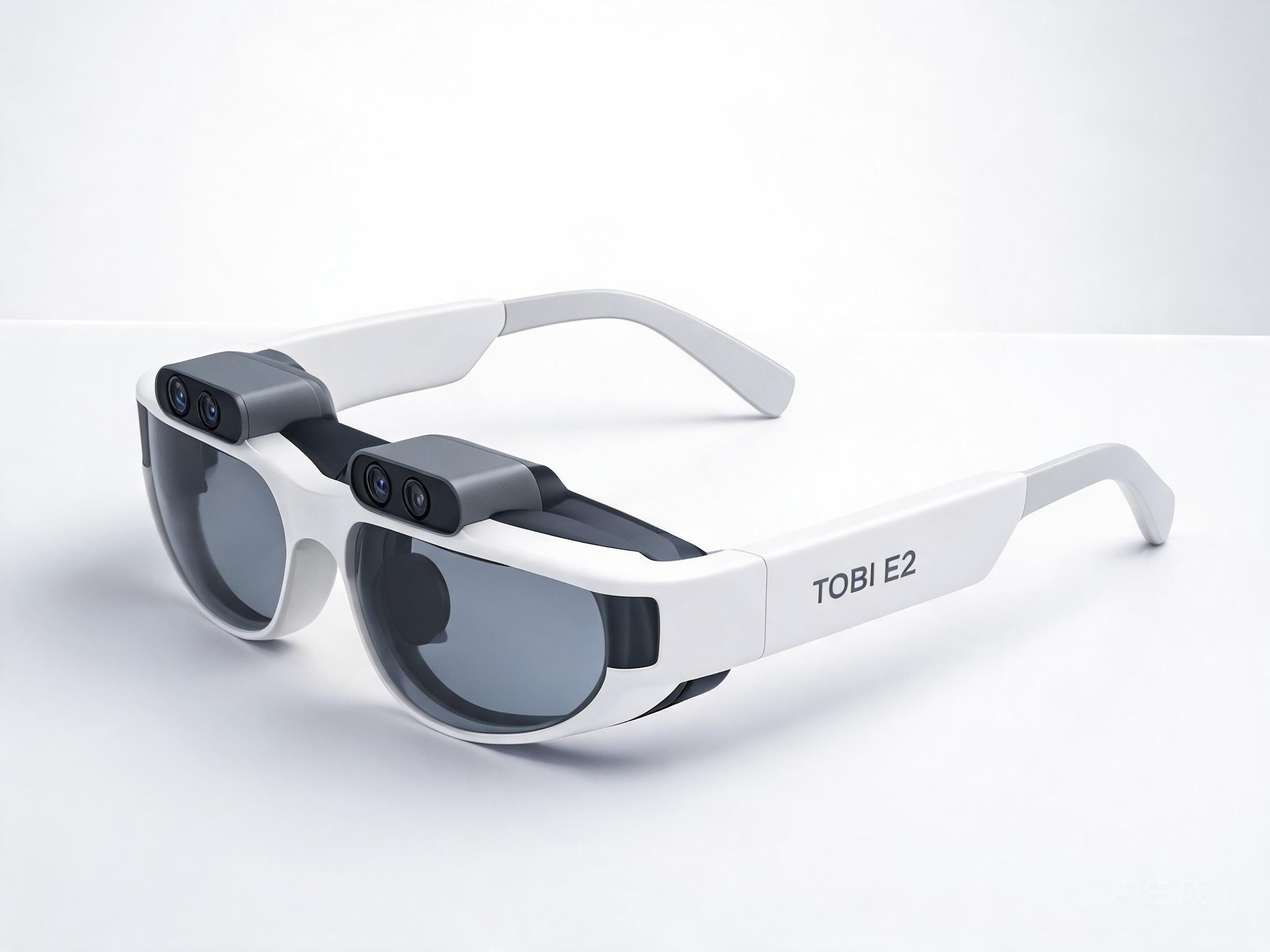
TOBI E2: a capture component for cross-embodiment alignment
The value of E2 for cross-embodiment research starts with how demonstrations are recorded. A head-worn view captures the operator’s interaction with the task. Wide-angle video can preserve hand activity and surrounding context, but viewpoint similarity alone does not establish that a learned policy will transfer to a robot.
RGB video and inertial measurements can be combined with optional wrist cameras or other sensors in a project-specific capture setup. Additional modalities require separate integration, synchronization and calibration. Their usefulness for transfer depends on how well the human observations and robot signals are aligned.
Third, TOBI's Ego+Exo capture scheme provides dual-view support for cross-embodiment transfer. Ego video helps the model learn operational policies, while Exo video helps the model understand the geometric relationships of human actions in three-dimensional space. When a robot needs to reproduce these actions, it can obtain spatial localization references from the Exo view and detailed operational references from the Ego view.
ACE-Ego-0 and the Rise of Unified Data Paradigms
Cross-embodiment transfer research is moving from 'working in isolation' toward a 'unified paradigm.' Representative projects such as ACE-Ego-0 seek to establish unified human-video and robot-data formats so that data from different research institutions can interoperate. This unification includes not only file formats, but also coordinate-system definitions, timestamp conventions, action representations, and annotation standards.
The significance of a unified data paradigm is to amplify the scale effect of data. When data from different capture scenarios, different robot platforms, and different research teams can be used within the same framework, the model is exposed to more diverse skills and richer environments. This is highly analogous to the successful path of 'massive text + unified tokenization' in the large language model era.
TOBI uses agreed data formats and metadata specifications when designing capture workflows. Compatibility with a particular research framework must be checked on a sample export. Custom collection can support paired human-demonstration and robot-task datasets when the required hardware and permissions are in place.

The Data Code: Three Elements That Determine Transfer Efficiency
Based on TOBI's practical experience across multiple cross-embodiment transfer projects, we have identified three core data elements that determine transfer efficiency. First, viewpoint consistency. Human videos used for training should be as close as possible to the robot's task-execution viewpoint, reducing the learning burden of viewpoint transformation on the model. Second, motion naturalness. Human demonstrations should come from real tasks, not deliberately slowed or standardized 'performative actions.' The noise, failures, and adjustments in real actions are precisely valuable resources for improving model robustness. Third, semantic annotation. Beyond raw video, data should also contain semantic information such as task goals, action segmentation, success/failure labels, and object categories, helping the model understand 'what was done' rather than just 'how it moved.'
Consistent viewpoints, natural actions and clear task semantics can support transfer experiments. Their effect should be measured on a held-out task set and robot platform rather than inferred from recording quality alone.
Human video is a useful resource for robot learning. Its value depends on clear task semantics, usable viewpoints and carefully validated data alignment.
Conclusion: Letting Robots Learn from Humans
Cross-embodiment transfer represents one of the highly imaginative directions in embodied intelligence: enabling robots to no longer explore every skill from scratch, but to learn on the shoulders of thousands of years of human practical experience. Realizing this path depends on systematic collection of human videos, standardized recording of robot data, and in-depth research into the alignment relationship between the two.
TOBI combines capture hardware, data operations, annotation and multimodal workflow design to support human-to-robot learning projects. Transfer gains must be demonstrated through controlled evaluation; they are not guaranteed by the capture device.
Need Cross-Embodiment Transfer Data Capture Services?
TOBI provides human Ego video capture, robot data capture, action alignment, and semantic annotation services to power your cross-embodiment transfer research and product development.
